Department of Neurology, Yale School of Medicine, Yale University, 15 York Street, PO Box 208018, New Haven, CT, 06520-8018, USA.
Department of Chronic Disease Epidemiology, Yale School of Public Health, Yale University, New Haven, CT, USA.
Cerebellum. 2018 Apr;17(2):104-110. doi: 10.1007/s12311-017-0876-3.
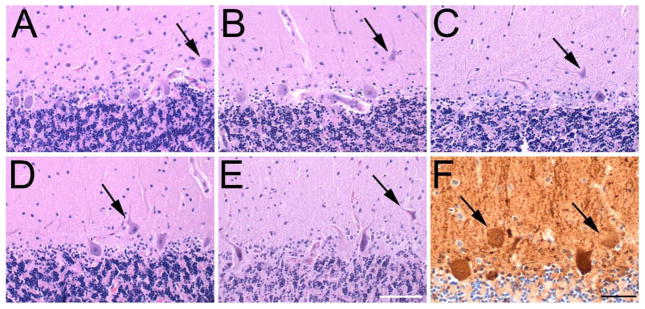
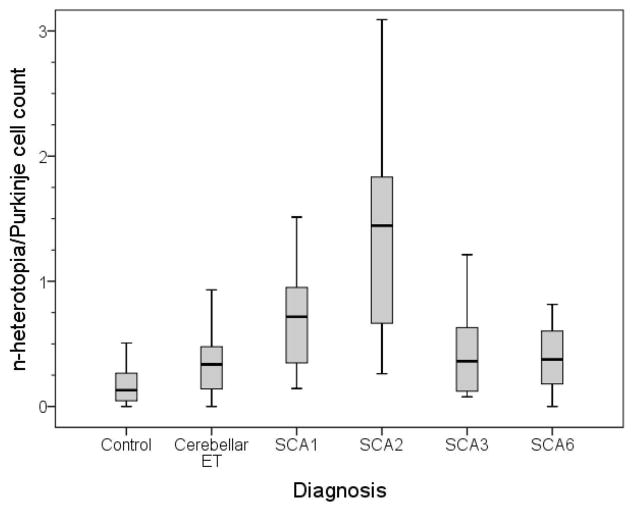
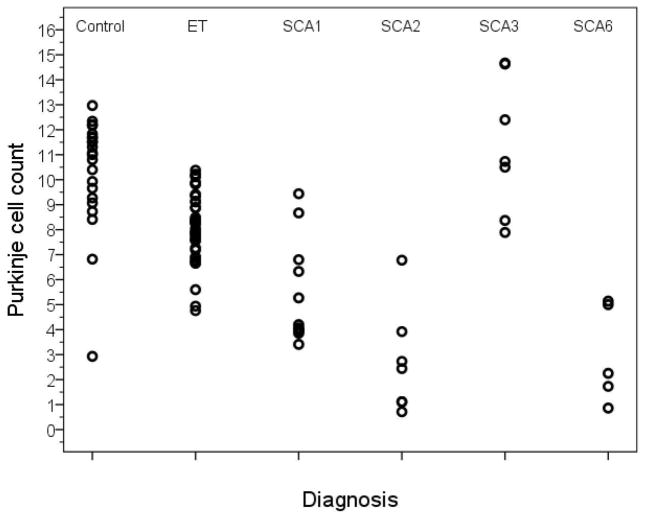
Essential tremor (ET) is among the most common neurological diseases. Postmortem studies have noted a series of pathological changes in the ET cerebellum. Heterotopic Purkinje cells (PCs) are those whose cell body is mis-localized in the molecular layer. In neurodegenerative settings, these are viewed as a marker of the progression of neuronal degeneration. We (1) quantify heterotopias in ET cases vs. controls, (2) compare ET cases to other cerebellar degenerative conditions (spinocerebellar ataxias (SCAs) 1, 2, 3, and 6), (3) compare these SCAs to one another, and (4) assess heterotopia within the context of associated PC loss in each disease. Heterotopic PCs were quantified using a standard LH&E-stained section of the neocerebellum. Counts were normalized to PC layer length (n-heterotopia count). It is also valuable to consider PC counts when assessing heterotopia, as loss of PCs extends both to normally located as well as heterotopic PCs. Therefore, we divided n-heterotopias by PC counts. There were 96 brains (43 ET, 31 SCA [12 SCA1, 7 SCA2, 7 SCA3, 5 SCA6], and 22 controls). The median number of n-heterotopias in ET cases was two times higher than that of the controls (2.6 vs. 1.2, p < 0.05). The median number of n-heterotopias in the various SCAs formed a spectrum, with counts being highest in SCA3 and SCA1. In analyses that factored in PC counts, ET had a median n-heterotopia/Purkinje cell count that was three times higher than the controls (0.35 vs. 0.13, p < 0.01), and SCA1 and SCA2 had counts that were 5.5 and 11 times higher than the controls (respective p < 0.001). The median n-heterotopia/PC count in ET was between that of the controls and the SCAs. Similarly, the median PC count in ET was between that of the controls and the SCAs; the one exception was SCA3, in which the PC population is well known to be preserved. Heterotopia is a disease-associated feature of ET. In comparison, several of the SCAs evidenced even more marked heterotopia, although a spectrum existed across the SCAs. The median n-heterotopia/PC count and median PC in ET was between that of the controls and the SCAs; hence, in this regard, ET could represent an intermediate state or a less advanced state of spinocerebellar atrophy.
特发性震颤(ET)是最常见的神经疾病之一。尸检研究指出 ET 小脑存在一系列病理变化。异位浦肯野细胞(PC)是指其细胞体位于分子层中的异常位置。在神经退行性疾病中,这些细胞被视为神经元退化进展的标志物。我们(1)对 ET 病例与对照组中的异位进行定量,(2)比较 ET 病例与其他小脑退行性疾病(脊髓小脑共济失调(SCA)1、2、3 和 6),(3)比较这些 SCA 之间的关系,以及(4)评估每种疾病中与相关 PC 丢失相关的异位情况。使用新小脑的 LH&E 染色标准切片对异位 PC 进行定量。将计数与 PC 层长度(n-异位计数)进行归一化。在评估异位时,考虑 PC 计数也是有价值的,因为 PC 的丢失不仅会影响正常位置的 PC,也会影响异位的 PC。因此,我们将 n-异位除以 PC 计数。共有 96 个大脑(43 个 ET,31 个 SCA [12 个 SCA1、7 个 SCA2、7 个 SCA3、5 个 SCA6],22 个对照组)。ET 病例的 n-异位中位数是对照组的两倍(2.6 比 1.2,p<0.05)。各种 SCA 中的 n-异位中位数形成一个谱,SCA3 和 SCA1 的计数最高。在考虑 PC 计数的分析中,ET 的 n-异位/浦肯野细胞计数是对照组的三倍(0.35 比 0.13,p<0.01),SCA1 和 SCA2 的计数分别是对照组的 5.5 倍和 11 倍(各自的 p<0.001)。ET 的 n-异位/PC 计数中位数在对照组和 SCA 之间。同样,ET 的 PC 中位数在对照组和 SCA 之间;唯一的例外是 SCA3,其中众所周知 PC 群体是保存的。异位是 ET 的疾病相关特征。相比之下,一些 SCA 证据表明异位更为明显,尽管在 SCA 之间存在一个谱。ET 的 n-异位/PC 计数中位数和 PC 中位数在对照组和 SCA 之间;因此,在这方面,ET 可能代表脊髓小脑萎缩的中间状态或较不发达的状态。