Section of Endocrinology and Investigative Medicine, Department of Medicine, Hammersmith Hospital, Imperial College London, London, UK.
Oxford Centre for Diabetes, Endocrinology and Metabolism, University of Oxford, Oxford, UK.
Int J Obes (Lond). 2017 Nov;41(11):1693-1701. doi: 10.1038/ijo.2017.164. Epub 2017 Jul 13.
High-protein diets (HPDs) are associated with greater satiety and weight loss than diets rich in other macronutrients. The exact mechanisms by which HPDs exert their effects are unclear. However, evidence suggests that the sensing of amino acids produced as a result of protein digestion may have a role in appetite regulation and satiety. We investigated the effects of l-phenylalanine (L-Phe) on food intake and glucose homeostasis in rodents.
We investigated the effects of the aromatic amino-acid and calcium-sensing receptor (CaSR) agonist l-phenylalanine (L-Phe) on food intake and the release of the gastrointestinal (GI) hormones peptide YY (PYY), glucagon-like peptide-1 (GLP-1) and ghrelin in rodents, and the role of the CaSR in mediating these effects in vitro and in vivo. We also examined the effect of oral l-Phe administration on glucose tolerance in rats.
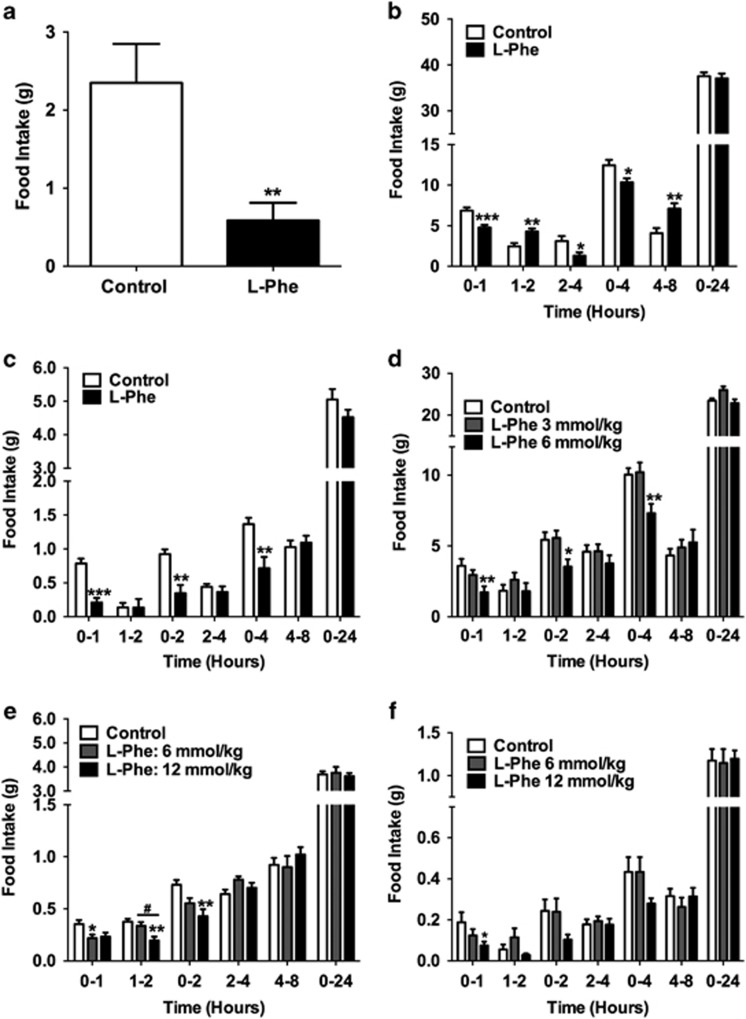
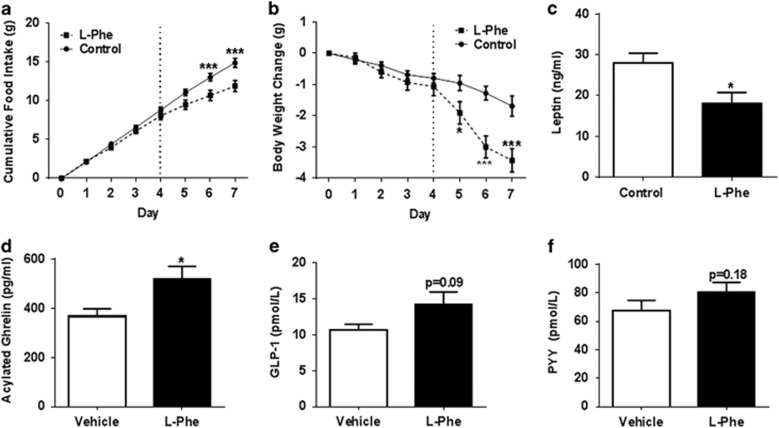
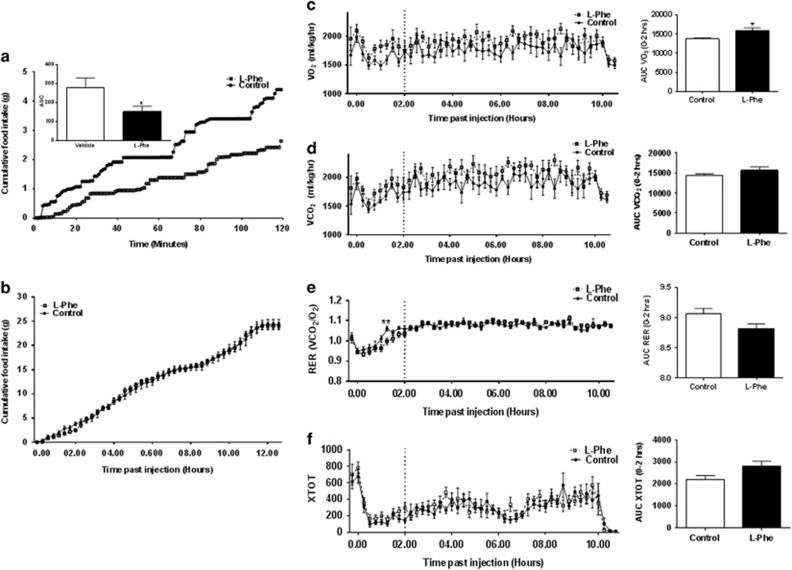
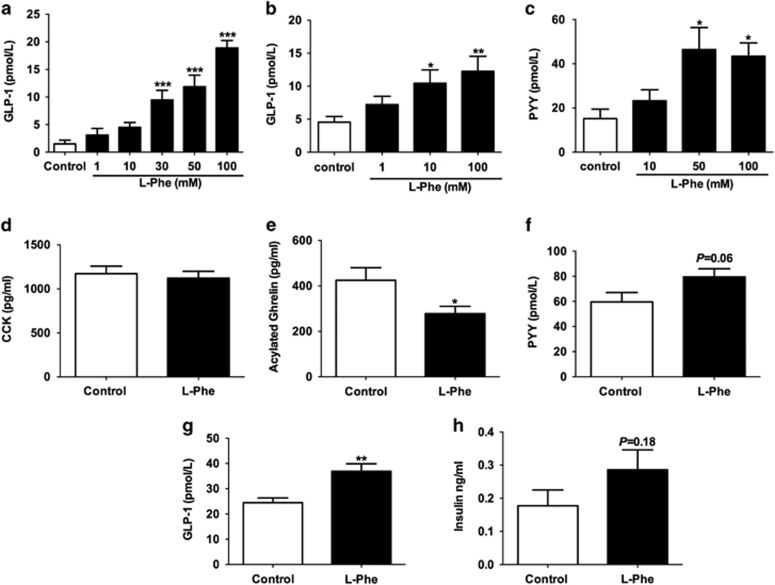
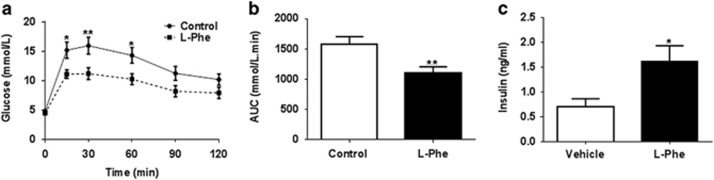
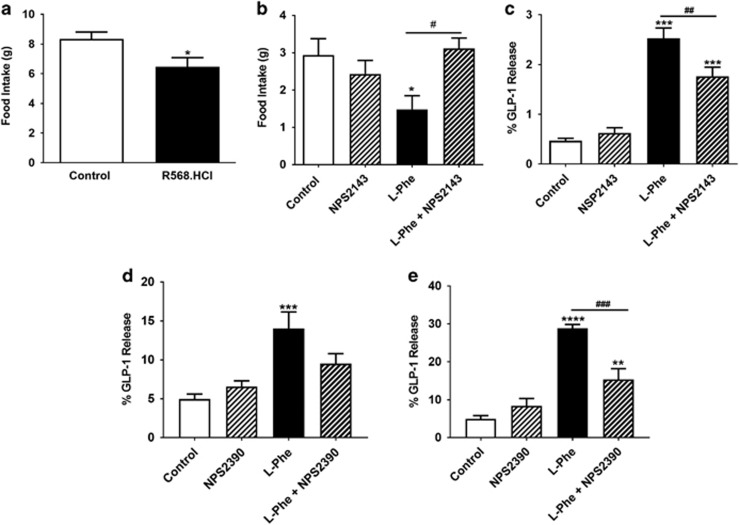
Oral administration of l-Phe acutely reduced food intake in rats and mice, and chronically reduced food intake and body weight in diet-induced obese mice. Ileal l-Phe also reduced food intake in rats. l-Phe stimulated GLP-1 and PYY release, and reduced plasma ghrelin, and also stimulated insulin release and improved glucose tolerance in rats. Pharmacological blockade of the CaSR attenuated the anorectic effect of intra-ileal l-Phe in rats, and l-Phe-induced GLP-1 release from STC-1 and primary L cells was attenuated by CaSR blockade.
l-Phe reduced food intake, stimulated GLP-1 and PYY release, and reduced plasma ghrelin in rodents. Our data provide evidence that the anorectic effects of l-Phe are mediated via the CaSR, and suggest that l-Phe and the CaSR system in the GI tract may have therapeutic utility in the treatment of obesity and diabetes. Further work is required to determine the physiological role of the CaSR in protein sensing in the gut, and the role of this system in humans.
高蛋白饮食(HPD)比富含其他宏量营养素的饮食更能让人产生饱腹感并减轻体重。HPD 发挥作用的确切机制尚不清楚。然而,有证据表明,作为蛋白质消化产物的氨基酸的感知可能在食欲调节和饱腹感中发挥作用。我们研究了 L-苯丙氨酸(L-Phe)对啮齿动物食物摄入和葡萄糖稳态的影响。
我们研究了芳香族氨基酸和钙敏感受体(CaSR)激动剂 L-苯丙氨酸(L-Phe)对啮齿动物食物摄入以及胃肠激素肽 YY(PYY)、胰高血糖素样肽-1(GLP-1)和胃饥饿素释放的影响,以及 CaSR 在体外和体内介导这些作用的作用。我们还检查了口服 L-Phe 给药对大鼠葡萄糖耐量的影响。
L-Phe 口服给药可急性减少大鼠和小鼠的食物摄入量,并慢性减少饮食诱导肥胖小鼠的食物摄入量和体重。回肠内 L-Phe 也减少了大鼠的食物摄入量。L-Phe 刺激 GLP-1 和 PYY 的释放,并降低血浆胃饥饿素,还刺激大鼠胰岛素释放并改善葡萄糖耐量。CaSR 药理学阻断减弱了大鼠回肠内 L-Phe 的厌食作用,而 CaSR 阻断减弱了 STC-1 和原代 L 细胞中 L-Phe 诱导的 GLP-1 释放。
L-Phe 减少了啮齿动物的食物摄入量,刺激了 GLP-1 和 PYY 的释放,并降低了血浆胃饥饿素。我们的数据提供了证据表明,L-Phe 的厌食作用是通过 CaSR 介导的,并表明 GI 道中的 L-Phe 和 CaSR 系统在肥胖症和糖尿病的治疗中可能具有治疗效用。需要进一步研究来确定 CaSR 在肠道中蛋白质感应中的生理作用,以及该系统在人类中的作用。