Bello Silvia M, Wallduck Rosalind, Parfitt Simon A, Stringer Chris B
Department of Earth Sciences, The Natural History Museum, London, United Kingdom.
University College London, Institute of Archaeology, London, United Kingdom.
PLoS One. 2017 Aug 9;12(8):e0182127. doi: 10.1371/journal.pone.0182127. eCollection 2017.
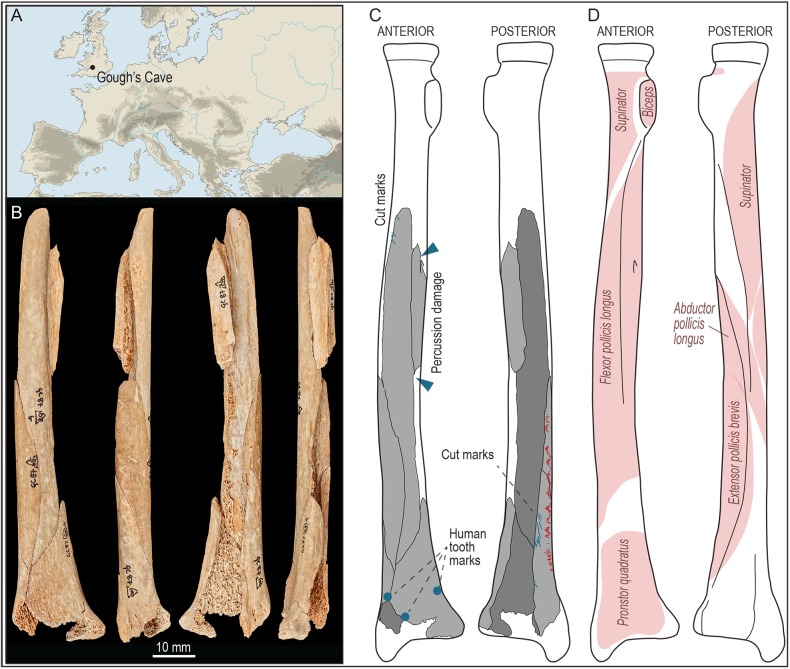
Cut-marked and broken human bones are a recurrent feature of Magdalenian (~17-12,000 years BP, uncalibrated dates) European sites. Human remains at Gough's Cave (UK) have been modified as part of a Magdalenian mortuary ritual that combined the intensive processing of entire corpses to extract edible tissues and the modification of skulls to produce skull-cups. A human radius from Gough's Cave shows evidence of cut marks, percussion damage and human tooth marks, indicative of cannibalism, as well as a set of unusual zig-zagging incisions on the lateral side of the diaphysis. These latter incisions cannot be unambiguously associated with filleting of muscles. We compared the macro- and micro-morphological characteristics of these marks to over 300 filleting marks on human and non-human remains and to approximately 120 engraved incisions observed on two artefacts from Gough's Cave. The new macro- and micro-morphometric analyses of the marks, as well as further comparisons with French Middle Magdalenian engraved artefacts, suggest that these modifications are the result of intentional engraving. The engraved motif comfortably fits within a Magdalenian pattern of design; what is exceptional in this case, however, is the choice of raw material (human bone) and the cannibalistic context in which it was produced. The sequence of the manipulations suggests that the engraving was a purposeful component of the cannibalistic practice, implying a complex ritualistic funerary behaviour that has never before been recognized for the Palaeolithic period.
带有切割痕迹和破损的人类骨骼是马格德林时期(约公元前17000 - 12000年,未校准日期)欧洲遗址的常见特征。英国高夫洞穴中的人类遗骸被改造,这是马格德林丧葬仪式的一部分,该仪式包括对整具尸体进行精细处理以提取可食用组织,以及对头骨进行改造以制作头骨杯。高夫洞穴中的一根人类桡骨显示出切割痕迹、撞击损伤和人类牙齿痕迹,表明存在同类相食现象,以及骨干外侧有一组不寻常的锯齿状切口。后一种切口无法明确与肌肉剔骨相关联。我们将这些痕迹的宏观和微观形态特征与300多个来自人类和非人类遗骸的剔骨痕迹以及在高夫洞穴的两件人工制品上观察到的约120个雕刻切口进行了比较。对这些痕迹的新的宏观和微观形态测量分析,以及与法国中马格德林时期雕刻人工制品的进一步比较表明,这些改造是有意雕刻的结果。雕刻图案完全符合马格德林时期的设计模式;然而,在这种情况下特别的是原材料(人类骨骼)的选择以及其产生的同类相食背景。操作顺序表明雕刻是同类相食行为中有目的的一部分,这意味着一种复杂的仪式性丧葬行为,在旧石器时代以前从未被认识到。