Department of Earth and Planetary Sciences, Johns Hopkins University, Baltimore, Maryland, USA.
NASA Marshall Space Flight Center, Earth Science Branch, Huntsville, Alabama, USA.
Sci Rep. 2017 Aug 9;7(1):7707. doi: 10.1038/s41598-017-07956-5.
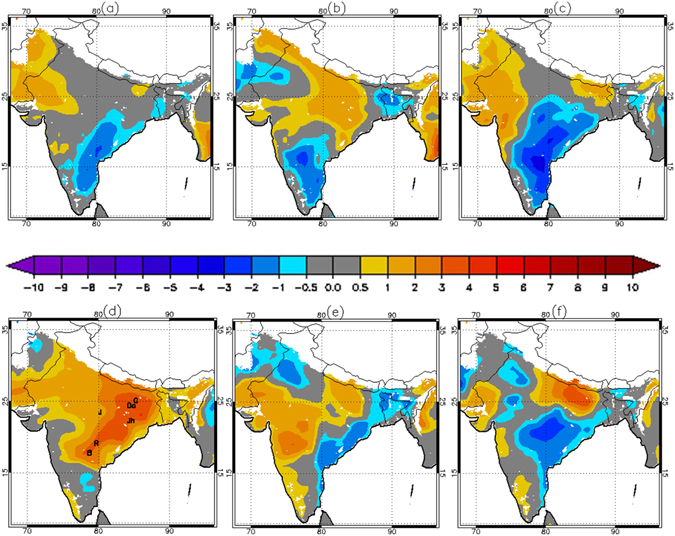
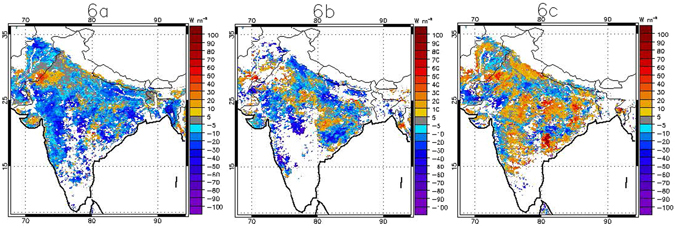
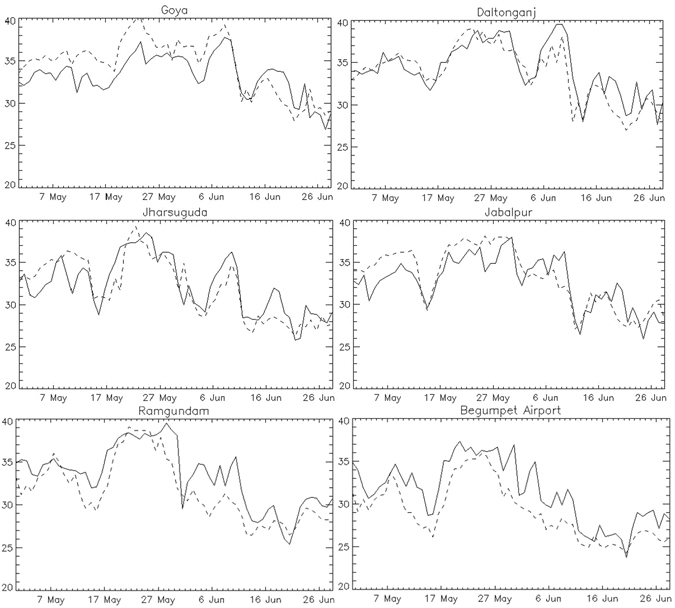
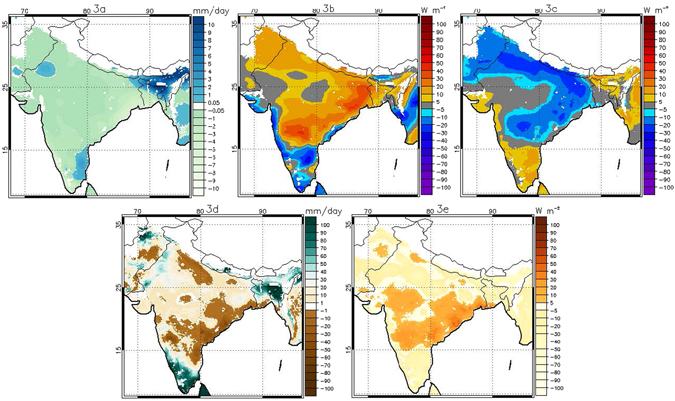
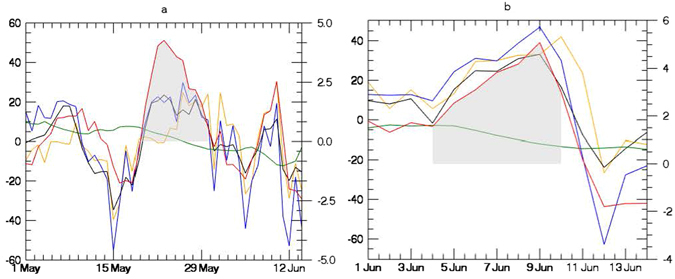
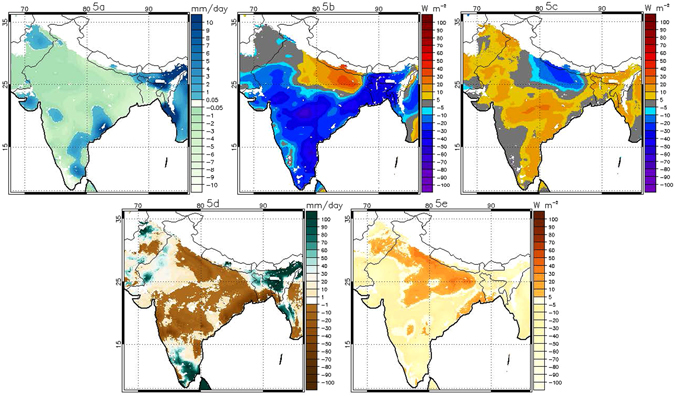
India faced a major heat wave during the summer of 2015. Temperature anomalies peaked in the dry period before the onset of the summer monsoon, suggesting that local land-atmosphere feedbacks involving desiccated soils and vegetation might have played a role in driving the heat extreme. Upon examination of in situ data, reanalysis, satellite observations, and land surface models, we find that the heat wave included two distinct peaks: one in late May, and a second in early June. During the first peak we find that clear skies led to a positive net radiation anomaly at the surface, but there is no significant sensible heat flux anomaly within the core of the heat wave affected region. By the time of the second peak, however, soil moisture had dropped to anomalously low levels in the core heat wave region, net surface radiation was anomalously high, and a significant positive sensible heat flux anomaly developed. This led to a substantial local forcing on air temperature that contributed to the intensity of the event. The analysis indicates that the highly agricultural landscape of North and Central India can reinforce heat extremes under dry conditions.
2015 年夏季,印度遭遇了一场严重的热浪。在夏季季风来临前的干旱期,温度异常达到峰值,这表明当地土壤和植被干枯导致的陆地-大气反馈可能在推动这场极端高温中发挥了作用。通过对现场数据、再分析、卫星观测和陆面模型的检查,我们发现热浪包括两个明显的高峰:一个在 5 月底,另一个在 6 月初。在第一个高峰期间,我们发现晴朗的天空导致地表出现净辐射异常,但在受热浪影响核心区域内,感热通量异常并不明显。然而,到了第二个高峰时,核心热浪区域的土壤湿度已经降至异常低的水平,地表净辐射异常高,并且出现了显著的正感热通量异常。这导致了对空气温度的实质性局部强迫,从而加剧了事件的强度。分析表明,印度北部和中部高度农业化的景观在干燥条件下可能会加剧热浪极端事件。