Department of Human Geography and Spatial Planning, Utrecht University, 3584, CS Utrecht, Netherlands.
Department of Child and Adolescent Psychiatry and Psychotherapy, University of Ulm, 89075, Ulm, Germany.
Sci Rep. 2017 Aug 9;7(1):7673. doi: 10.1038/s41598-017-08117-4.
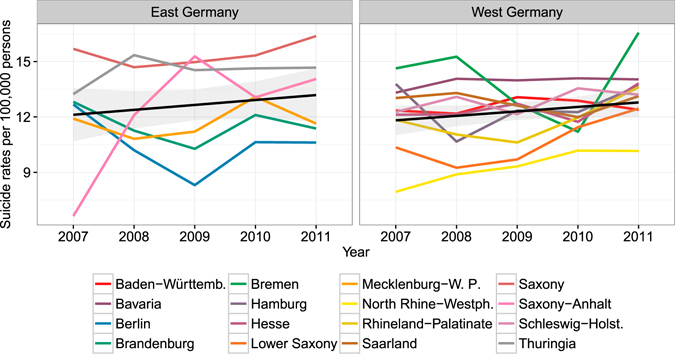
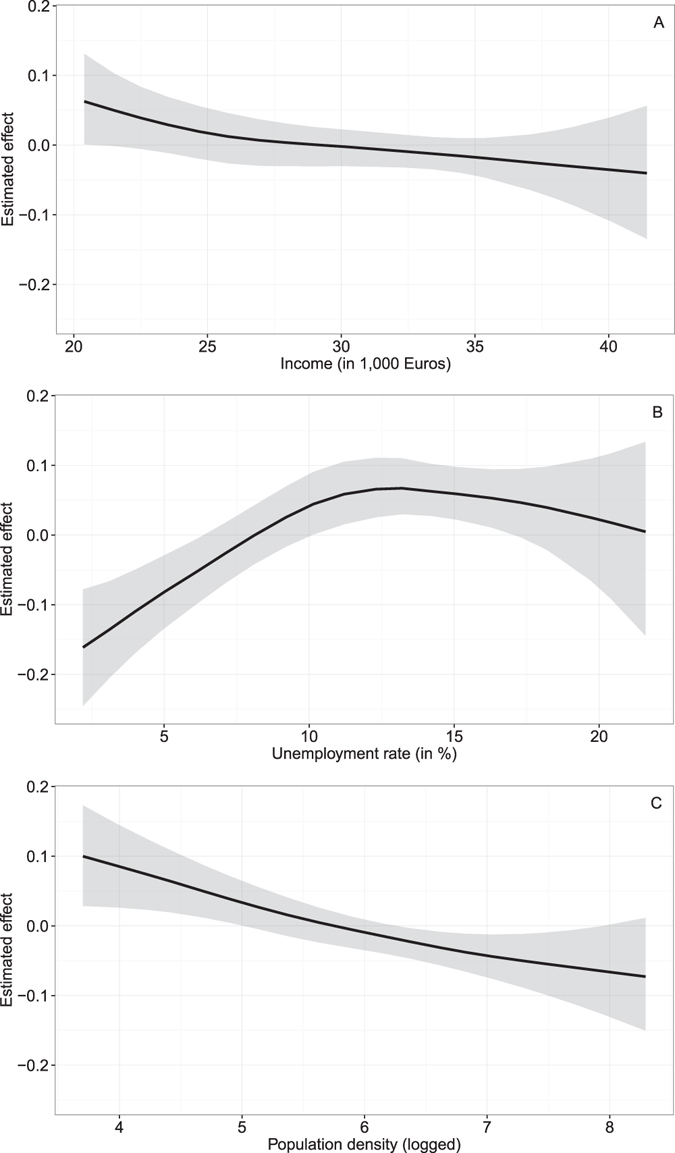
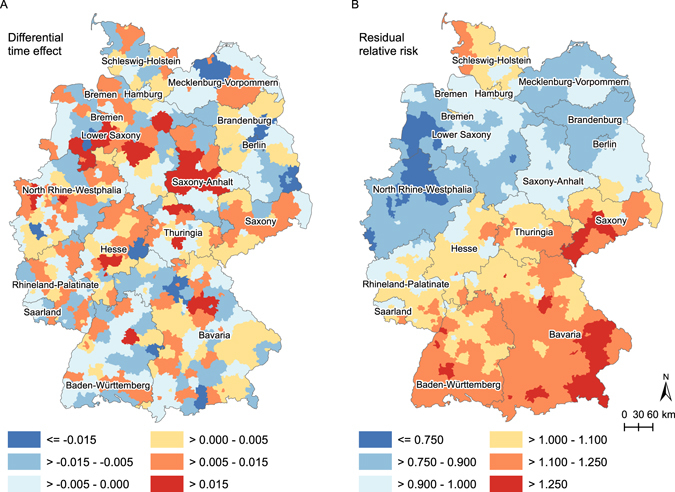
Despite comprehensive prevention programs in Germany, suicide has been on the rise again since 2007. The underlying reasons and spatiotemporal risk patterns are poorly understood. We assessed the spatiotemporal risk of suicide per district attributable to multiple risk and protective factors longitudinally for the period 2007-11. Bayesian space-time regression models were fitted. The nationwide temporal trend showed an increase in relative risk (RR) of dying from suicide (RR 1.008, 95% credibility intervals (CI) 1.001-1.016), whereas district-specific deviations from the grand trend occurred. Striking patterns of amplified risk emerged in southern Germany. While the number of general practitioners was positively related (RR 1.003, 95% CI 1.000-1.006), income was negatively and non-linearly related with suicide risk, as was population density. Unemployment was associated and showed a marked nonlinearity. Neither depression prevalence nor mental health service supply were related. The findings are vital for the implementation of future suicide prevention programs. Concentrating preventive efforts on vulnerable areas of excess risk is recommended.
尽管德国有全面的预防计划,但自 2007 年以来,自杀率再次上升。其潜在原因和时空风险模式仍不清楚。我们评估了 2007 年至 2011 年期间每个地区归因于多种风险和保护因素的自杀时空风险。拟合了贝叶斯时空回归模型。全国时间趋势显示自杀死亡率的相对风险增加(RR1.008,95%置信区间(CI)1.001-1.016),而地区特定的偏离总趋势的情况发生了。在德国南部出现了明显的风险放大模式。虽然普通医生的数量呈正相关(RR1.003,95%CI1.000-1.006),但收入与自杀风险呈负相关且非线性相关,人口密度也是如此。失业率与自杀风险相关,且具有明显的非线性。抑郁患病率和精神卫生服务供应均与自杀风险无关。这些发现对实施未来的自杀预防计划至关重要。建议将预防工作集中在高风险的脆弱地区。