School of Biological Sciences and Oceans Institute, University of Western Australia, Crawley, WA, 6009, Australia.
Australian Institute of Marine Science (M096), University of Western Australia, Crawley, WA, 6009, Australia.
Sci Rep. 2017 Aug 9;7(1):7641. doi: 10.1038/s41598-017-07751-2.
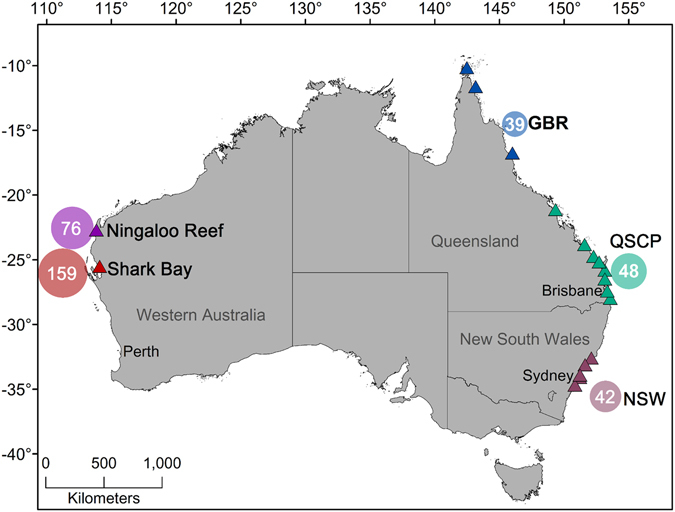
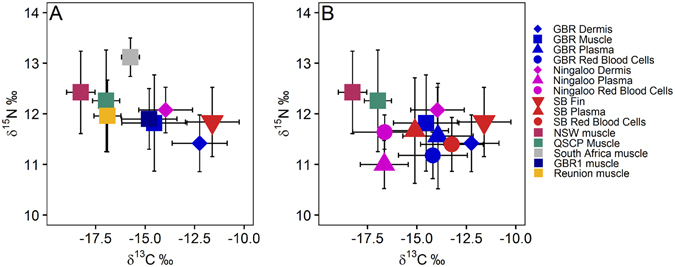
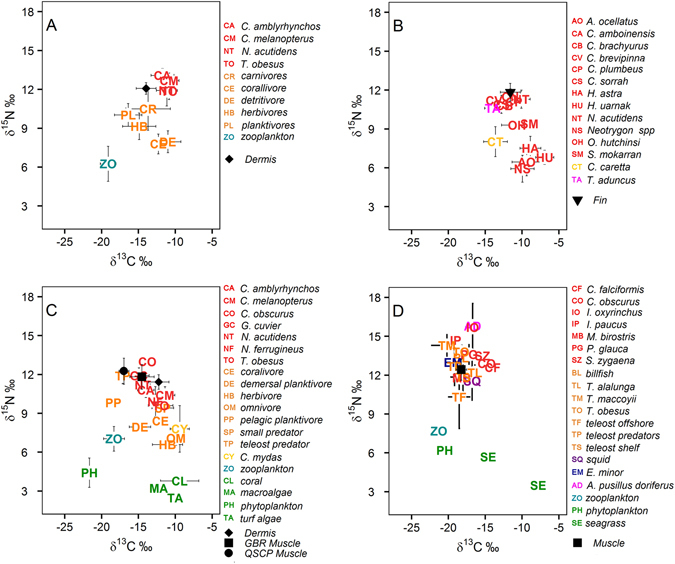
Tiger sharks were sampled off the western (Ningaloo Reef, Shark Bay) and eastern (the Great Barrier Reef; GBR, Queensland and New South Wales; NSW) coastlines of Australia. Multiple tissues were collected from each shark to investigate the effects of location, size and sex of sharks on δC and δN stable isotopes among these locations. Isotopic composition of sharks sampled in reef and seagrass habitats (Shark Bay, GBR) reflected seagrass-based food-webs, whereas at Ningaloo Reef analysis revealed a dietary transition between pelagic and seagrass food-webs. In temperate habitats off southern Queensland and NSW coasts, shark diets relied on pelagic food-webs. Tiger sharks occupied roles at the top of food-webs at Shark Bay and on the GBR, but not at Ningaloo Reef or off the coast of NSW. Composition of δC in tissues was influenced by body size and sex of sharks, in addition to residency and diet stability. This variability in stable isotopic composition of tissues is likely to be a result of adaptive foraging strategies that allow these sharks to exploit multiple shelf and offshore habitats. The trophic role of tiger sharks is therefore both context- and habitat-dependent, consistent with a generalist, opportunistic diet at the population level.
在澳大利亚西部(宁格鲁珊瑚礁、鲨鱼湾)和东部(大堡礁;昆士兰州和新南威尔士州;新南威尔士州)沿海采集了虎鲨样本。从每只鲨鱼身上采集了多种组织,以研究位置、大小和性别对这些地点之间 δC 和 δN 稳定同位素的影响。在珊瑚礁和海草生境(鲨鱼湾、大堡礁)中采样的鲨鱼的同位素组成反映了基于海草的食物网,而在宁格鲁珊瑚礁的分析中则揭示了浮游生物和海草食物网之间的饮食转变。在昆士兰州南部和新南威尔士州沿海的温带生境中,鲨鱼的饮食依赖于浮游生物食物网。在鲨鱼湾和大堡礁,虎鲨在食物网中处于顶层位置,但在宁格鲁珊瑚礁或新南威尔士州沿海并不如此。组织中 δC 的组成受鲨鱼的体型和性别、居留地和饮食稳定性的影响。组织中稳定同位素组成的这种可变性可能是一种适应性觅食策略的结果,使这些鲨鱼能够利用多个大陆架和近海栖息地。因此,虎鲨的营养角色既取决于环境,也取决于栖息地,这与种群水平上的一般性、机会主义饮食一致。