Cooksey Gail Sondermeyer, Nguyen Alyssa, Knutson Kirsten, Tabnak Farzaneh, Benedict Kaitlin, McCotter Orion, Jain Seema, Vugia Duc
MMWR Morb Mortal Wkly Rep. 2017 Aug 11;66(31):833-834. doi: 10.15585/mmwr.mm6631a4.
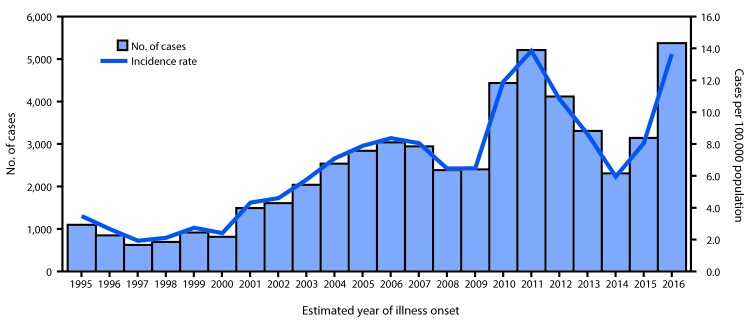
Coccidioidomycosis, or Valley Fever, is an infectious disease caused by inhalation of Coccidioides spp. spores (1). This soil-dwelling fungus is endemic in the southwestern United States, with most (97%) U.S. cases reported from Arizona and California (1,2). Following an incubation period of 1-3 weeks, symptomatic patients most often experience self-limited, influenza-like symptoms, but coccidioidomycosis also can lead to severe pulmonary disease and to rare cases of disseminated disease, including meningitis (1). Those at increased risk for severe disease include persons of African or Filipino descent, pregnant women, adults in older age groups, and persons with weakened immune systems (1). In 2016, a large increase in coccidioidomycosis incidence was observed in California compared with previous years (3). Using data reported by health care providers and laboratories via local health departments to the California Department of Public Health as of May 9, 2017, incidence rates were calculated by estimated year of illness onset as the number of confirmed coccidioidomycosis cases per 100,000 population (3). Estimated year of illness onset was extracted from the closest date to the time when symptoms first appeared for each patient. From 1995, when coccidioidomycosis became an individually reportable disease in California, to 2009, annual incidence rates ranged from 1.9 to 8.4 per 100,000, followed by a substantial increase to 11.9 per 100,000 in 2010 and a peak of 13.8 per 100,000 in 2011 (Figure). Annual rates decreased during 2012-2014, but increased in 2016 to 13.7 per 100,000, with 5,372 reported cases, the highest annual number of cases in California recorded to date.
球孢子菌病,又称圣河谷热,是一种因吸入球孢子菌属孢子而引发的传染病(1)。这种生长于土壤中的真菌在美国西南部为地方病,美国大部分(97%)病例报告来自亚利桑那州和加利福尼亚州(1,2)。经过1至3周的潜伏期后,出现症状的患者最常经历自限性的流感样症状,但球孢子菌病也可导致严重的肺部疾病以及罕见的播散性疾病病例,包括脑膜炎(1)。患严重疾病风险增加的人群包括非洲或菲律宾裔人士、孕妇、老年成年人以及免疫系统较弱的人(1)。2016年,加利福尼亚州观察到球孢子菌病发病率与前几年相比大幅上升(3)。利用医疗服务提供者和实验室通过当地卫生部门向加利福尼亚州公共卫生部报告的数据,截至2017年5月9日,发病率按估计发病年份计算,即每10万人口中确诊的球孢子菌病病例数(3)。估计发病年份从每位患者症状首次出现的最接近日期提取。从1995年球孢子菌病在加利福尼亚州成为需单独报告的疾病起,至2009年,年发病率为每10万人1.9至8.4例,随后在2010年大幅增至每10万人11.9例,并在2011年达到每10万人13.8例的峰值(图)。2012 - 2014年期间年发病率下降,但在2016年增至每10万人13.7例,报告病例达5372例,是加利福尼亚州迄今记录的年度病例数最高值。