Vonaesch Pascale, Tondeur Laura, Breurec Sébastien, Bata Petula, Nguyen Liem Binh Luong, Frank Thierry, Farra Alain, Rafaï Clotaire, Giles-Vernick Tamara, Gody Jean Chrysostome, Gouandjika-Vasilache Ionela, Sansonetti Philippe, Vray Muriel
Unité de Pathogénie Microbienne Moléculaire, Institut Pasteur, Paris, France.
Unité d'épidémiologie et d'expertise des maladies émergentes, Institut Pasteur, Paris, France.
PLoS One. 2017 Aug 10;12(8):e0182363. doi: 10.1371/journal.pone.0182363. eCollection 2017.
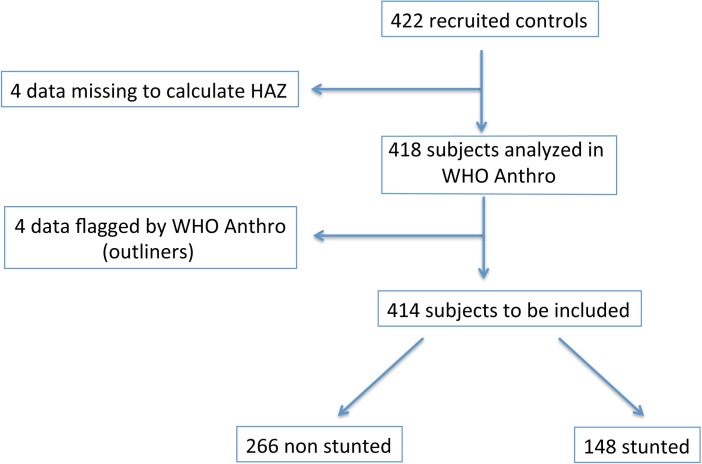
Stunting remains a major public health concern worldwide. Although its global prevalence is slowly decreasing, the actual number of affected children is still rising in Sub-Saharan Africa. In the Central African Republic (CAR), about one third of all children below the age of five are stunted. Stunting is correlated with many long-term consequences, including poor cognitive development and a higher rate of morbidity and mortality, making stunting a major contributor to poverty. In CAR, little is known about the factors that contribute to stunting. This study aimed at analysing, in a cross-sectional study, the main factors associated with stunting in a group of 414 children recruited between December 2011 and November 2013, aged five years or less and living in Bangui. For all children, demographic, socio-economic and anthropometric data were recorded and asymptomatic enteropathogen carriage was assessed in stool samples using classical microbiological assays. The study group had a mean age of 14.2±10 months. Fifty-eight percent (292/414) were boys, and 36 percent (148/414) exhibited stunted growth. Of the stunted children, 51% (75/148) showed a moderate delay in linear growth for their age group [height-for-age z-score (HAZ) between -2 and -3 SD] while 49% (73/148) presented a severe delay (HAZ < -3). Factors significantly associated with stunting included gender (aOR: 1.67; 95% CI: 1.07; 2.62 for boys compared to girls) and age (aOR of 3.98 (95% CI: 2.45; 6.46) for toddlers and aOR 4.42 (95% CI: 2.36; 8.28) for children compared to infants). Most importantly, we identified being overweight [weight-for-height z-score (WHZ) > 2 SD; aOR: 3.21; 95% CI: 1.50; 6.90 of overweight compared to normal weight] as also being significantly associated with stunting. This is the first study showing that even in the poorest countries of the world there is an association of stunting with being overweight.
发育迟缓仍是全球主要的公共卫生问题。尽管其全球患病率在缓慢下降,但撒哈拉以南非洲受影响儿童的实际数量仍在上升。在中非共和国(CAR),五岁以下儿童中约有三分之一发育迟缓。发育迟缓与许多长期后果相关,包括认知发育不良以及更高的发病率和死亡率,这使得发育迟缓成为贫困的一个主要因素。在中非共和国,人们对导致发育迟缓的因素知之甚少。本研究旨在通过一项横断面研究,分析2011年12月至2013年11月期间招募的414名年龄在五岁及以下、居住在班吉的儿童中与发育迟缓相关的主要因素。对所有儿童记录了人口统计学、社会经济和人体测量数据,并使用经典微生物学检测方法评估粪便样本中无症状肠道病原体携带情况。研究组的平均年龄为14.2±10个月。58%(292/414)为男孩,36%(148/414)表现出发育迟缓。在发育迟缓的儿童中,51%(75/148)在其年龄组中线性生长出现中度延迟[年龄别身高Z评分(HAZ)在-2至-3标准差之间],而49%(73/148)表现出严重延迟(HAZ<-3)。与发育迟缓显著相关的因素包括性别(与女孩相比,男孩的调整后比值比:1.67;95%置信区间:1.07;2.62)和年龄(与婴儿相比,幼儿的调整后比值比为3.98(95%置信区间:2.45;6.46),儿童的调整后比值比为4.42(95%置信区间:2.36;8.28))。最重要的是,我们发现超重[身高别体重Z评分(WHZ)>2标准差;与正常体重相比,超重的调整后比值比:3.21;95%置信区间:1.50;6.90]也与发育迟缓显著相关。这是第一项表明即使在世界上最贫穷的国家,发育迟缓也与超重有关的研究。