Department of Growth and Development, Capital Institute of Pediatrics, Beijing, China.
PLoS One. 2021 Jan 14;16(1):e0245455. doi: 10.1371/journal.pone.0245455. eCollection 2021.
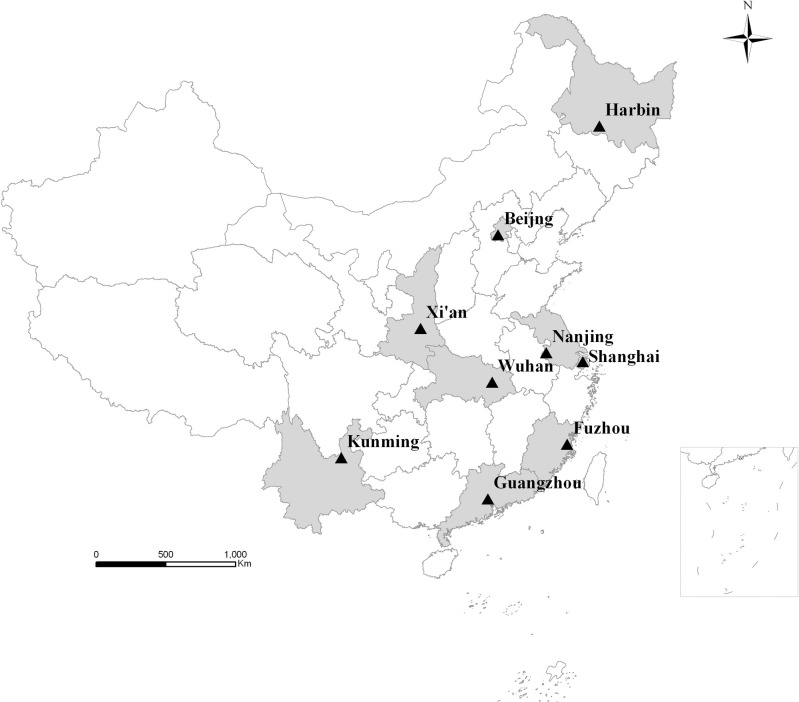
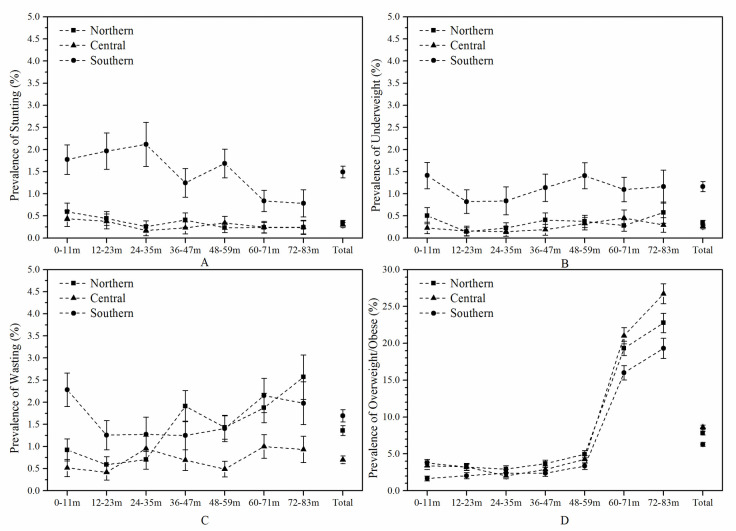
The prevalence of stunting, wasting, overweight and their coexistence are various in different populations and they also have changed with social developing and environmental improving. In this paper, we aimed to analyze the prevalence of stunting, wasting, overweight and their coexistence in some developed regions of China. Data were collected in a population-based cross-sectional survey by a multi-stage cluster sampling method in nine cities located in the northern, central, and southern region of China in 2016. Children under seven years (n = 110,491) were measured. WHO growth standards were used to assess the growth status. Stunting, underweight, wasting, overweight and obesity were considered as the primary forms of malnutrition (includes undernutrition and overnutrition) for infant or young children at population-levels. The prevalence of stunting, underweight, wasting, and overweight or obesity were respectively 0.7%, 0.6%, 1.2%, and 7.6%. Most of these children (95.4%) suffered from one form of malnutrition, and only 0.2% of them concurrently stunted and wasted, 0.4% concurrently stunted and overweight, 1.7% concurrently stunted and underweight, 2.3% concurrently underweight and wasted. Among stunted children, 91.2% were appropriate body proportion, and only 2.3% were wasted, 6.5% were overweight or obesity. Among overweight or obese children, only 0.6% were stunted, whereas, 15.8% were high stature and 83.6% were the appropriate ranges of stature. Sex, age, urban/suburban, and region were associated with these primary forms of malnutrition in the multivariate logistic analysis. In conclusion, we found that the coexistence of stunting and overweight was not common at both population-level and individual-level. The situation for undernutrition had significantly improved, and overweight may be the leading public health issue for children under seven years in the nine cities of China.
中国部分发达地区儿童生长迟缓、消瘦、超重及其共存现况分析
本研究旨在分析中国部分发达地区儿童生长迟缓、消瘦、超重及其共存现况。采用多阶段整群抽样方法,于 2016 年在我国北方、中部和南方 9 个城市,收集了 7 岁以下儿童(n=110491)的横断面调查数据。采用 WHO 生长标准评估儿童生长状况。在人群水平,将生长迟缓、消瘦、超重和肥胖定义为婴幼儿营养不良的主要形式(包括营养不足和营养过剩)。生长迟缓、消瘦、超重和肥胖的发生率分别为 0.7%、0.6%、1.2%和 7.6%。大多数儿童(95.4%)存在 1 种形式的营养不良,仅 0.2%同时存在生长迟缓与消瘦,0.4%同时存在生长迟缓与超重,1.7%同时存在生长迟缓与消瘦,2.3%同时存在消瘦与超重。在生长迟缓的儿童中,91.2%的儿童体型适宜,仅有 2.3%的儿童消瘦,6.5%的儿童超重或肥胖。在超重或肥胖的儿童中,仅 0.6%的儿童生长迟缓,而 15.8%的儿童高身材,83.6%的儿童身材处于适宜范围。多因素 logistic 分析显示,性别、年龄、城乡和地区与这些主要营养不良形式有关。总之,本研究发现人群和个体层面同时存在生长迟缓与超重的情况并不常见。营养不足的情况已明显改善,超重可能是中国这 9 个城市 7 岁以下儿童面临的主要公共卫生问题。