Pérez-Losada Marcos, Graham Robert J, Coquillette Madeline, Jafarey Amenah, Castro-Nallar Eduardo, Aira Manuel, Freishtat Robert J, Mansbach Jonathan M
Computational Biology Institute, Milken Institute School of Public Health, George Washington University, Washington, DC, United States of America.
Division of Emergency Medicine, Children's National Medical Center, Washington, DC, United States of America.
PLoS One. 2017 Aug 10;12(8):e0182520. doi: 10.1371/journal.pone.0182520. eCollection 2017.
Airway microbiota dynamics during lower respiratory infection (LRI) are still poorly understood due, in part, to insufficient longitudinal studies and lack of uncontaminated lower airways samples. Furthermore, the similarity between upper and lower airway microbiomes is still under debate. Here we compare the diversity and temporal dynamics of microbiotas directly sampled from the trachea via tracheostomy in patients with (YLRI) and without (NLRI) lower respiratory infections.
We prospectively collected 127 tracheal aspirates across four consecutive meteorological seasons (quarters) from 40 patients, of whom 20 developed LRIs and 20 remained healthy. All aspirates were collected when patients had no LRI. We generated 16S rRNA-based microbial profiles (~250 bp) in a MiSeq platform and analyzed them using Mothur and the SILVAv123 database. Differences in microbial diversity and taxon normalized (via negative binomial distribution) abundances were assessed using linear mixed effects models and multivariate analysis of variance.
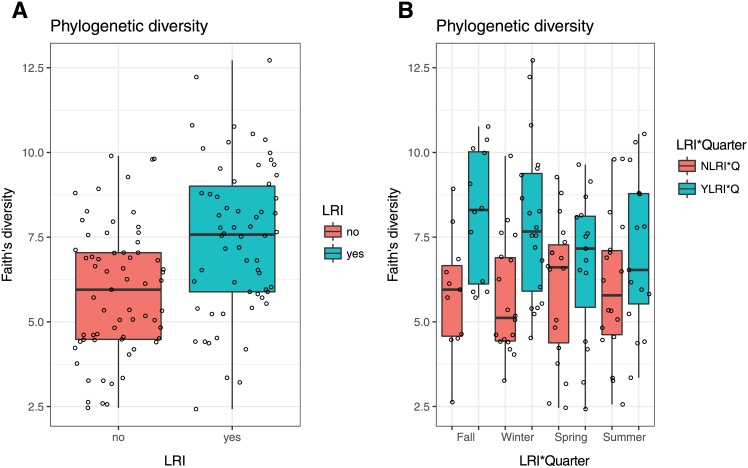
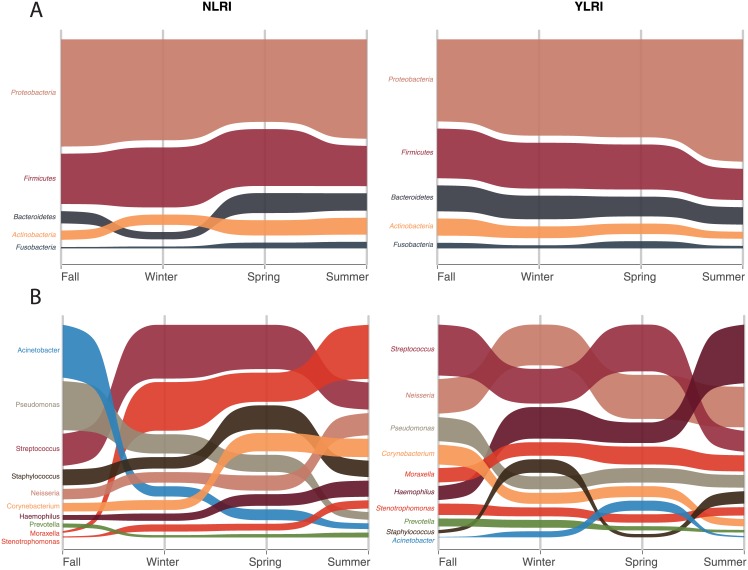
Alpha-diversity (ACE, Fisher and phylogenetic diversity) and beta-diversity (Bray-Curtis, Jaccard and Unifrac distances) indices varied significantly (P<0.05) between NLRI and YLRI microbiotas from tracheostomised patients. Additionally, Haemophilus was significantly (P = 0.009) more abundant in YLRI patients than in NLRI patients, while Acinetobacter, Corynebacterium and Pseudomonas (P<0.05) showed the inverse relationship. We did not detect significant differences in diversity and bacterial abundance among seasons. This result disagrees with previous evidence suggesting seasonal variation in airway microbiotas. Further study is needed to address the interaction between microbes and LRI during times of health and disease.
下呼吸道感染(LRI)期间气道微生物群的动态变化仍未得到充分了解,部分原因是纵向研究不足以及缺乏未受污染的下呼吸道样本。此外,上呼吸道和下呼吸道微生物群之间的相似性仍存在争议。在此,我们比较了通过气管切开术直接从患有下呼吸道感染(YLRI)和未患下呼吸道感染(NLRI)的患者气管中采集的微生物群的多样性和时间动态变化。
我们前瞻性地在四个连续气象季节(季度)收集了40例患者的127份气管吸出物,其中20例发生了LRI,20例保持健康。所有吸出物均在患者无LRI时采集。我们在MiSeq平台上生成了基于16S rRNA的微生物图谱(约250 bp),并使用Mothur和SILVAv123数据库进行分析。使用线性混合效应模型和多变量方差分析评估微生物多样性和分类单元标准化(通过负二项分布)丰度的差异。
气管切开患者的NLRI和YLRI微生物群之间,α多样性(ACE、Fisher和系统发育多样性)和β多样性(Bray-Curtis、Jaccard和Unifrac距离)指数存在显著差异(P<0.05)。此外,YLRI患者中的嗜血杆菌明显(P = 0.009)比NLRI患者丰富,而不动杆菌、棒状杆菌和假单胞菌(P<0.05)则呈现相反的关系。我们未检测到各季节之间在多样性和细菌丰度上的显著差异。这一结果与之前表明气道微生物群存在季节性变化的证据不一致。需要进一步研究以探讨健康和疾病时期微生物与LRI之间的相互作用。