Hirata Akiko, Nakamura Katsunori, Nakao Katsuhiro, Kominami Yuji, Tanaka Nobuyuki, Ohashi Haruka, Takano Kohei Takenaka, Takeuchi Wataru, Matsui Tetsuya
Center for International Partnerships and Research on Climate Change, Forestry and Forest Products Research Institute, Matsunosato, Tsukuba, Ibaraki, Japan.
Tohoku Research Center, Forestry and Forest Products Research Institute, Nabeyashiki, Shimokuriyagawa, Morioka, Iwate, Japan.
PLoS One. 2017 Aug 10;12(8):e0182837. doi: 10.1371/journal.pone.0182837. eCollection 2017.
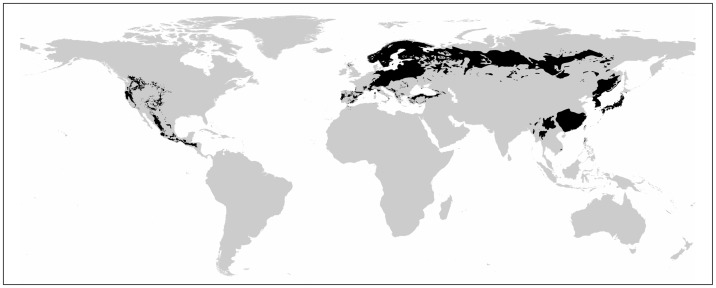
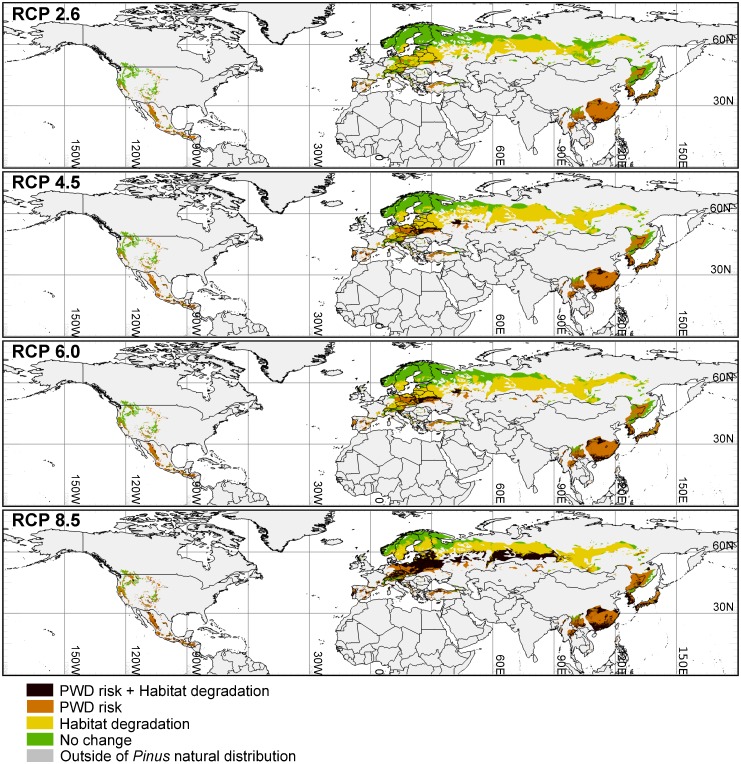
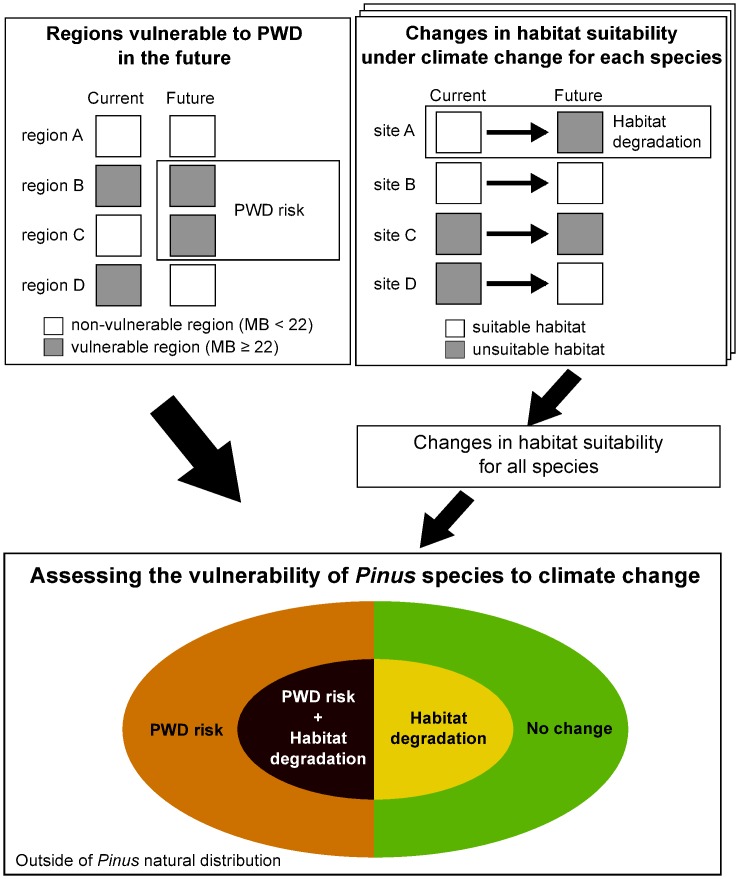
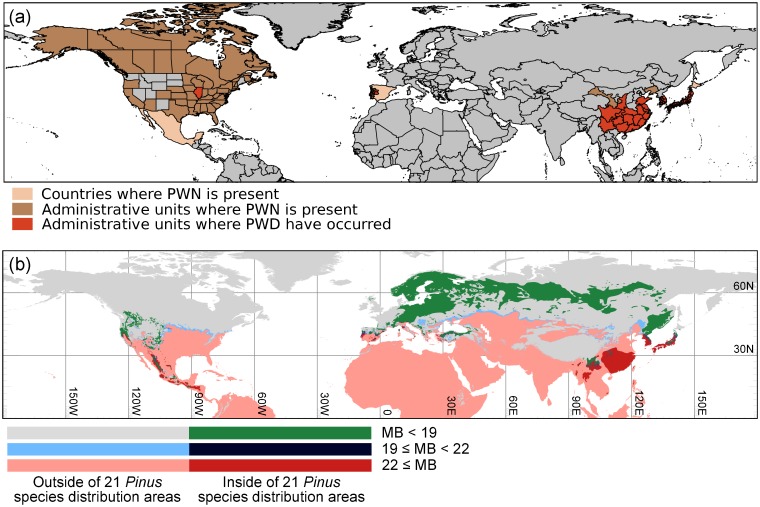
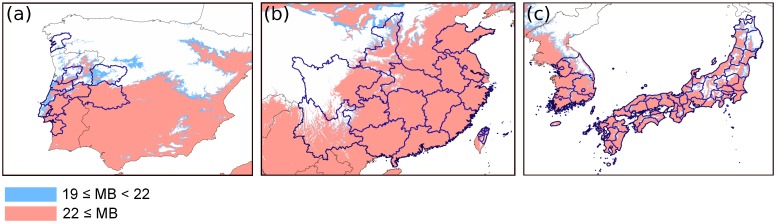
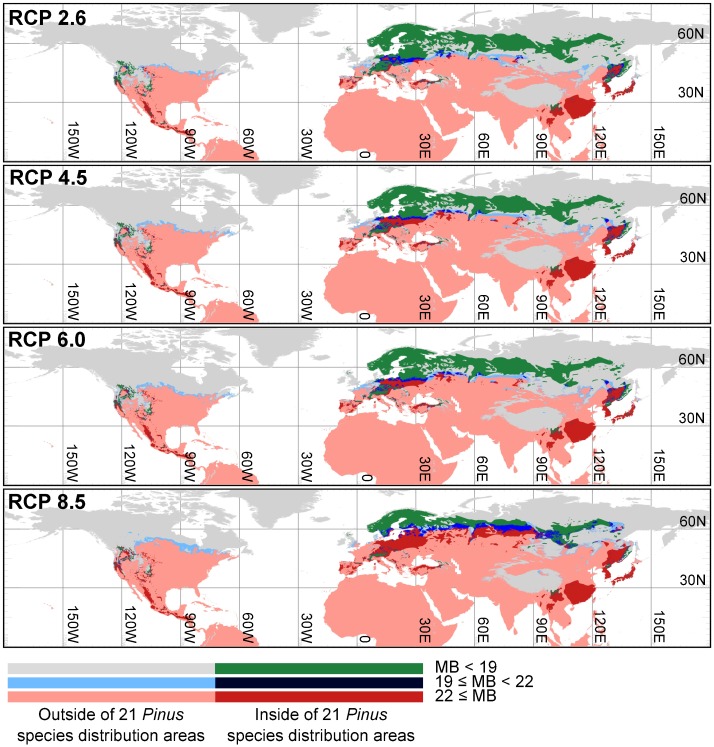
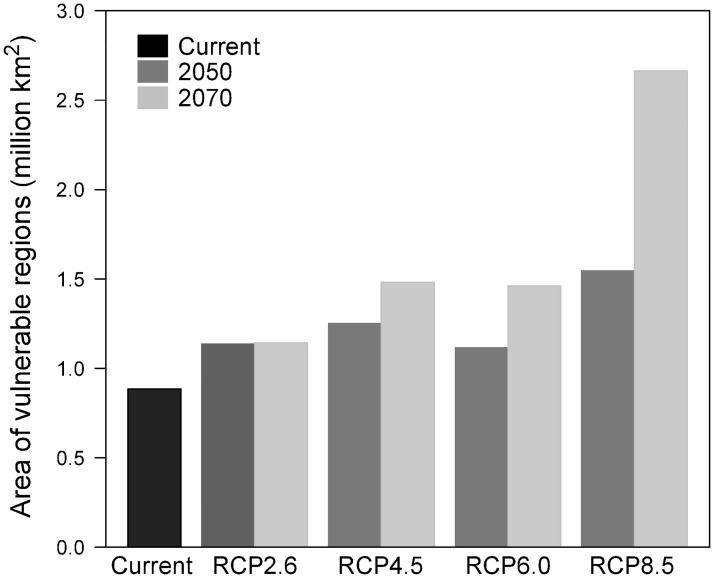
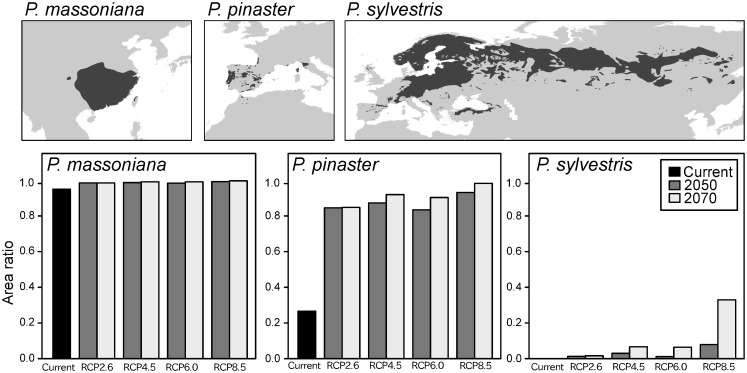
Pine wilt disease (PWD) constitutes a serious threat to pine forests. Since development depends on temperature and drought, there is a concern that future climate change could lead to the spread of PWD infections. We evaluated the risk of PWD in 21 susceptible Pinus species on a global scale. The MB index, which represents the sum of the difference between the mean monthly temperature and 15 when the mean monthly temperatures exceeds 15°C, was used to determine current and future regions vulnerable to PWD (MB ≥ 22). For future climate conditions, we compared the difference in PWD risks among four different representative concentration pathways (RCPs 2.6, 4.5, 6.0, and 8.5) and two time periods (2050s and 2070s). We also evaluated the impact of climate change on habitat suitability for each Pinus species using species distribution models. The findings were then integrated and the potential risk of PWD spread under climate change was discussed. Within the natural Pinus distribution area, southern parts of North America, Europe, and Asia were categorized as vulnerable regions (MB ≥ 22; 16% of the total Pinus distribution area). Representative provinces in which PWD has been reported at least once overlapped with the vulnerable regions. All RCP scenarios showed expansion of vulnerable regions in northern parts of Europe, Asia, and North America under future climate conditions. By the 2070s, under RCP 8.5, an estimated increase in the area of vulnerable regions to approximately 50% of the total Pinus distribution area was revealed. In addition, the habitat conditions of a large portion of the Pinus distribution areas in Europe and Asia were deemed unsuitable by the 2070s under RCP 8.5. Approximately 40% of these regions overlapped with regions deemed vulnerable to PWD, suggesting that Pinus forests in these areas are at risk of serious damage due to habitat shifts and spread of PWD.
松材线虫病(PWD)对松林构成严重威胁。由于其发展取决于温度和干旱,人们担心未来的气候变化可能导致松材线虫病感染的传播。我们在全球范围内评估了21种易感松树品种的松材线虫病风险。当平均月气温超过15°C时,MB指数代表平均月气温与15之间的差值之和,用于确定当前和未来易受松材线虫病影响的地区(MB≥22)。对于未来气候条件,我们比较了四种不同代表性浓度路径(RCP 2.6、4.5、6.0和8.5)和两个时间段(2050年代和2070年代)之间松材线虫病风险的差异。我们还使用物种分布模型评估了气候变化对每个松树品种栖息地适宜性的影响。然后整合研究结果,并讨论了气候变化下松材线虫病传播的潜在风险。在天然松树分布区内,北美、欧洲和亚洲的南部地区被归类为易受影响地区(MB≥22;占松树总分布面积的16%)。至少有一次报告松材线虫病的代表性省份与易受影响地区重叠。所有RCP情景都显示,在未来气候条件下,欧洲、亚洲和北美的北部地区易受影响地区将扩大。到2070年代,在RCP 8.5情景下,易受影响地区的面积估计将增加到松树总分布面积的约50%。此外,到2070年代,在RCP 8.5情景下,欧洲和亚洲大部分松树分布区的栖息地条件被认为不适宜。这些地区中约40%与被认为易受松材线虫病影响的地区重叠,这表明这些地区的松树森林因栖息地变化和松材线虫病传播而面临严重破坏的风险。