Department of Neurology, Xuan Wu Hospital, Capital Medical University, Beijing, 100053, China.
Department of Neurosurgery, Xuan Wu Hospital, Capital Medical University, Beijing, 100053, China.
Sci Rep. 2017 Aug 10;7(1):7776. doi: 10.1038/s41598-017-06802-y.
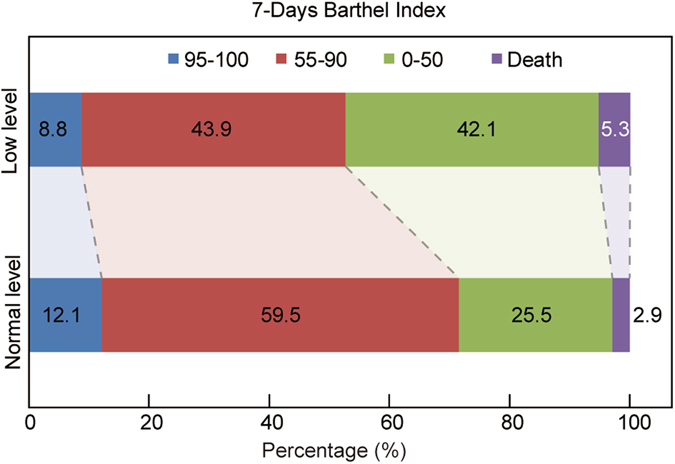
Serum albumin levels has been shown to predict outcome in ischemic stroke patients. We aimed to investigate the relationship between serum albumin levels and hemorrhagic transformation (HT) after intravenous thrombolysis (IVT) in patients with acute stroke. 428 patients receiving intravenous rt-PA therapy were included from 2013 to 2016 and were categorized into two groups: low level (<35 mmol/L) and normal level (35-55 mmol/L) group. Demographic, clinical and laboratory information, HT and functional outcomes were analyzed. Hemorrhagic transformation was comfirmed by CT scan or MRI within 7 days. The functional outcome was measured by modified Barthel Index and modified Rankin Scale (mRS) at 7 days and 90 days. Patients with lower albumin had significantly higher risk of HT (15.3% vs. 4.2%, P = 0.002) and sICH (6.2% vs. 1.4%, P = 0.03) than those with normal level of albumin. In univariate analysis for HT, atrial fibrillation and level of albumin were identified as significant factors (P < 0.001, P = 0.001 respectively). On multivariate logistic regression analysis, serum albumin level remained independent predictor of HT (OR = 4.369, 95% CI = 1.626-11.742, P = 0.003). No significantly difference were found in the clinical outcome at 7 days and 90 days between two groups (P > 0.05). Low level of serum albumin within 24 hours may be an independent predictor of post-thrombolytic HT.
血清白蛋白水平已被证明可预测缺血性脑卒中患者的预后。我们旨在研究急性脑卒中患者静脉溶栓(IVT)后血清白蛋白水平与出血性转化(HT)之间的关系。2013 年至 2016 年共纳入 428 例接受静脉 rt-PA 治疗的患者,并分为两组:低水平组(<35mmol/L)和正常水平组(35-55mmol/L)。分析了人口统计学、临床和实验室信息、HT 和功能结局。HT 通过 CT 扫描或 MRI 在 7 天内确认。功能结局通过改良 Barthel 指数和改良 Rankin 量表(mRS)在 7 天和 90 天进行测量。白蛋白水平较低的患者 HT(15.3%比 4.2%,P=0.002)和 sICH(6.2%比 1.4%,P=0.03)的风险明显高于白蛋白正常水平的患者。HT 的单因素分析中,心房颤动和白蛋白水平被确定为显著因素(P<0.001,P=0.001)。多因素 logistic 回归分析显示,血清白蛋白水平仍然是 HT 的独立预测因素(OR=4.369,95%CI=1.626-11.742,P=0.003)。两组在 7 天和 90 天的临床结局无显著差异(P>0.05)。24 小时内血清白蛋白水平较低可能是溶栓后 HT 的独立预测因素。