Centre for Behavioural Ecology and Evolution (CBEE), and Hubei Collaborative Innovation Center for Green Transformation of Bio-Resources, College of Life Sciences, Hubei University, Wuhan, 430062, China.
Department of Biological Sciences, National University of, Singapore, Singapore.
Sci Rep. 2017 Aug 10;7(1):7784. doi: 10.1038/s41598-017-07668-w.
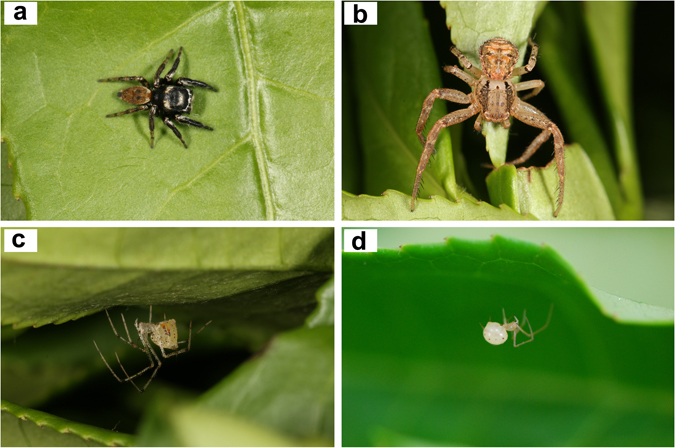
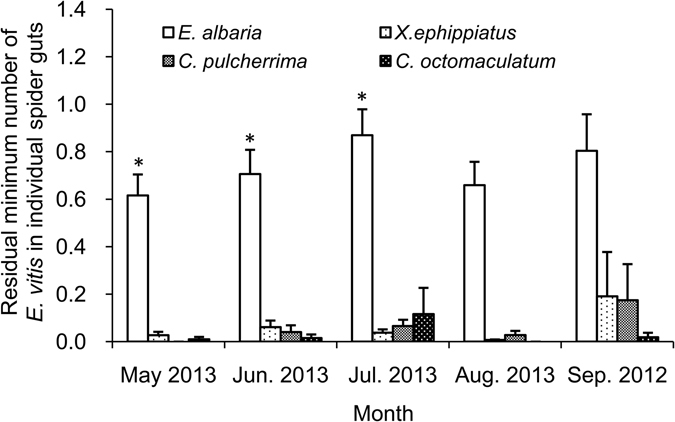
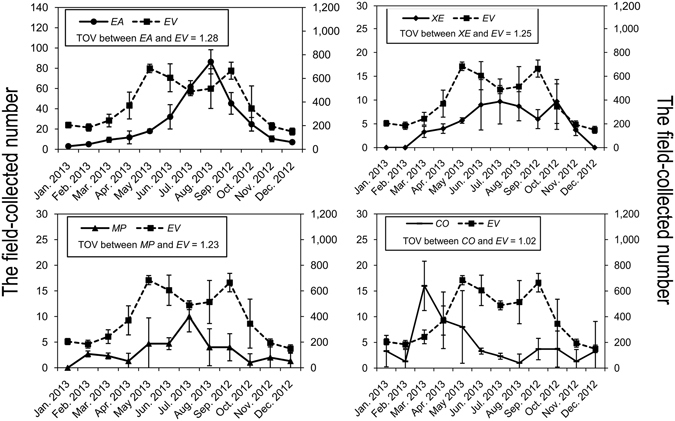
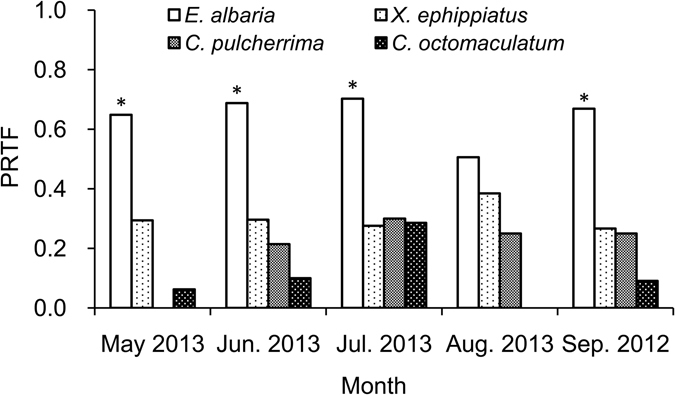
Biological control using predators of key pest species is an attractive option in integrated pest management (IPM). Molecular gut analysis can provide an estimation of predator efficiency on a given prey. Here we use a combination of various experimental approaches, both in field and lab, to identify a potential biological control species of the common pest of commercially grown tea, Empoasca vitis (Göthe) (Hemiptera), in a Chinese plantation. We collected 2655 spiders from plantations and established relative abundances of spider species and their temporal overlap with the pest species in tea canopy. We analyzed DNA from 1363 individuals of the most common spider species using targeted RQ-PCR to quantify the potential efficiency of spiders as a predator on E. vitis. The results showed that, in the field, the jumping spider Evarcha albaria was the most abundant, had the closest temporal overlap with the pest, and frequently fed on it. Therefore, this spider may play a key role in pest suppression. The present study demonstrates the potential of our experimental approach to study predator-prey relationships in taxa that do not lend themselves to morphological identification of gut contents, such as spiders.
利用关键害虫天敌进行生物防治是综合虫害管理(IPM)中一种有吸引力的选择。分子肠道分析可以估计捕食者对特定猎物的效率。在这里,我们使用各种实验方法的组合,包括田间和实验室,来确定中国茶园中一种商业种植的茶叶常见害虫——茶黄蓟马(Empoasca vitis)(半翅目)的潜在生物控制物种。我们从茶园中收集了 2655 只蜘蛛,并确定了蜘蛛物种的相对丰度及其与茶树冠层中害虫物种的时间重叠。我们使用靶向 RQ-PCR 从最常见的 1363 只蜘蛛个体中分析 DNA,以量化蜘蛛作为 E. vitis 捕食者的潜在效率。结果表明,在野外,跳蛛 Evarcha albaria 是最丰富的,与害虫的时间重叠最接近,并且经常以其为食。因此,这种蜘蛛可能在害虫抑制中发挥关键作用。本研究证明了我们的实验方法在研究不易进行形态学鉴定的分类群(如蜘蛛)的捕食者-猎物关系方面的潜力。