Kennedy Alana E, Kaf Wafaa A, Ferraro John A, Delgado Rafael E, Lichtenhan Jeffery T
Department of Communication Sciences and Disorders, Missouri State UniversitySpringfield, MO, United States.
Department of Hearing and Speech, University of Kansas Medical CenterKansas City, KS, United States.
Front Neurosci. 2017 Jul 27;11:429. doi: 10.3389/fnins.2017.00429. eCollection 2017.
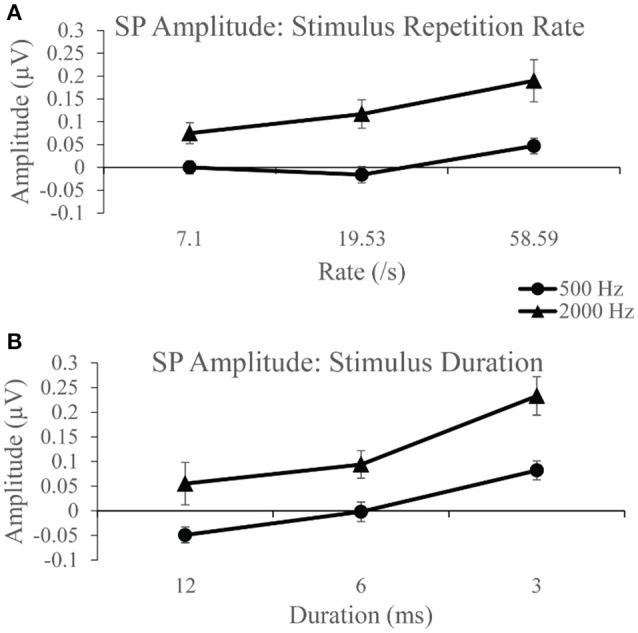
Electrocochleography (ECochG) to high repetition rate tone bursts may have advantages over ECochG to clicks with standard slow rates. Tone burst stimuli presented at a high repetition rate may enhance summating potential (SP) measurements by reducing neural contributions resulting from neural adaptation to high stimulus repetition rates. To allow for the analysis of the complex ECochG responses to high rates, we deconvolved responses using the Continuous Loop Averaging Deconvolution (CLAD) technique. We examined the effect of high stimulus repetition rate and stimulus duration on SP amplitude measurements made with extratympanic ECochG to tone bursts in 20 adult females with normal hearing. We used 500 and 2,000 Hz tone bursts of various stimulus durations (12, 6, 3 ms) and repetition rates (five rates ranging from 7.1 to 234.38/s). A within-subject repeated measures (rate x duration) analysis of variance was conducted. We found that, for both 500 and 2,000 Hz stimuli, the mean deconvolved SP amplitudes were larger at faster repetition rates (58.59 and 97.66/s) compared to slower repetition rates (7.1 and 19.53/s), and larger at shorter stimulus duration compared longer stimulus duration. Our concluding hypothesis is that large SP amplitude to short duration stimuli may originate primarily from neural excitation, and large SP amplitudes to long duration, fast repetition rate stimuli may originate from hair cell responses. While the hair cell or neural origins of the SP to various stimulus parameters remains to be validated, our results nevertheless provide normative data as a step toward applying the CLAD technique to understanding diseased ears.
与标准慢速率短声诱发的耳蜗电图(ECochG)相比,高重复率短纯音诱发的ECochG可能具有优势。以高重复率呈现的短纯音刺激可通过减少因神经适应高刺激重复率而产生的神经贡献,来增强总和电位(SP)测量。为了分析对高重复率的复杂ECochG反应,我们使用连续循环平均反卷积(CLAD)技术对反应进行反卷积。我们研究了高刺激重复率和刺激持续时间对20名听力正常成年女性外耳道ECochG短纯音刺激下SP振幅测量的影响。我们使用了不同刺激持续时间(12、6、3毫秒)和重复率(7.1至234.38/秒的五个速率)的500和2000赫兹短纯音。进行了受试者内重复测量(速率×持续时间)方差分析。我们发现,对于500和2000赫兹刺激,与较慢重复率(7.1和19.53/秒)相比,较快重复率(58.59和97.66/秒)下平均反卷积后的SP振幅更大,且较短刺激持续时间下比长刺激持续时间下更大。我们的结论性假设是,短持续时间刺激下大的SP振幅可能主要源于神经兴奋,而长持续时间、快重复率刺激下大的SP振幅可能源于毛细胞反应。虽然SP对各种刺激参数的毛细胞或神经起源仍有待验证,但我们的结果仍然提供了规范性数据,作为将CLAD技术应用于理解患病耳朵的第一步。