Koroleva Kseniya, Mustafina Alsu, Yakovlev Aleksey, Hermann Anton, Giniatullin Rashid, Sitdikova Guzel
Department of Human and Animal Physiology, Institute of Fundamental Medicine and Biology, Kazan Federal UniversityKazan, Russia.
Department of Cell Biology and Physiology, University of SalzburgSalzburg, Austria.
Front Cell Neurosci. 2017 Jul 27;11:226. doi: 10.3389/fncel.2017.00226. eCollection 2017.
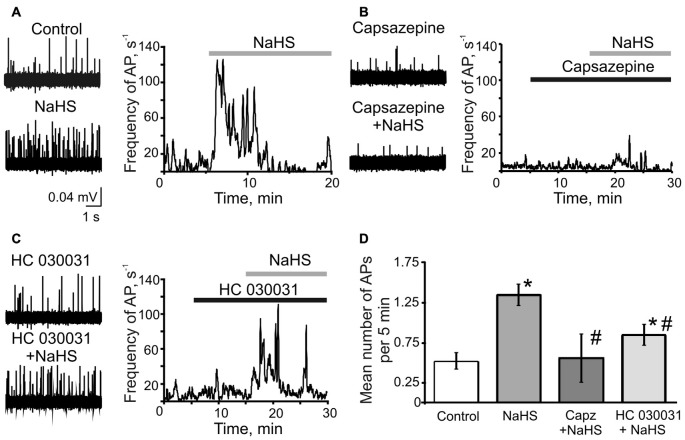
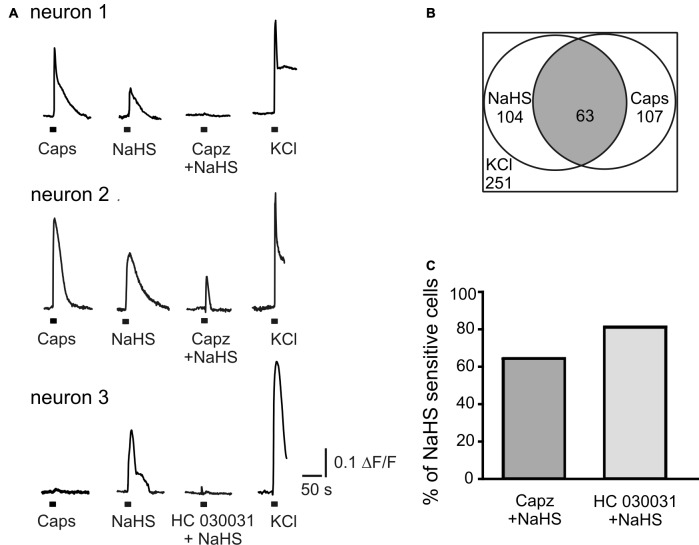
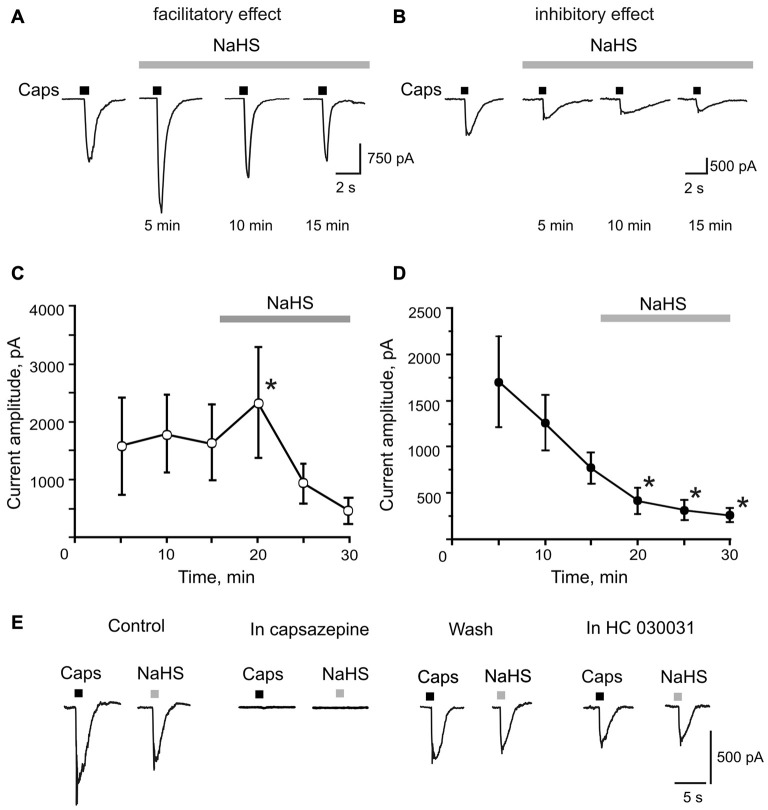
Hydrogen sulfide (HS), a well-established member of the gasotransmitter family, is involved in a variety of physiological functions, including pro-nociceptive action in the sensory system. Although several reports have shown that HS activates sensory neurons, the molecular targets of HS action in trigeminal (TG) nociception, implicated in migraine, remains controversial. In this study, using suction electrode recordings, we investigate the effect of the HS donor, sodium hydrosulfide (NaHS), on nociceptive firing in rat meningeal TG nerve fibers. The effect of NaHS was also explored with patch-clamp and calcium imaging techniques on isolated TG neurons. NaHS dramatically increased the nociceptive firing in TG nerve fibers. This effect was abolished by the TRPV1 inhibitor capsazepine but was partially prevented by the TRPA1 blocker HC 030031. In a fraction of isolated TG neurons, NaHS transiently increased amplitude of capsaicin-induced currents. Moreover, NaHS by itself induced inward currents in sensory neurons, which were abolished by the TRPV1 inhibitor capsazepine suggesting involvement of TRPV1 receptors. In contrast, the inhibitor of TRPA1 receptors HC 030031 did not prevent the NaHS-induced currents. Imaging of a large population of TG neurons revealed that NaHS induced calcium transients in 41% of tested neurons. Interestingly, this effect of NaHS in some neurons was inhibited by the TRPV1 antagonist capsazepine whereas in others it was sensitive to the TRPA1 blocker HC 030031. Our data suggest that both TRPV1 and TRPA1 receptors play a role in the pro-nociceptive action of NaHS in peripheral TG nerve endings in meninges and in somas of TG neurons. We propose that activation of TRPV1 and TRPA1 receptors by HS during neuro-inflammation conditions contributes to the nociceptive firing in primary afferents underlying migraine pain.
硫化氢(HS)是气体信号分子家族中一个已被充分认知的成员,参与多种生理功能,包括在感觉系统中的促伤害感受作用。尽管有几份报告显示HS可激活感觉神经元,但HS在偏头痛相关的三叉神经(TG)伤害感受中的分子靶点仍存在争议。在本研究中,我们使用吸力电极记录法,研究了HS供体硫氢化钠(NaHS)对大鼠脑膜TG神经纤维伤害性放电的影响。还运用膜片钳和钙成像技术,在分离的TG神经元上探究了NaHS的作用。NaHS显著增加了TG神经纤维的伤害性放电。TRPV1抑制剂辣椒素可消除此效应,但TRPA1阻断剂HC 030031只能部分抑制该效应。在一部分分离的TG神经元中,NaHS可短暂增加辣椒素诱导电流的幅度。此外,NaHS本身可在感觉神经元中诱导内向电流,该电流可被TRPV1抑制剂辣椒素消除,提示TRPV1受体参与其中。相反,TRPA1受体抑制剂HC 030031并不能阻止NaHS诱导的电流。对大量TG神经元的成像显示,NaHS可在41%的受试神经元中诱导钙瞬变。有趣的是,NaHS在某些神经元中的这种效应可被TRPV1拮抗剂辣椒素抑制,而在另一些神经元中则对TRPA1阻断剂HC 030031敏感。我们的数据表明,TRPV1和TRPA1受体均在脑膜外周TG神经末梢和TG神经元胞体中NaHS的促伤害感受作用中发挥作用。我们提出,在神经炎症状态下,HS对TRPV1和TRPA1受体的激活,促成了偏头痛疼痛背后初级传入神经元的伤害性放电。