Kim Mikyung, Kim Jung-Eun, Lee Hye-Yoon, Kim Ae-Ran, Park Hyo-Ju, Kwon O-Jin, Kim Bo-Kyung, Cho Jung Hyo, Kim Joo-Hee
Clinical Research Division, Korea Institute of Oriental Medicine, Daejeon, Republic of Korea.
Department of Neuropsychiatry, College of Oriental Medicine, Dong-eui University, Busan, Republic of Korea.
BMJ Open. 2017 Aug 11;7(8):e016269. doi: 10.1136/bmjopen-2017-016269.
Although insomnia is one of the most prevalent and disturbing symptoms among patients with cancer, it has not been properly managed. Electroacupuncture (EA) has received attention as a promising intervention for insomnia, and a few previous studies have reported that this intervention may be beneficial for treating insomnia in patients with cancer. The aim of this pilot study is to explore the feasibility and preliminary effectiveness of EA on the sleep disturbance of patients with cancer with insomnia using a subjective method, patient-reported questionnaires and an objective tool, actigraphy, to measure the quality of sleep.
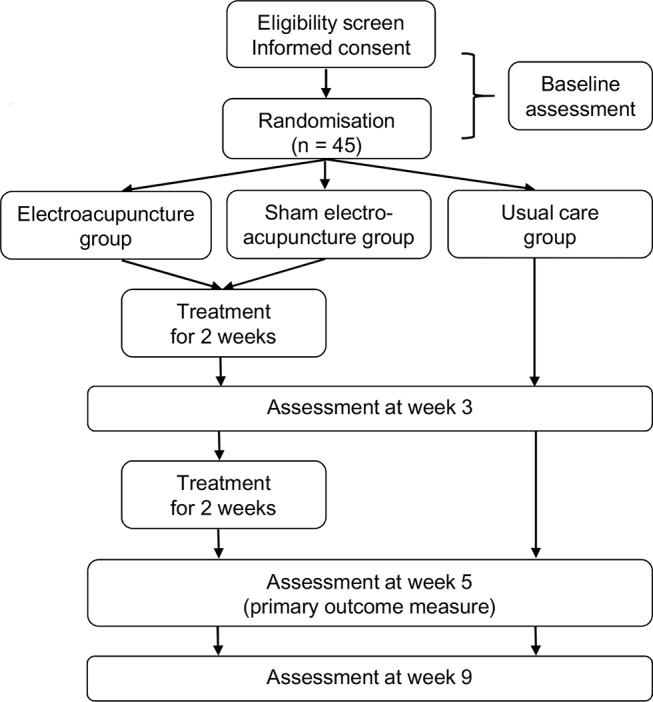
This is a study protocol for a randomised, three-arm, multicentre, pilot clinical trial. A total of 45 patients with cancer who have continuous insomnia related to cancer treatment or cancer itself will be randomly allocated to an EA group, sham EA group or usual care group in equal proportions. The EA group will receive 10 sessions of EA treatment over 4 weeks. The sham EA group will receive sham EA at non-acupoints using non-penetrating Streitberger acupuncture needles with mock EA. The usual care group will not receive EA treatment. All participants will be provided a brochure on the management of sleep disorders regardless of their group assignment. The primary outcome measure is the mean change in the insomnia severity index from the baseline to week 5. Information related to sleep quality will also be obtained through the Pittsburgh Sleep Quality Index, a sleep diary and actigraphy. Participants will complete the trial by visiting the research centre at week 9 for follow-up assessment.
This study protocol was approved by the institutional review boards of each research centre. Written informed consent will be obtained from all participants. The result of this study will be published in peer-reviewed journals or presented at academic conferences.
KCT0002162; Pre-results.
尽管失眠是癌症患者中最常见且令人困扰的症状之一,但尚未得到妥善处理。电针疗法作为一种有前景的失眠干预方法受到关注,此前已有一些研究报道该干预可能有助于治疗癌症患者的失眠。本试点研究的目的是采用主观方法、患者报告问卷以及客观工具(活动记录仪)来测量睡眠质量,探讨电针疗法对患有失眠的癌症患者睡眠障碍的可行性和初步疗效。
这是一项随机、三臂、多中心试点临床试验的研究方案。共有45名因癌症治疗或癌症本身而持续失眠的癌症患者将被等比例随机分配至电针组、假电针组或常规护理组。电针组将在4周内接受10次电针治疗。假电针组将使用非穿透性 Streitberger 针灸针在非穴位处进行假电针治疗并模拟电针刺激。常规护理组不接受电针治疗。无论分组如何,所有参与者都将获得一份关于睡眠障碍管理的宣传册。主要结局指标是从基线到第5周失眠严重程度指数的平均变化。还将通过匹兹堡睡眠质量指数、睡眠日记和活动记录仪获取与睡眠质量相关的信息。参与者将在第9周前往研究中心进行随访评估以完成试验。
本研究方案已获得各研究中心机构审查委员会的批准。将从所有参与者处获得书面知情同意书。本研究结果将发表在同行评审期刊上或在学术会议上展示。
KCT0002162;预结果。