Shanghai Municipal Hospital of Traditional Chinese Medicine, Shanghai University of Traditional Chinese Medicine, Shanghai, China.
School of Basic Medical Sciences, Shanghai Medical College, Fudan University, Shanghai, China.
JAMA Netw Open. 2022 Jul 1;5(7):e2220563. doi: 10.1001/jamanetworkopen.2022.20563.
Electroacupuncture (EA) is a widely recognized therapy for depression and sleep disorders in clinical practice, but its efficacy in the treatment of comorbid insomnia and depression remains uncertain.
To assess the efficacy and safety of EA as an alternative therapy in improving sleep quality and mental state for patients with insomnia and depression.
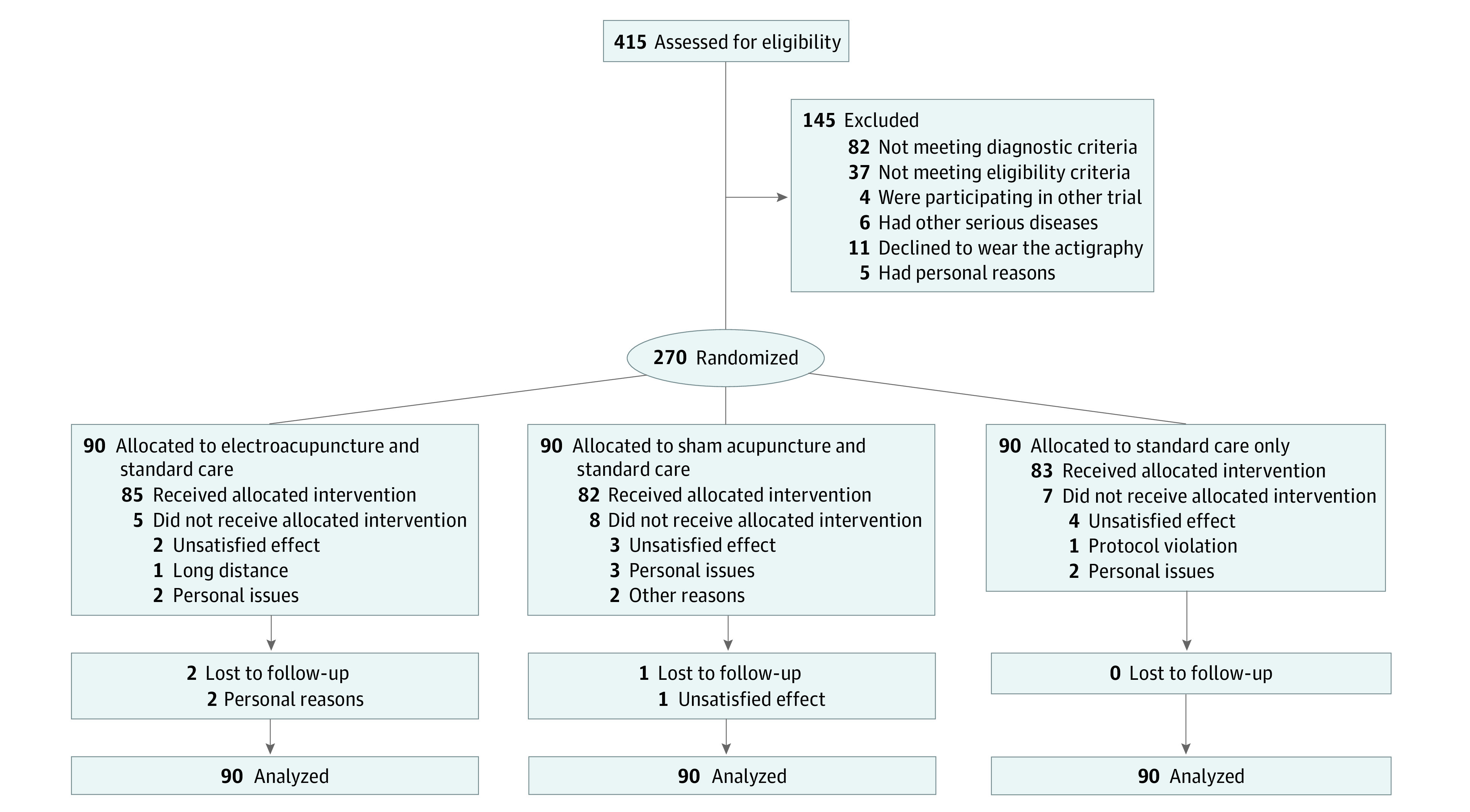
DESIGN, SETTING, AND PARTICIPANTS: A 32-week patient- and assessor-blinded, randomized, sham-controlled clinical trial (8-week intervention plus 24-week observational follow-up) was conducted from September 1, 2016, to July 30, 2019, at 3 tertiary hospitals in Shanghai, China. Patients were randomized to receive EA treatment and standard care, sham acupuncture (SA) treatment and standard care, or standard care only as control. Patients were 18 to 70 years of age, had insomnia, and met the criteria for depression as classified in the Diagnostic and Statistical Manual of Mental Disorders (Fifth Edition). Data were analyzed from May 4 to September 13, 2020.
All patients in the 3 groups were provided with standard care guided by psychiatrists. Patients in the EA and SA groups received real or sham acupuncture treatment, 3 sessions per week for 8 weeks, for a total of 24 sessions.
The primary outcome was change in Pittsburgh Sleep Quality Index (PSQI) from baseline to week 8. Secondary outcomes included PSQI at 12, 20, and 32 weeks of follow-up; sleep parameters recorded in actigraphy; Insomnia Severity Index; 17-item Hamilton Depression Rating Scale score; and Self-rating Anxiety Scale score.
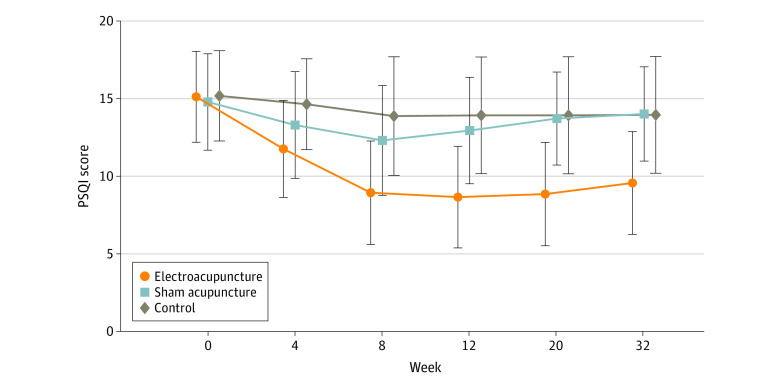
Among the 270 patients (194 women [71.9%] and 76 men [28.1%]; mean [SD] age, 50.3 [14.2] years) included in the intention-to-treat analysis, 247 (91.5%) completed all outcome measurements at week 32, and 23 (8.5%) dropped out of the trial. The mean difference in PSQI from baseline to week 8 within the EA group was -6.2 (95% CI, -6.9 to -5.6). At week 8, the difference in PSQI score was -3.6 (95% CI, -4.4 to -2.8; P < .001) between the EA and SA groups and -5.1 (95% CI, -6.0 to -4.2; P < .001) between the EA and control groups. The efficacy of EA in treating insomnia was sustained during the 24-week postintervention follow-up. Significant improvement in the 17-item Hamilton Depression Rating Scale (-10.7 [95% CI, -11.8 to -9.7]), Insomnia Severity Index (-7.6 [95% CI, -8.5 to -6.7]), and Self-rating Anxiety Scale (-2.9 [95% CI, -4.1 to -1.7]) scores and the total sleep time recorded in the actigraphy (29.1 [95% CI, 21.5-36.7] minutes) was observed in the EA group during the 8-week intervention period (P < .001 for all). No between-group differences were found in the frequency of sleep awakenings. No serious adverse events were reported.
In this randomized clinical trial of EA treatment for insomnia in patients with depression, quality of sleep improved significantly in the EA group compared with the SA or control group at week 8 and was sustained at week 32.
ClinicalTrials.gov Identifier: NCT03122080.
电针(EA)是临床实践中广泛认可的治疗抑郁症和睡眠障碍的方法,但它在治疗共病性失眠和抑郁症方面的疗效仍不确定。
评估 EA 作为替代疗法改善失眠和抑郁症患者睡眠质量和精神状态的疗效和安全性。
设计、地点和参与者:这是一项 32 周的患者和评估者设盲、随机、假针刺对照临床试验(8 周干预加 24 周观察随访),于 2016 年 9 月 1 日至 2019 年 7 月 30 日在中国上海的 3 家三级医院进行。患者被随机分配接受 EA 治疗和标准护理、假针刺(SA)治疗和标准护理或仅接受标准护理作为对照。患者年龄在 18 至 70 岁之间,患有失眠症,并符合精神障碍诊断与统计手册(第五版)分类的抑郁症标准。数据于 2020 年 5 月 4 日至 9 月 13 日进行分析。
所有三组患者均接受由精神科医生指导的标准护理。EA 和 SA 组患者接受真或假针刺治疗,每周 3 次,共 8 周,共 24 次。
主要结局是匹兹堡睡眠质量指数(PSQI)从基线到第 8 周的变化。次要结局包括 12、20 和 32 周随访时的 PSQI;在活动记录仪中记录的睡眠参数;失眠严重程度指数;17 项汉密尔顿抑郁评定量表评分;以及自评焦虑量表评分。
在 270 名(194 名女性[71.9%]和 76 名男性[28.1%];平均[SD]年龄,50.3[14.2]岁)意向治疗分析患者中,247 名(91.5%)完成了所有 32 周的结局测量,23 名(8.5%)退出了试验。EA 组从基线到第 8 周 PSQI 的平均差异为-6.2(95%CI,-6.9 至-5.6)。第 8 周时,EA 组与 SA 组和 EA 组与对照组之间 PSQI 评分的差异分别为-3.6(95%CI,-4.4 至-2.8;P<.001)和-5.1(95%CI,-6.0 至-4.2;P<.001)。在 24 周干预后随访期间,EA 在治疗失眠方面的疗效持续。17 项汉密尔顿抑郁评定量表(-10.7[95%CI,-11.8 至-9.7])、失眠严重程度指数(-7.6[95%CI,-8.5 至-6.7])和自评焦虑量表(-2.9[95%CI,-4.1 至-1.7])评分以及活动记录仪中记录的总睡眠时间(29.1[95%CI,21.5-36.7]分钟)均显著改善(所有 P<.001)。EA 组在 8 周干预期间,夜间觉醒次数无组间差异。未报告严重不良事件。
在这项针对抑郁症患者失眠的 EA 治疗的随机临床试验中,与 SA 或对照组相比,EA 组在第 8 周时睡眠质量显著改善,并在第 32 周时持续改善。
ClinicalTrials.gov 标识符:NCT03122080。