Mahfuz Mustafa, Das Subhasish, Mazumder Ramendra Nath, Masudur Rahman M, Haque Rashidul, Bhuiyan Md Muzibur Rahman, Akhter Hasina, Sarker Md Shafiqul Alam, Mondal Dinesh, Muaz Syed Shafi Ahmed, Karim A S M Bazlul, Borowitz Stephen M, Moskaluk Christopher A, Barratt Michael J, Petri William A, Gordon Jeffrey I, Ahmed Tahmeed
Nutrition and Clinical Services Division (NCSD), International Centre for Diarrhoeal Disease Research, Bangladesh (icddr,b), Dhaka, Bangladesh.
Department of Gastroenterology, Dhaka Medical College and Hospital, Dhaka, Bangladesh.
BMJ Open. 2017 Aug 11;7(8):e017768. doi: 10.1136/bmjopen-2017-017768.
Environmental enteric dysfunction (EED) is a subacute inflammatory condition of the small intestinal mucosa with unclear aetiology that may account for more than 40% of all cases of stunting. Currently, there are no universally accepted protocols for the diagnosis, treatment and ultimately prevention of EED. The Bangladesh Environmental Enteric Dysfunction (BEED) study is designed to validate non-invasive biomarkers of EED with small intestinal biopsy, better understand disease pathogenesis and identify potential therapeutic targets for interventions designed to control EED and stunting.
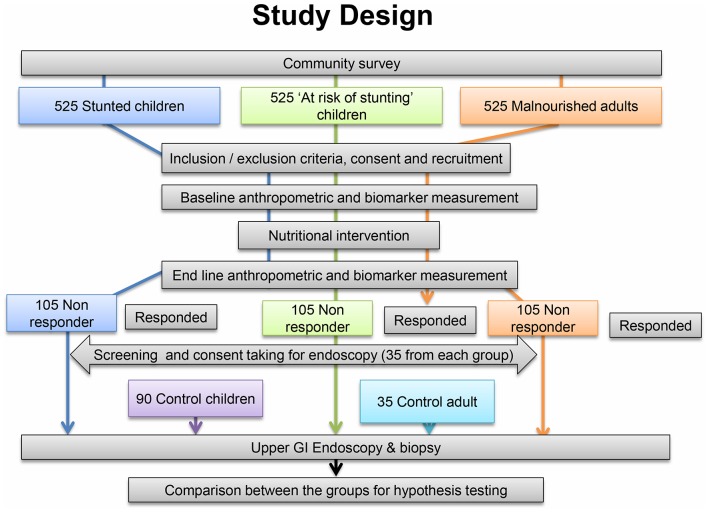
The BEED study is a community-based intervention where participants are recruited from three cohorts: stunted children aged 12-18 months (length for age Z-score (LAZ) <-2), at risk of stunting children aged 12-18 months (LAZ <-1 to -2) and malnourished adults aged 18-45 years (body mass index <18.5 kg/m). After screening, participants eligible for study provide faecal, urine and plasma specimens to quantify the levels of candidate EED biomarkers before and after receiving a nutritional intervention. Participants who fail to respond to nutritional therapy are considered as the candidates for upper gastrointestinal endoscopy with biopsy. Histopathological scoring for EED will be performed on biopsies obtained from several locations within the proximal small intestine. Candidate EED biomarkers will be correlated with nutritional status, the results of histochemical and immunohistochemical analyses of epithelial and lamina propria cell populations, plus assessments of microbial community structure.
Ethics approval was obtained in all participating institutes. Results of this study will be submitted for publication in peer-reviewed journals.
ClinicalTrials.gov ID: NCT02812615. Registered on 21 June 2016.
环境肠道功能障碍(EED)是一种小肠黏膜的亚急性炎症状态,病因不明,可能占所有发育迟缓病例的40%以上。目前,对于EED的诊断、治疗以及最终预防,尚无普遍接受的方案。孟加拉国环境肠道功能障碍(BEED)研究旨在通过小肠活检验证EED的非侵入性生物标志物,更好地了解疾病发病机制,并确定旨在控制EED和发育迟缓的干预措施的潜在治疗靶点。
BEED研究是一项基于社区的干预研究,参与者从三个队列中招募:12至18个月龄的发育迟缓儿童(年龄别身长Z评分(LAZ)<-2)、12至18个月龄有发育迟缓风险的儿童(LAZ<-1至-2)以及18至45岁的营养不良成年人(体重指数<18.5 kg/m²)。筛查后,符合研究条件的参与者提供粪便、尿液和血浆样本,以量化接受营养干预前后候选EED生物标志物的水平。对营养治疗无反应的参与者被视为上消化道内镜活检的候选对象。将对从小肠近端多个部位获取的活检组织进行EED的组织病理学评分。候选EED生物标志物将与营养状况、上皮和固有层细胞群体的组织化学和免疫组织化学分析结果以及微生物群落结构评估相关联。
所有参与机构均获得了伦理批准。本研究结果将提交至同行评审期刊发表。
ClinicalTrials.gov标识符:NCT02812615。于2016年6月21日注册。