Chemistry of Interaction Plasma Surface (ChIPS), University of Mons, 7000 Mons, Belgium.
University of Vienna, Faculty of Physics, Boltzmanngasse 5, A-1090, Vienna, Austria.
Sci Rep. 2017 Aug 11;7(1):7960. doi: 10.1038/s41598-017-08651-1.
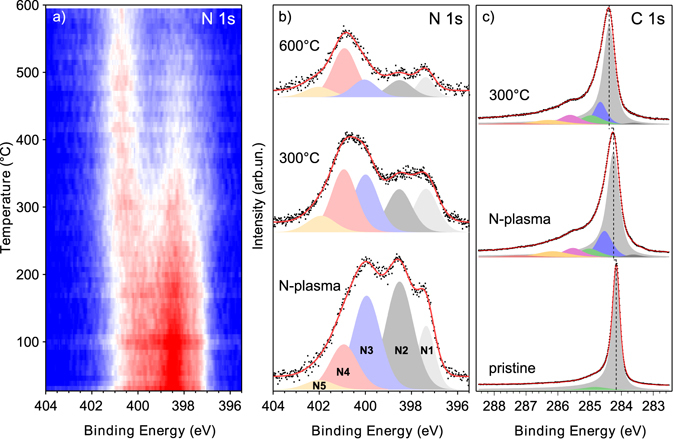
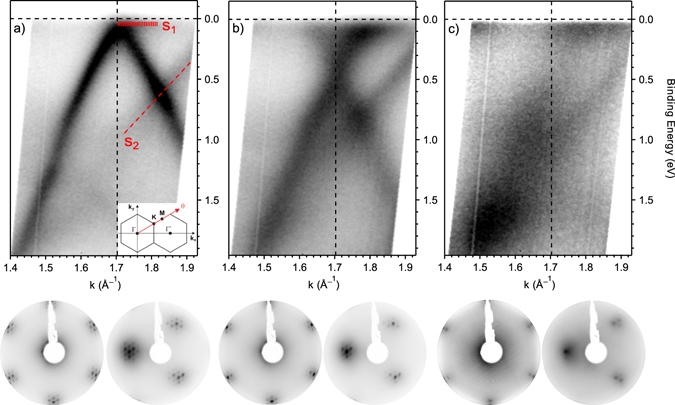
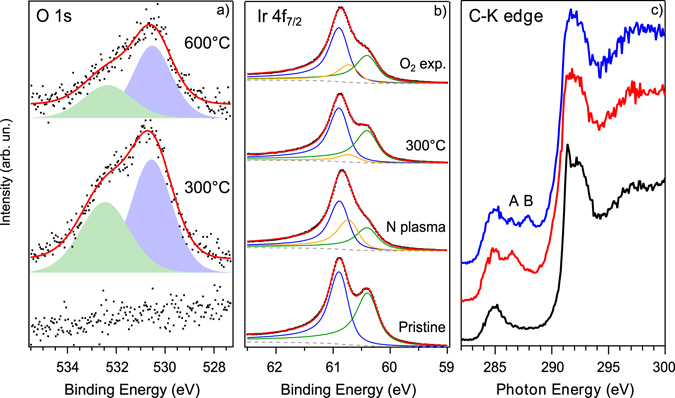
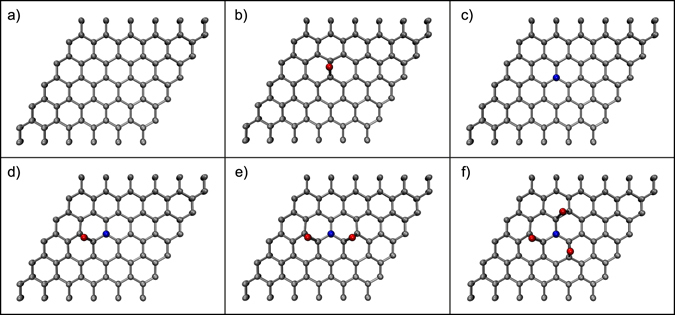
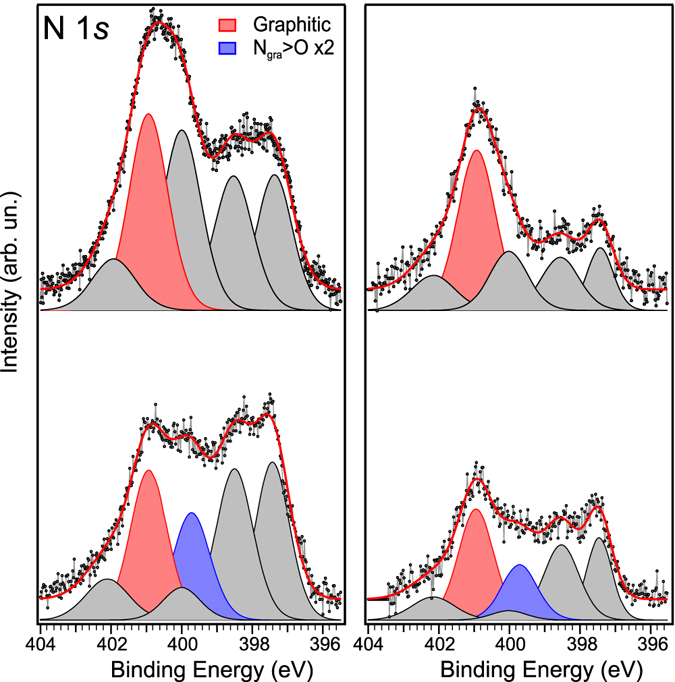
Carbon nanomaterials' reactivity towards oxygen is very poor, limiting their potential applications. However, nitrogen doping is an established way to introduce active sites that facilitate interaction with gases. This boosts the materials' reactivity for bio-/gas sensing and enhances their catalytic performance for the oxygen reduction reaction. Despite this interest, the role of differently bonded nitrogen dopants in the interaction with oxygen is obscured by experimental challenges and has so far resisted clear conclusions. We study the interaction of molecular oxygen with graphene doped via nitrogen plasma by in situ high-resolution synchrotron techniques, supported by density functional theory core level simulations. The interaction leads to oxygen dissociation and the formation of carbon-oxygen single bonds on graphene, along with a band gap opening and a rounding of the Dirac cone. The change of the N 1 s core level signal indicates that graphitic nitrogen is involved in the observed mechanism: the adsorbed oxygen molecule is dissociated and the two O atoms chemisorb with epoxy bonds to the nearest carbon neighbours of the graphitic nitrogen. Our findings help resolve existing controversies and offer compelling new evidence of the ORR pathway.
碳纳米材料对氧气的反应性很差,限制了它们的潜在应用。然而,氮掺杂是引入活性位点的一种成熟方法,可以促进与气体的相互作用。这提高了材料在生物/气体传感方面的反应性,并增强了它们在氧还原反应中的催化性能。尽管人们对此很感兴趣,但不同键合的氮掺杂剂在与氧气相互作用中的作用由于实验挑战而变得模糊不清,迄今为止,人们仍然无法得出明确的结论。我们通过原位高分辨率同步辐射技术研究了氮等离子体掺杂石墨烯与分子氧的相互作用,并结合密度泛函理论核心能级模拟进行了研究。相互作用导致氧的离解和石墨烯上碳氧单键的形成,同时带隙打开,狄拉克锥变圆。N 1s 芯能级信号的变化表明,石墨氮参与了观察到的机制:吸附的氧分子离解,两个 O 原子与最邻近的石墨氮的碳邻位以环氧键化学吸附。我们的发现有助于解决现有争议,并提供令人信服的新证据,证明了 ORR 途径。