Department of Medical Imaging, Ann & Robert H. Lurie Children's Hospital of Chicago, Chicago, Illinois, USA.
Department of Radiology, Feinberg School of Medicine, Northwestern University, Chicago, Illinois, USA.
J Magn Reson Imaging. 2018 Apr;47(4):936-947. doi: 10.1002/jmri.25836. Epub 2017 Aug 11.
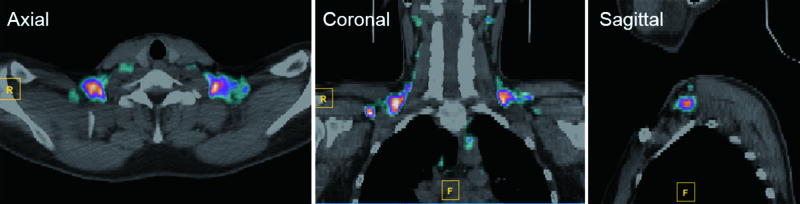
To implement quantitative Dixon magnetic resonance imaging (MRI) methods for brown adipose tissue (BAT) characterization at inactive and cold-activated states in normal weight, overweight, and obese subjects. The hypotheses are that MRI characteristics of BAT would differentiate between nonobese and obese subjects, and activation of BAT in response to thermal challenges that are detected by MRI would be correlated with BAT activity measured by positron emission tomography / computed tomography (PET/CT).
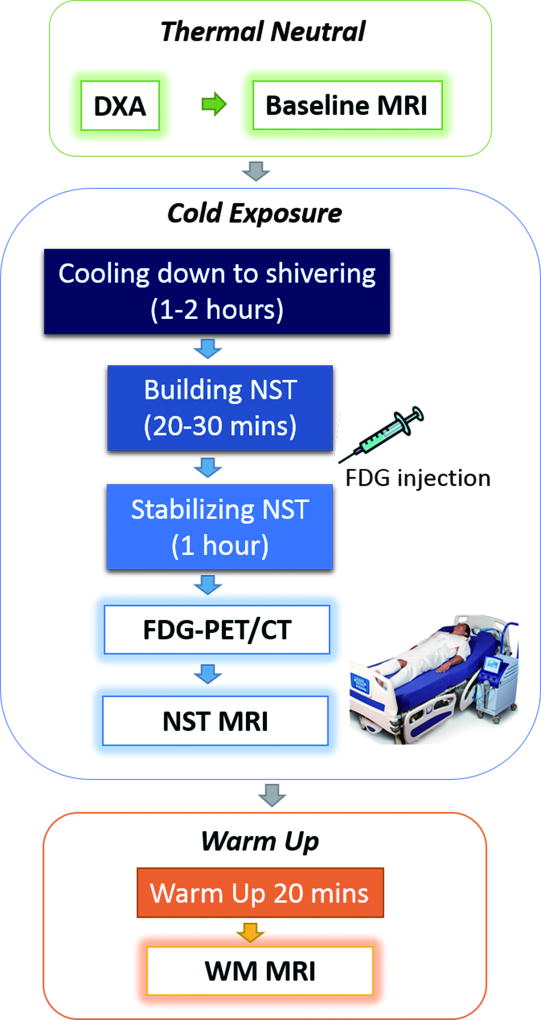
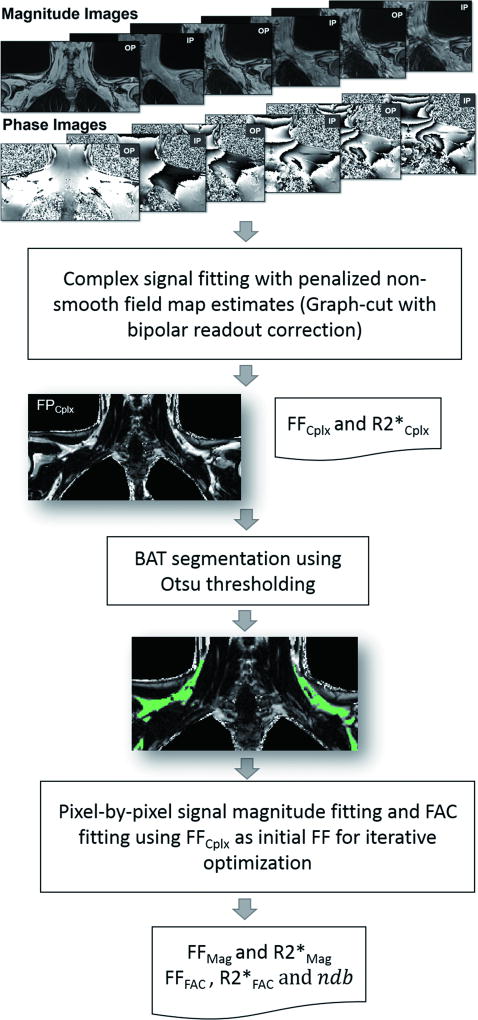
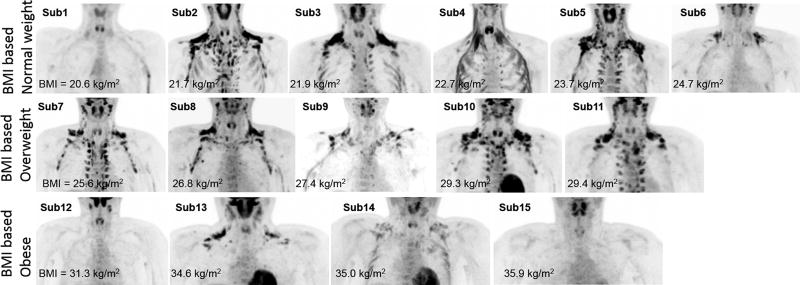
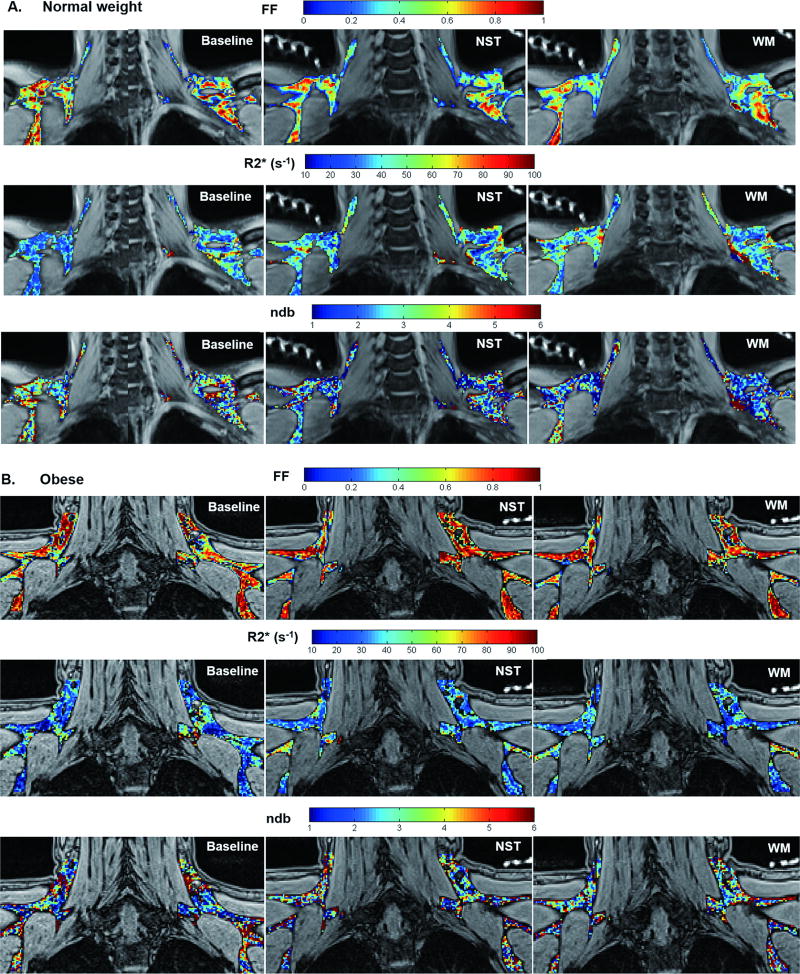
Fifteen male subjects (20.7 ± 1.5 years old) including six normal weight, five overweight, and four obese subjects participated in the study. A multiecho Dixon MRI sequence was performed on a 1.5T scanner. MRI was acquired under thermoneutral, nonshivering thermogenesis, and subsequent warm-up conditions. Fat fraction (FF), R2*, and the number of double bonds (ndb) were measured by solving an optimization problem that fits in- and out-of-phase MR signal intensities to the fat-water interference models. Imaging acquisition and postprocessing were performed by two MRI physicists. In each subject, Dixon MRI measurements of FF, R2*, and ndb were calculated for each voxel within all BAT regions of interest (ROIs) under each thermal condition. Mean FF, R2*, and ndb were compared between nonobese (ie, normal-weight/overweight) and obese subjects using the two-sample t-test. Receiver operating characteristic (ROC) analyses were performed to differentiate nonobese vs. obese subjects. BAT MRI measurement changes in response to thermal condition changes were compared with hypermetabolic BAT volume/activity measured by PET/CT using the Pearson's correlation. In addition, BAT MRI measurements were compared with body adiposity using the Pearson's correlation. P < 0.05 was considered statistically significant.
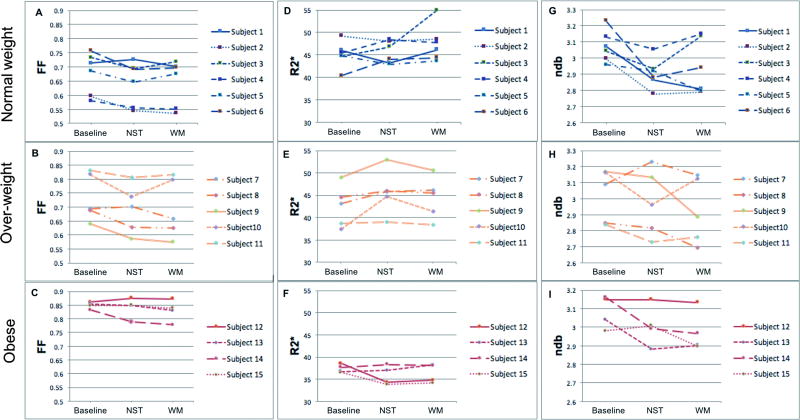
Obese subjects showed higher FF and lower R2* than nonobese subjects under all three thermal conditions (P < 0.01). ROC analyses demonstrated that FF and R2* were excellent predictors for the differentiation of nonobese from obese subjects (100% specificity and 100% sensitivity). FF changes under thermal challenges were correlated with hypermetabolic BAT volume (r = -0.55, P = 0.04 during activation, and r = 0.72, P = 0.003 during deactivation), and with BAT activity (r = 0.69, P = 0.006 during deactivation), as measured by PET/CT. FF and R2* under all three thermal conditions were highly correlated with body adiposity (P ≤ 0.002).
MRI characteristics of BAT differentiated between nonobese and obese subjects in both inactivated and activated states. BAT activation detected by Dixon MRI in response to thermal challenges were correlated with glucose uptake of metabolically active BAT.
1 Technical Efficacy: Stage 3 J. Magn. Reson. Imaging 2018;47:936-947.
在正常体重、超重和肥胖受试者的静息和冷激活状态下,实现用于棕色脂肪组织 (BAT) 特征描述的定量 Dixon 磁共振成像 (MRI) 方法。假设 MRI 特征可以区分非肥胖和肥胖受试者,并且通过 MRI 检测到的对热挑战的 BAT 激活将与通过正电子发射断层扫描/计算机断层扫描 (PET/CT) 测量的 BAT 活性相关。
15 名男性受试者(20.7±1.5 岁),包括 6 名正常体重者、5 名超重者和 4 名肥胖者,参加了这项研究。在 1.5T 扫描仪上进行多回波 Dixon MRI 序列。MRI 在体温中性、非颤抖产热和随后的热身条件下采集。通过解决拟合同相位和反相位 MR 信号强度与脂肪-水干扰模型的优化问题,测量脂肪分数 (FF)、R2和双键数 (ndb)。每个受试者的所有 BAT 感兴趣区域 (ROI) 内的每个体素的 Dixon MRI 测量值均在每个热条件下进行计算。使用两样本 t 检验比较非肥胖(即正常体重/超重)和肥胖受试者之间的 FF、R2和 ndb 的平均值。使用接收器工作特性 (ROC) 分析来区分非肥胖与肥胖受试者。使用 Pearson 相关比较 BAT MRI 测量值在热条件变化下的变化与 PET/CT 测量的高代谢 BAT 体积/活性。此外,使用 Pearson 相关比较 BAT MRI 测量值与身体脂肪含量。P<0.05 被认为具有统计学意义。
在所有三种热条件下,肥胖受试者的 FF 均高于非肥胖受试者,而 R2则低于非肥胖受试者(P<0.01)。ROC 分析表明,FF 和 R2是区分非肥胖和肥胖受试者的优秀预测指标(100%特异性和 100%敏感性)。在热挑战下,FF 变化与高代谢 BAT 体积(激活时 r=−0.55,P=0.04,失活时 r=0.72,P=0.003)和 BAT 活性(失活时 r=0.69,P=0.006)相关,通过 PET/CT 测量。在所有三种热条件下,FF 和 R2*与身体脂肪含量高度相关(P≤0.002)。
在静息和激活状态下,BAT 的 MRI 特征可以区分非肥胖和肥胖受试者。对热挑战的 Dixon MRI 检测到的 BAT 激活与代谢活跃的 BAT 的葡萄糖摄取相关。
1 技术功效:第 3 阶段 J. Magn. Reson. Imaging 2018;47:936-947.