Department of Surgery, Davis Heart and Lung Research Institute, Center for Regenerative Medicine & Cell-Based Therapies, Wexner Medical Center, The Ohio State University, Columbus, OH 43210, USA; Department of Dermatology and Venereology, Zagazig University, 44519 Zagazig, Egypt.
Department of Surgery, Davis Heart and Lung Research Institute, Center for Regenerative Medicine & Cell-Based Therapies, Wexner Medical Center, The Ohio State University, Columbus, OH 43210, USA.
Mol Ther. 2017 Nov 1;25(11):2502-2512. doi: 10.1016/j.ymthe.2017.07.010. Epub 2017 Jul 20.
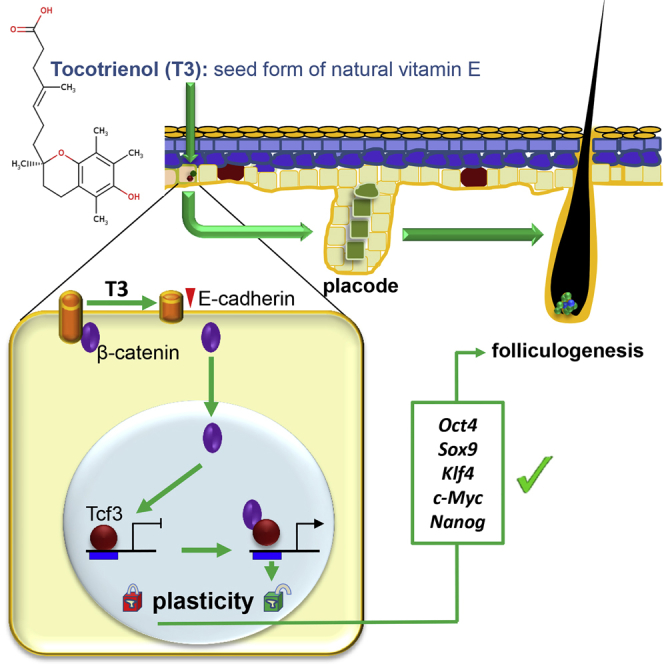
Unlike the epidermis, which regenerates continually, hair follicles anchored in the subcutis periodically regenerate by spontaneous repetitive cycles of growth (anagen), degeneration (catagen), and rest (telogen). The loss of hair follicles in response to injuries or pathologies such as alopecia endangers certain inherent functions of the skin. Thus, it is of interest to understand mechanisms underlying follicular regeneration in adults. In this work, a phytochemical rich in the natural vitamin E tocotrienol (TRF) served as a productive tool to unveil a novel epidermal pathway of hair follicular regeneration. Topical TRF application markedly induced epidermal hair follicle development akin to that during fetal skin development. This was observed in the skin of healthy as well as diabetic mice, which are known to be resistant to anagen hair cycling. TRF suppressed epidermal E-cadherin followed by 4-fold induction of β-catenin and its nuclear translocation. Nuclear β-catenin interacted with Tcf3. Such sequestration of Tcf3 from its otherwise known function to repress pluripotent factors induced the plasticity factors Oct4, Sox9, Klf4, c-Myc, and Nanog. Pharmacological inhibition of β-catenin arrested anagen hair cycling by TRF. This work reports epidermal E-cadherin/β-catenin as a novel pathway capable of inducing developmental folliculogenesis in the adult skin.
与不断再生的表皮不同,锚定在真皮中的毛囊通过自发的生长(生长期)、退化(退行期)和静止(休止期)的周期性重复循环周期性地再生。毛囊对损伤或疾病(如脱发)的反应丧失会危及皮肤的某些固有功能。因此,了解成人毛囊再生的机制是很有意义的。在这项工作中,一种富含天然维生素 E 生育三烯酚(TRF)的植物化学物质被用作揭示毛囊再生新表皮途径的有效工具。局部应用 TRF 可显著诱导表皮毛囊发育,类似于胎儿皮肤发育过程中的情况。这在健康和糖尿病小鼠的皮肤中都观察到了,众所周知,这些小鼠对生长期毛发循环有抗性。TRF 抑制表皮 E-钙粘蛋白,随后β-连环蛋白及其核转位被诱导 4 倍。核β-连环蛋白与 Tcf3 相互作用。这种将 Tcf3 从其抑制多能因子的已知功能中隔离出来,诱导了多能性因子 Oct4、Sox9、Klf4、c-Myc 和 Nanog 的可塑性因子。β-连环蛋白的药理学抑制通过 TRF 阻止了生长期毛发循环。这项工作报告了表皮 E-钙粘蛋白/β-连环蛋白作为一种新的途径,能够在成人皮肤中诱导发育性毛囊发生。