Department of Infectious Disease Epidemiology, Faculty of Epidemiology and Population Health, London School of Hygiene & Tropical Medicine, Keppel Street, London, WC1E 7HT, England.
School of Paediatrics and Child Health, University of Western Australia, Crawley, Australia.
Bull World Health Organ. 2017 Aug 1;95(8):574-583. doi: 10.2471/BLT.16.180273. Epub 2017 May 26.
To investigate the effect of birth weight on infant mortality, illness and care seeking in rural Ghana.
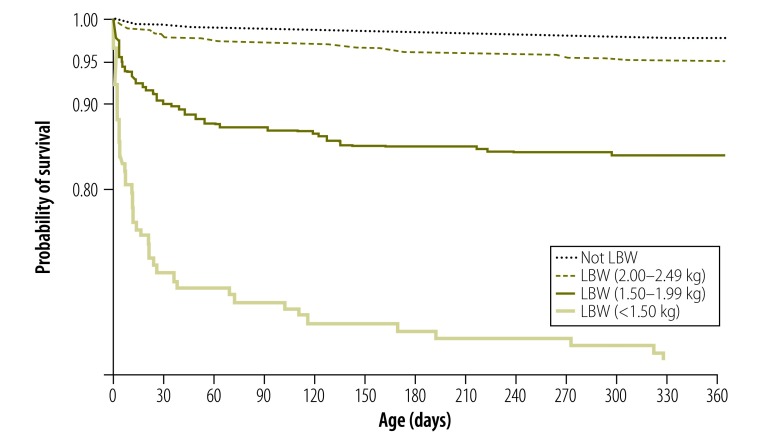
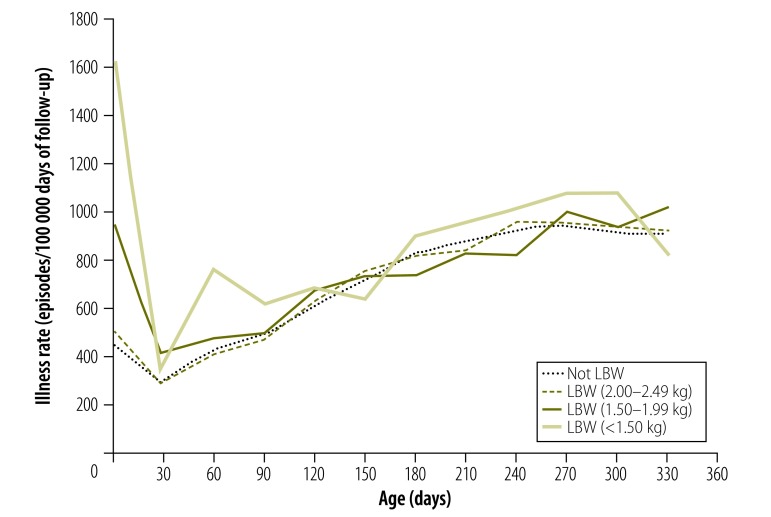
Using randomized controlled trial data, we compared infants weighing 2.00-2.49, 1.50-1.99 and < 1.50 kg with non-low-birth-weight infants. We generated adjusted mortality hazard ratios (aHR), adjusted illness rate ratios (aRR) and adjusted odds ratios (aOR) for health-facility admissions and absence of care seeking for four time periods: infancy, the neonatal period, early infancy and late infancy - represented by ages of 0-364, 0-27, 28-182 and 183-364 days, respectively.
Among 22 906 infants, compared with non-low-birth-weight infants: (i) infants weighing 2.00-2.49, 1.50-1.99 and < 1.50 kg were about two (aHR: 2.13; 95% confidence interval, CI: 1.76-2.59), eight (aHR: 8.21; 95% CI: 6.26-10.76) and 25 (aHR: 25.38; 95% CI: 18.36-35.10) times more likely to die in infancy, respectively; (ii) those born weighing < 1.50 kg were about 48 (aHR: 48.45; 95% CI: 32.81-71.55) and eight (aHR: 8.42; 95% CI: 3.09-22.92) times more likely to die in the neonatal period and late infancy, respectively; (iii) those born weighing 1.50-1.99 kg (aRR: 1.57; 95% CI: 1.27-1.95) or < 1.50 kg (aRR: 1.58; 95% CI: 1.13-2.21) had higher neonatal illness rates; and (iv) for those born weighing 1.50-1.99 kg, care was less likely to be sought in the neonatal period (aOR: 3.30; 95% CI: 1.98-5.48) and early infancy (aOR : 1.74; 95% CI: 1.26-2.39).
For low-birth-weight infants in Ghana, strategies to minimize mortality and improve care seeking are needed.
探讨出生体重对加纳农村婴儿死亡率、疾病和就医寻求的影响。
我们使用随机对照试验数据,将体重为 2.00-2.49kg、1.50-1.99kg 和 <1.50kg 的婴儿与非低出生体重婴儿进行比较。我们生成了校正后的死亡率风险比(aHR)、校正后的疾病发生率比(aRR)和校正后的就诊率比值(aOR),用于四个时期的健康机构入院和就医寻求的缺失:婴儿期、新生儿期、早期婴儿期和晚期婴儿期 - 分别代表 0-364 天、0-27 天、28-182 天和 183-364 天的年龄。
在 22906 名婴儿中,与非低出生体重婴儿相比:(i)体重为 2.00-2.49kg、1.50-1.99kg 和 <1.50kg 的婴儿在婴儿期死亡的风险分别高约两倍(aHR:2.13;95%置信区间,CI:1.76-2.59)、八倍(aHR:8.21;95%CI:6.26-10.76)和二十五倍(aHR:25.38;95%CI:18.36-35.10);(ii)出生体重 <1.50kg 的婴儿在新生儿期和晚期婴儿期死亡的风险分别高约四十八倍(aHR:48.45;95%CI:32.81-71.55)和八倍(aHR:8.42;95%CI:3.09-22.92);(iii)体重为 1.50-1.99kg 的婴儿(aRR:1.57;95%CI:1.27-1.95)或 <1.50kg 的婴儿(aRR:1.58;95%CI:1.13-2.21)新生儿期疾病发生率较高;(iv)对于体重为 1.50-1.99kg 的婴儿,在新生儿期(aOR:3.30;95%CI:1.98-5.48)和早期婴儿期(aOR:1.74;95%CI:1.26-2.39),不太可能寻求治疗。
对于加纳的低出生体重婴儿,需要采取策略来最大限度地降低死亡率并改善治疗寻求。