• 文献检索
  • 文档翻译
  • 深度研究
  • 学术资讯
  • Suppr Zotero 插件Zotero 插件
  • 邀请有礼
  • 套餐&价格
  • 历史记录
应用&插件
Suppr Zotero 插件Zotero 插件浏览器插件Mac 客户端Windows 客户端微信小程序
定价
高级版会员购买积分包购买API积分包
服务
文献检索文档翻译深度研究API 文档MCP 服务
关于我们
关于 Suppr公司介绍联系我们用户协议隐私条款
关注我们

Suppr 超能文献

核心技术专利:CN118964589B侵权必究
粤ICP备2023148730 号-1Suppr @ 2026

文献检索

告别复杂PubMed语法,用中文像聊天一样搜索,搜遍4000万医学文献。AI智能推荐,让科研检索更轻松。

立即免费搜索

文件翻译

保留排版,准确专业,支持PDF/Word/PPT等文件格式,支持 12+语言互译。

免费翻译文档

深度研究

AI帮你快速写综述,25分钟生成高质量综述,智能提取关键信息,辅助科研写作。

立即免费体验

刚果儿童在随访 4 年内的科佐认知和运动表现:纵向分析。

Cognitive and motor performance in Congolese children with konzo during 4 years of follow-up: a longitudinal analysis.

机构信息

Department of Psychiatry and Neurology & Ophthalmology, Michigan State University, East Lansing, MI, USA.

Centre NeuroPsychopathologique (CNPP), University of Kinshasa, Kinshasa, Congo.

出版信息

Lancet Glob Health. 2017 Sep;5(9):e936-e947. doi: 10.1016/S2214-109X(17)30267-X.

DOI:10.1016/S2214-109X(17)30267-X
PMID:28807191
原文链接:https://pmc.ncbi.nlm.nih.gov/articles/PMC5594926/
Abstract

BACKGROUND

Konzo is an irreversible upper-motor neuron disorder affecting children dependent on bitter cassava for food. The neurocognitive ability of children with konzo over time has yet to be fully documented.

METHODS

We did a longitudinal study in a konzo outbreak zone continuously affected by konzo since 1990, in the district of Kahemba, southern Bandundu Province, Congo. We enrolled children with a record of neurological diagnosis of konzo in Kahemba town. For all study children with konzo enrolled in the final sample for the baseline assessment, a neurological exam was done by neurologists to confirm konzo diagnosis using the 1996 WHO criteria at 2 years and 4 years. In the initial baseline sample for each child with konzo, we attempted to get consent from a comparison child without konzo (1996 WHO criteria) within 2 years of age, from a neighbouring household who met inclusion criteria. The neuropsychological assessments were the Kaufman Assessment Battery for Children, second edition (KABC-II), and the Bruininks-Oseretsky Test of Motor Proficiency, second edition (BOT-2).

FINDINGS

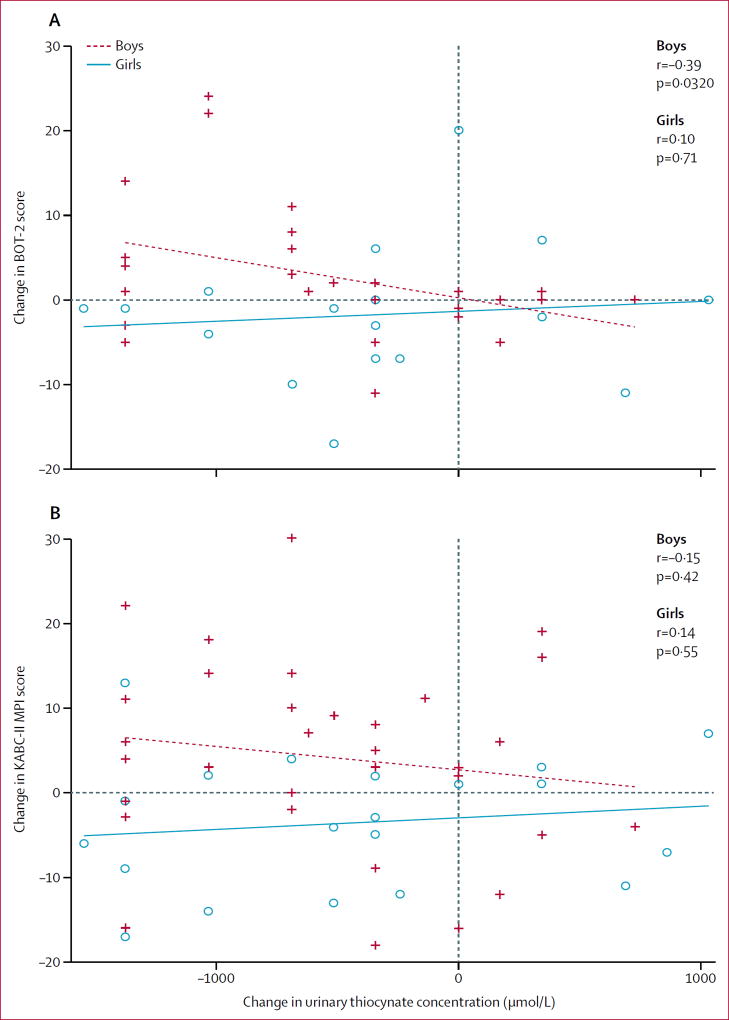
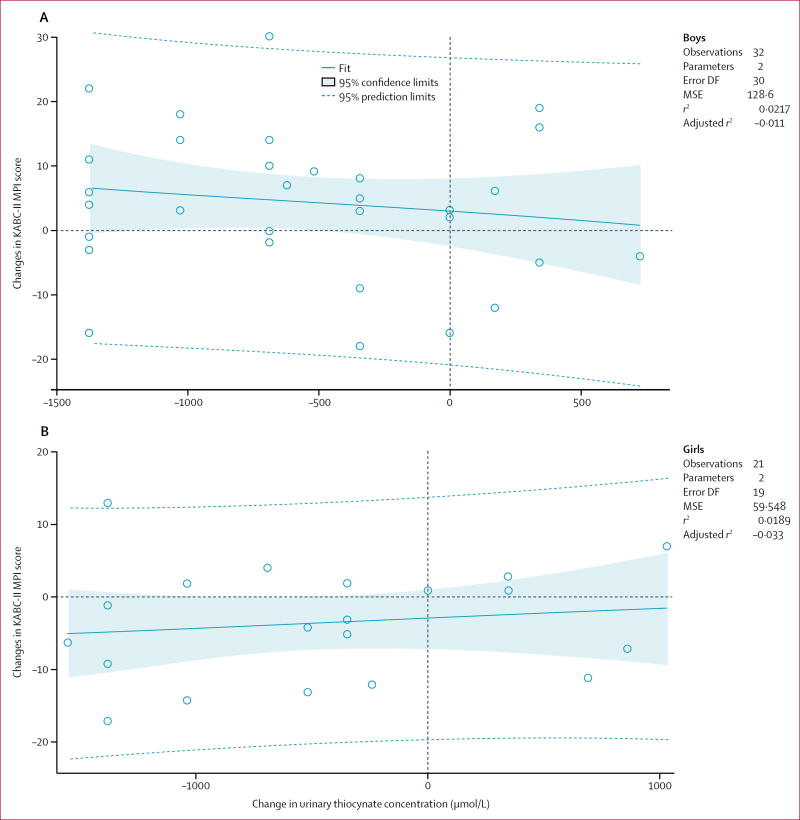
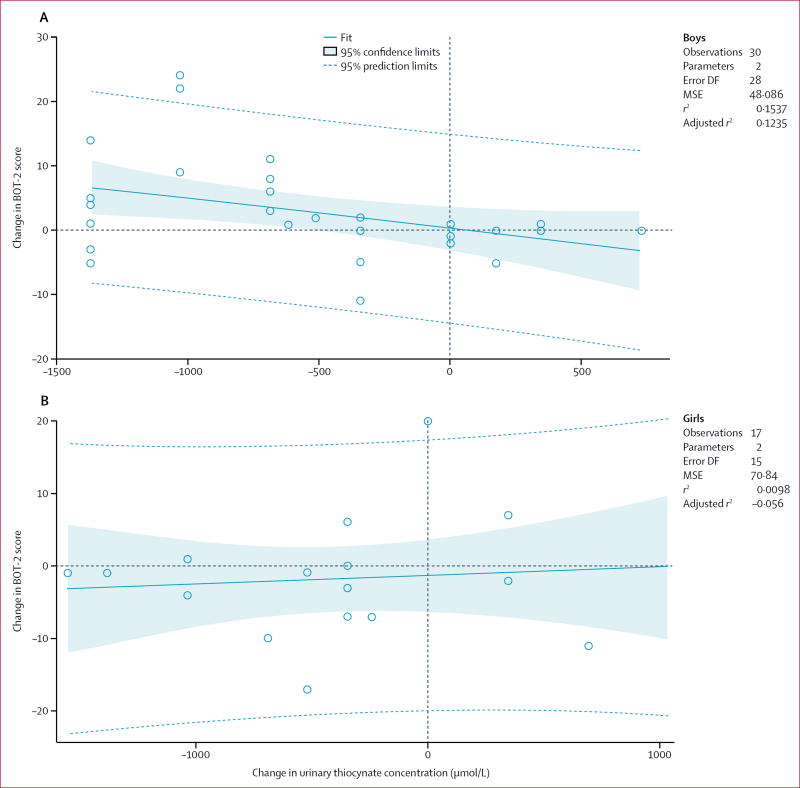
Data collection occurred between Oct 12, 2011, and Aug 14, 2015, in the town of Kahemba. 123 children from the Congo with konzo and 87 presumably healthy children without konzo from neighbouring households were enrolled. The planned assessments were completed by 76 children with konzo and 82 children without konzo at 2-year follow-up, and by 55 children with konzo and 33 children without konzo at 4-year follow-up. Boys with konzo did worse than those without konzo on the KABC-II Learning (p=0·0424) and on the Mental Processing Index (MPI; p=0·0111) assessments at 2-year follow-up, but girls did not. These differences observed in boys might have been caused by stunting. At 4-year follow-up, the difference in KABC-II MPI score between boys or girls with or without konzo was not significant. Both boys and girls with konzo had lower scores on BOT-2 than children without konzo at both follow-up times (p<0·0001). These differences were not attenuated when controlling for physical growth. Boys with and without konzo declined on BOT-2 fine motor proficiency at 2-year follow-up (boys with konzo p=0·0076; boys without konzo p=0·0224) and KABC-II MPI performance at 2-year follow-up and 4-year follow-up (2 years: boys with konzo p<0·0001, boys without konzo p=0·0213; 4 years: boys with konzo p=0·0256, boys without konzo p=0·10), but that was not the case for the girls with scores remaining stable regardless of konzo status. For boys, increases in urinary thiocyanate concentration was significantly associated with reductions in BOT-2 motor proficiency (p=0·0321), but was not significantly associated in girls and urinary thiocyanate concentration was not associated with KABC-II MPI score for either boys or girls.

INTERPRETATION

Motor and cognitive performance continues to be significantly impaired in boys with konzo at 2-year follow-up compared with boys without konzo. Because these impairments are associated in part with exposure to poorly processed cassava as measured by urinary thiocyanate, interventions are urgently needed to ensure improved processing of cassava to detoxify this food source.

FUNDING

US National Institutes of Health.

摘要

背景

科酮病是一种不可逆的上运动神经元疾病,影响依赖苦木薯作为食物的儿童。患有科酮病的儿童的神经认知能力尚未得到充分记录。

方法

我们在刚果南部班顿杜省卡亨巴区进行了一项纵向研究,该地区自 1990 年以来一直持续受到科酮病的影响。我们招募了在卡亨巴镇有科酮病神经学诊断记录的儿童。对于最终纳入基线评估的所有患有科酮病的研究儿童,神经病学家通过使用 1996 年世卫组织标准进行神经检查,在 2 岁和 4 岁时确认科酮病诊断。在每个患有科酮病的儿童的初始基线样本中,我们试图从年龄在 2 岁以内的、来自符合纳入标准的相邻家庭的无科酮病(1996 年世卫组织标准)的对照儿童那里获得同意。神经心理评估是 Kaufman 儿童评估量表,第二版(KABC-II)和 Bruininks-Oseretsky 运动技能测试,第二版(BOT-2)。

发现

数据收集于 2011 年 10 月 12 日至 2015 年 8 月 14 日在卡亨巴镇进行。来自刚果的 123 名患有科酮病的儿童和来自相邻家庭的 87 名可能没有患有科酮病的健康儿童被纳入研究。计划评估在 2 岁随访时完成了 76 名患有科酮病的儿童和 82 名无科酮病的儿童,在 4 岁随访时完成了 55 名患有科酮病的儿童和 33 名无科酮病的儿童。患有科酮病的男孩在 KABC-II 学习(p=0·0424)和精神处理指数(MPI;p=0·0111)评估方面的表现比没有科酮病的男孩差,而女孩则没有。这些在男孩中观察到的差异可能是由发育迟缓引起的。在 4 岁随访时,患有或不患有科酮病的男孩和女孩之间的 KABC-II MPI 评分差异不显著。与没有科酮病的儿童相比,患有科酮病的男孩和女孩在两次随访时 BOT-2 精细运动技能(p<0·0001)和 KABC-II MPI 表现(2 岁:患有科酮病的男孩 p<0·0001,没有科酮病的男孩 p=0·0213;4 岁:患有科酮病的男孩 p=0·0256,没有科酮病的男孩 p=0·10)的得分较低。这些差异在男孩中并没有随着时间的推移而减弱,而女孩的分数则保持稳定,无论科酮病的状况如何。对于男孩,尿硫氰酸盐浓度的增加与 BOT-2 运动能力的降低显著相关(p=0·0321),但在女孩中并不显著相关,尿硫氰酸盐浓度与男孩或女孩的 KABC-II MPI 评分均无相关性。

解释

与没有科酮病的男孩相比,患有科酮病的男孩在 2 岁随访时的运动和认知表现仍显著受损。由于这些损伤部分与尿液中硫氰酸盐测量的食用未加工木薯有关,因此迫切需要采取干预措施,以确保木薯加工得到改善,以去除这种食物来源的毒素。

资助

美国国立卫生研究院。

https://cdn.ncbi.nlm.nih.gov/pmc/blobs/cfe3/5594926/c5ffb45c10f1/nihms902099f3.jpg
https://cdn.ncbi.nlm.nih.gov/pmc/blobs/cfe3/5594926/06fe18e3d037/nihms902099f1.jpg
https://cdn.ncbi.nlm.nih.gov/pmc/blobs/cfe3/5594926/5979c31c1666/nihms902099f2.jpg
https://cdn.ncbi.nlm.nih.gov/pmc/blobs/cfe3/5594926/c5ffb45c10f1/nihms902099f3.jpg
https://cdn.ncbi.nlm.nih.gov/pmc/blobs/cfe3/5594926/06fe18e3d037/nihms902099f1.jpg
https://cdn.ncbi.nlm.nih.gov/pmc/blobs/cfe3/5594926/5979c31c1666/nihms902099f2.jpg
https://cdn.ncbi.nlm.nih.gov/pmc/blobs/cfe3/5594926/c5ffb45c10f1/nihms902099f3.jpg

相似文献

1
Cognitive and motor performance in Congolese children with konzo during 4 years of follow-up: a longitudinal analysis.刚果儿童在随访 4 年内的科佐认知和运动表现:纵向分析。
Lancet Glob Health. 2017 Sep;5(9):e936-e947. doi: 10.1016/S2214-109X(17)30267-X.
2
Neuropsychological effects of konzo: a neuromotor disease associated with poorly processed cassava.科佐的神经心理学影响:一种与未充分加工的木薯相关的运动神经元疾病。
Pediatrics. 2013 Apr;131(4):e1231-9. doi: 10.1542/peds.2012-3011. Epub 2013 Mar 25.
3
Lower serum levels of selenium, copper, and zinc are related to neuromotor impairments in children with konzo.低血清硒、铜和锌水平与患有konzo的儿童的神经运动障碍有关。
J Neurol Sci. 2015 Feb 15;349(1-2):149-53. doi: 10.1016/j.jns.2015.01.007. Epub 2015 Jan 10.
4
Serum 8,12-iso-iPF2α-VI isoprostane marker of oxidative damage and cognition deficits in children with konzo.血清8,12-异前列腺素F2α-VI异前列腺素是konzo患儿氧化损伤和认知缺陷的标志物。
PLoS One. 2014 Sep 15;9(9):e107191. doi: 10.1371/journal.pone.0107191. eCollection 2014.
5
Determinants of cognitive performance in children relying on cyanogenic cassava as staple food.以含氰木薯为主食的儿童认知能力的决定因素。
Metab Brain Dis. 2014 Jun;29(2):359-66. doi: 10.1007/s11011-014-9492-9. Epub 2014 Feb 1.
6
[Socioemotional disorders in children living in Konzo-affected areas, an epidemic paralytic disease associated with cyanide poisoning from food in sub-Saharan Africa].[生活在受Konzo影响地区的儿童的社会情感障碍,一种与撒哈拉以南非洲食物中的氰化物中毒相关的流行性麻痹疾病]
Pan Afr Med J. 2018 Oct 17;31:118. doi: 10.11604/pamj.2018.31.118.11640. eCollection 2018.
7
Lower sulfurtransferase detoxification rates of cyanide in konzo-A tropical spastic paralysis linked to cassava cyanogenic poisoning.在与木薯含氰化物中毒相关的konzo(一种热带痉挛性麻痹)中,氰化物的硫转移酶解毒率较低。
Neurotoxicology. 2017 Mar;59:256-262. doi: 10.1016/j.neuro.2016.05.016. Epub 2016 May 28.
8
Geographical and seasonal association between linamarin and cyanide exposure from cassava and the upper motor neurone disease konzo in former Zaire.在原扎伊尔,木薯中含有的亚麻苦苷及氰化物暴露与上运动神经元疾病——konzo之间的地理和季节关联。
Trop Med Int Health. 1997 Dec;2(12):1143-51. doi: 10.1046/j.1365-3156.1997.d01-215.x.
9
Appearance of konzo in South-Kivu, a wartorn area in the Democratic Republic of Congo.南基伍省出现科佐病,该省位于刚果民主共和国饱受战争蹂躏的地区。
Food Chem Toxicol. 2011 Mar;49(3):644-9. doi: 10.1016/j.fct.2010.07.050. Epub 2010 Aug 4.
10
Neurocognitive and motor deficits in HIV-infected Ugandan children with high CD4 cell counts.高 CD4 细胞计数的感染 HIV 的乌干达儿童的神经认知和运动缺陷。
Clin Infect Dis. 2012 Apr;54(7):1001-9. doi: 10.1093/cid/cir1037. Epub 2012 Feb 4.

引用本文的文献

1
Children's cognitive impairment associated with cassava cyanide in Democratic Republic of the Congo: Burden of disease.刚果民主共和国儿童因木薯氰化物导致的认知障碍:疾病负担
PLOS Glob Public Health. 2024 Jan 16;4(1):e0002761. doi: 10.1371/journal.pgph.0002761. eCollection 2024.
2
DNA methylation patterns associated with konzo in Sub-Saharan Africa.与撒哈拉以南非洲科恩氏病相关的 DNA 甲基化模式。
Clin Epigenetics. 2022 Dec 19;14(1):179. doi: 10.1186/s13148-022-01372-x.
3
Prevalence, profile and associations of cognitive impairment in Ugandan first-episode psychosis patients.

本文引用的文献

1
Cyanide and the human brain: perspectives from a model of food (cassava) poisoning.氰化物与人类大脑:来自食物(木薯)中毒模型的观点
Ann N Y Acad Sci. 2016 Aug;1378(1):50-57. doi: 10.1111/nyas.13159. Epub 2016 Jul 23.
2
Lower serum levels of selenium, copper, and zinc are related to neuromotor impairments in children with konzo.低血清硒、铜和锌水平与患有konzo的儿童的神经运动障碍有关。
J Neurol Sci. 2015 Feb 15;349(1-2):149-53. doi: 10.1016/j.jns.2015.01.007. Epub 2015 Jan 10.
3
Determinants of cognitive performance in children relying on cyanogenic cassava as staple food.
乌干达首发精神病患者认知障碍的患病率、特征及相关性
Schizophr Res Cogn. 2021 Dec 30;28:100234. doi: 10.1016/j.scog.2021.100234. eCollection 2022 Jun.
4
[Formula: see text]Neurodevelopmental assessment at one year of age predicts neuropsychological performance at six years in a cohort of West African Children.[公式:见正文]在西非儿童队列中,一岁时的神经发育评估可预测六岁时的神经心理学表现。
Child Neuropsychol. 2021 May;27(4):548-571. doi: 10.1080/09297049.2021.1876012. Epub 2021 Feb 1.
5
Motor control and cognition deficits associated with protein carbamoylation in food (cassava) cyanogenic poisoning: Neurodegeneration and genomic perspectives.食物(木薯)含氰化物中毒中与蛋白质氨甲酰化相关的运动控制和认知缺陷:神经退行性变和基因组学视角
Food Chem Toxicol. 2021 Feb;148:111917. doi: 10.1016/j.fct.2020.111917. Epub 2020 Dec 6.
6
Preclinical and clinical research on the toxic and neurological effects of cassava (Manihot esculenta Crantz) consumption.木薯(Manihot esculenta Crantz)食用的毒理学和神经学效应的临床前和临床研究。
Metab Brain Dis. 2020 Jan;35(1):65-74. doi: 10.1007/s11011-019-00522-0. Epub 2019 Dec 4.
7
Regional Sub-Saharan Africa Total Diet Study in Benin, Cameroon, Mali and Nigeria Reveals the Presence of 164 Mycotoxins and Other Secondary Metabolites in Foods.贝宁、喀麦隆、马里和尼日利亚的撒哈拉以南非洲区域全饮食研究揭示了食品中存在 164 种霉菌毒素和其他次生代谢物。
Toxins (Basel). 2019 Jan 17;11(1):54. doi: 10.3390/toxins11010054.
8
Konzo: a distinct neurological disease associated with food (cassava) cyanogenic poisoning.科酮病:一种与食物(木薯)氰苷中毒相关的独特的神经疾病。
Brain Res Bull. 2019 Feb;145:87-91. doi: 10.1016/j.brainresbull.2018.07.001. Epub 2018 Jul 5.
9
Cassava, konzo, and neurotoxicity.木薯、痉挛性截瘫与神经毒性。
Lancet Glob Health. 2017 Sep;5(9):e853-e854. doi: 10.1016/S2214-109X(17)30306-6.
以含氰木薯为主食的儿童认知能力的决定因素。
Metab Brain Dis. 2014 Jun;29(2):359-66. doi: 10.1007/s11011-014-9492-9. Epub 2014 Feb 1.
4
Neuropsychological effects of konzo: a neuromotor disease associated with poorly processed cassava.科佐的神经心理学影响:一种与未充分加工的木薯相关的运动神经元疾病。
Pediatrics. 2013 Apr;131(4):e1231-9. doi: 10.1542/peds.2012-3011. Epub 2013 Mar 25.
5
Cassava food toxins, konzo disease, and neurodegeneration in sub-Sahara Africans.木薯食品毒素、科酮病与撒哈拉以南非洲人的神经退行性变。
Neurology. 2013 Mar 5;80(10):949-51. doi: 10.1212/WNL.0b013e3182840b81.
6
Household food access and child malnutrition: results from the eight-country MAL-ED study.家庭食物获取与儿童营养不良:来自八国 MAL-ED 研究的结果。
Popul Health Metr. 2012 Dec 13;10(1):24. doi: 10.1186/1478-7954-10-24.
7
Control of konzo in DRC using the wetting method on cassava flour.使用湿磨法在木薯粉上控制刚果(金)的科恩佐病。
Food Chem Toxicol. 2012 May;50(5):1517-23. doi: 10.1016/j.fct.2012.02.001. Epub 2012 Feb 10.
8
Uptake of wetting method in Africa to reduce cyanide poisoning and konzo from cassava.在非洲采用湿法以减少木薯导致的氰化物中毒和脚气病。
Food Chem Toxicol. 2011 Mar;49(3):539-42. doi: 10.1016/j.fct.2010.04.049. Epub 2010 May 25.
9
Chapter 18 Toxic disorders of the upper motor neuron system.第18章 上运动神经元系统的中毒性疾病
Handb Clin Neurol. 2007;82:353-72. doi: 10.1016/S0072-9752(07)80021-2.
10
Konzo outbreak, in the south-west of the Democratic Republic of Congo, 1996.1996年,在刚果民主共和国西南部发生了痉挛性截瘫疫情。
J Trop Pediatr. 2002 Aug;48(4):234-8. doi: 10.1093/tropej/48.4.234.