Yan Ling, Ding Shuang, Gu Bing, Ma Ping
Medical Technology Institute of Xuzhou Medical College, Xuzhou, Jiangsu 221004, China.
Department of Laboratory Medicine, the Affiliated Hospital of Xuzhou Medical College, Xuzhou, Jiangsu 221002, China.
J Biomed Res. 2017 Jul 13;31(4):315-320. doi: 10.7555/JBR.31.20150152.
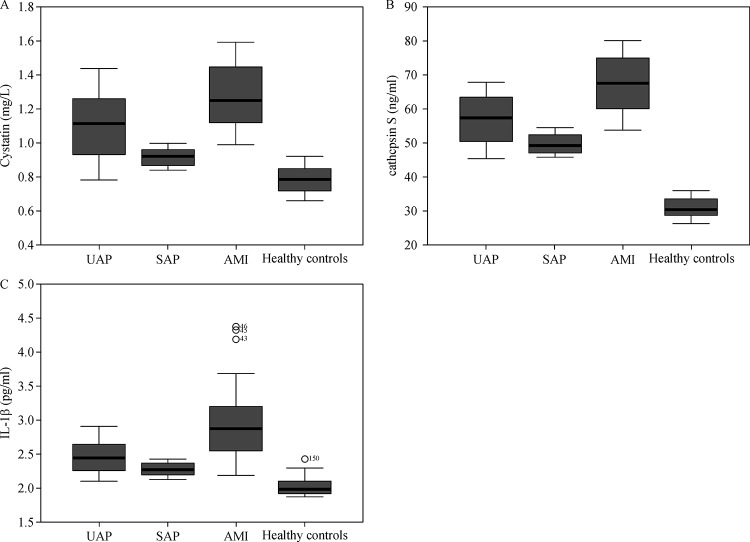
Cystatin C, cathepsin S, and IL-1 are three important biomarkers of atherosclerosis. Previous studies emphasized the relationship between individual biomarkers in coronary artery disease (CAD) patients and severity of atherosclerostic lesions of the coronary arteries, while combined cystatin C, cathepsin S, and IL-1 have not been reported for clinical classification of CAD. We aimed to establish a link between cystatin C, cathepsin S, IL-1 and CAD in this cohort study. Totally 112 subjects were enrolled and divided into the stable angina pectoris group, the unstable angina pectoris group and the acute myocardial infarction (AMI) groups, and 50 healthy adults served as controls. The levels of the three biomarkers were detected by ELISA. The results showed that serum level of cystatin C (mg/L) was higher in CAD patients compared with those in the healthy controls (AMIvs. unstable angina pectoris vs. stable angina pectoris vs.
1.27±0.18 vs. 1.09±0.19 vs. 0.91±0.05 vs. 0.78±0.07, all P<0.01). Cathepsin S (ng/mL) was also significantly different among the groups (AMI vs. unstable angina pectoris vs. stable angina pectoris vs.
67.30±8.36 vs. 56.90±7.16 vs. 49.8±2.72 vs. 67.30±8.36, all P<0.01). IL-1 (pg/mL) was significantly different among the groups as well (AMIvs. unstable angina pectoris vs. stable angina pectoris vs.
2.96±0.57 vs. 2.46±0.24 vs. 2.28±0.09 vs. 2.02±0.13, all P<0.01). Spearman's correlation test revealed positive correlation between cystatin C, cathepsin S, IL-1 and Gensini score (r=0.451, 0.491, 0.397, respectively). It is suggested that simultaneous detection of cystatin C, cathepsin S, and IL-1 in serum may be useful in clinical classification and assessment of severity of CAD.
胱抑素C、组织蛋白酶S和白细胞介素-1是动脉粥样硬化的三种重要生物标志物。先前的研究强调了冠状动脉疾病(CAD)患者个体生物标志物与冠状动脉粥样硬化病变严重程度之间的关系,而联合检测胱抑素C、组织蛋白酶S和白细胞介素-1用于CAD临床分类的情况尚未见报道。在这项队列研究中,我们旨在建立胱抑素C、组织蛋白酶S、白细胞介素-1与CAD之间的联系。共纳入112名受试者,分为稳定型心绞痛组、不稳定型心绞痛组和急性心肌梗死(AMI)组,50名健康成年人作为对照组。采用酶联免疫吸附测定法(ELISA)检测三种生物标志物的水平。结果显示,与健康对照组相比,CAD患者血清胱抑素C水平(mg/L)更高(AMI组vs.不稳定型心绞痛组vs.稳定型心绞痛组vs.对照组:1.27±0.18 vs. 1.09±0.19 vs. 0.91±0.05 vs. 0.78±0.07,P均<0.01)。组织蛋白酶S水平(ng/mL)在各组间也存在显著差异(AMI组vs.不稳定型心绞痛组vs.稳定型心绞痛组vs.对照组:67.30±8.36 vs. 56.90±7.16 vs. 49.8±2.72 vs. 67.30±8.36,P均<0.01)。白细胞介素-1水平(pg/mL)在各组间同样存在显著差异(AMI组vs.不稳定型心绞痛组vs.稳定型心绞痛组vs.对照组:2.96±0.57 vs. 2.46±0.24 vs. 2.28±0.09 vs. 2.02±0.13,P均<0.01)。Spearman相关性检验显示胱抑素C、组织蛋白酶S、白细胞介素-1与Gensini评分呈正相关(r分别为0.451、0.491、0.397)。提示同时检测血清中的胱抑素C、组织蛋白酶S和白细胞介素-1可能有助于CAD的临床分类和严重程度评估。