Department of Ophthalmology and Visual Science, Seoul St. Mary's Hospital, College of Medicine, The Catholic University of Korea, Seoul, South Korea.
Department of Biostatistics, The Catholic University of Korea, Seoul, South Korea.
Sci Rep. 2017 Aug 14;7(1):8038. doi: 10.1038/s41598-017-07890-6.
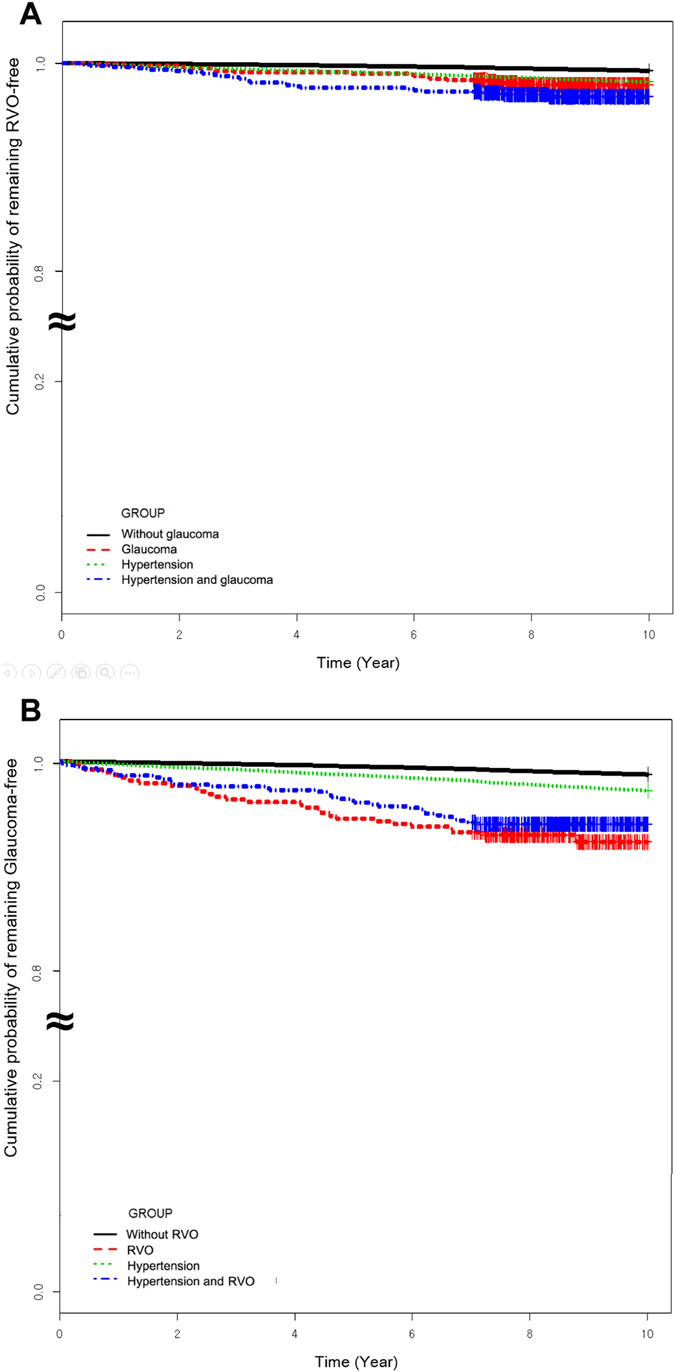
To evaluate the risk of retinal vein occlusion (RVO) development after primary open-angle glaucoma (POAG) and the risk of POAG development after RVO, we conducted a nationwide, population-based 11-year longitudinal study. National registry data were collected from the Korean National Health Insurance Research Database, comparing 1 025 340 (~2.2%) subjects who were selected from 46 605 433 Korean residents in 2002. Each sampled patients was tracked until 2013. POAG developed in 0.92% of the RVO group (n = 6 826) and in 0.22% of the comparison group. RVO developed in 0.99% of the POAG group (n = 4 138) and in 0.37% of the comparison group. RVO was associated with an increased risk of POAG development (hazard ratio [HR], 3.25; 95% confidence interval [CI], 2.39-4.42) and POAG was associated with an increased risk of RVO development (HR, 5.05; 95% CI, 3.94-6.47). Comorbidity of systemic hypertension and diabetes mellitus further increased the risk of POAG development in the RVO group (HR, 3.58 and HR, 5.98, respectively). Patients with RVO exhibit a significantly higher risk of POAG development and patients with POAG exhibit a significantly higher risk of RVO development, based on an 11-year follow-up period.
为了评估原发性开角型青光眼(POAG)后视网膜静脉阻塞(RVO)的发病风险以及 RVO 后 POAG 的发病风险,我们进行了一项全国性的、基于人群的 11 年纵向研究。国家注册数据来自韩国国家健康保险研究数据库,比较了 2002 年从 46605433 名韩国居民中选择的 1025340(约 2.2%)名受试者。每个抽样患者都被跟踪到 2013 年。RVO 组(n=6826)中 POAG 的发病率为 0.92%,对照组为 0.22%。POAG 组(n=4138)中 RVO 的发病率为 0.99%,对照组为 0.37%。RVO 与 POAG 发病风险增加相关(风险比[HR],3.25;95%置信区间[CI],2.39-4.42),POAG 与 RVO 发病风险增加相关(HR,5.05;95% CI,3.94-6.47)。全身性高血压和糖尿病合并症进一步增加了 RVO 组 POAG 发病的风险(HR 分别为 3.58 和 5.98)。在 11 年的随访期间,患有 RVO 的患者发生 POAG 的风险显著增加,患有 POAG 的患者发生 RVO 的风险显著增加。