Phang Chung-Weng, Karsani Saiful Anuar, Abd Malek Sri Nurestri
Institute of Biological Sciences, Faculty of Science, University of Malaya, Kuala Lumpur, Malaysia.
Pharmacogn Mag. 2017 Jul;13(Suppl 2):S321-S328. doi: 10.4103/0973-1296.210180. Epub 2017 Jul 11.
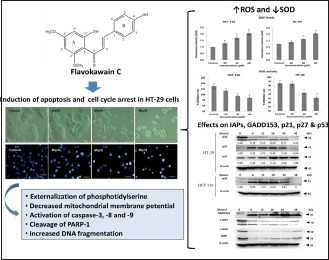
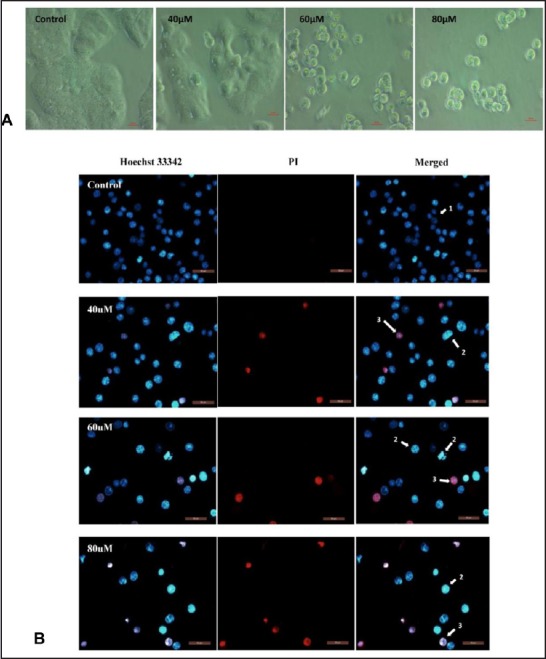
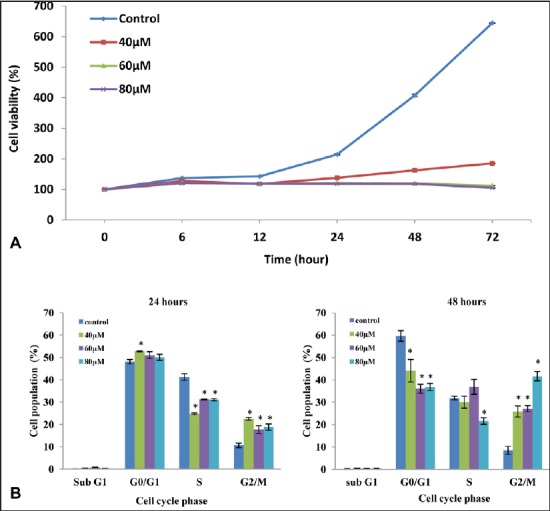
Chalcones have been shown to exhibit anti-cancer properties by targeting multiple molecular pathways. It was, therefore, of interest to investigate flavokawain C (FKC), a naturally occurring chalcone, which can be isolated from Kava ( Forst) root extract. The aim of this study was to investigate the inhibitory effect of FKC on the growth of HT-29 cells and its underlying mechanism of action. Cell viability of HT-29 cells was assessed by Sulforhodamine B assay after FKC treatment. Induction of apoptosis was examined by established morphological and biochemical assays. ROS generation was determined by dichlorofluorescein fluorescence staining, and superoxide dismutase activity was measured using the spectrophotometric method. Western blotting was used to examine the changes in the protein levels. FKC markedly decreased the cell viability of HT-29 cells and the cells showed dramatic changes in cellular and nuclear morphologies with typical apoptotic features. The induction of apoptosis correlated well with the externalization of phosphatidylserine, DNA fragmentation, decreased mitochondrial membrane potential, activation of caspases, and PARP cleavage. This was associated with an increase in reactive oxygen species and a decrease in SOD activity. The protein levels of XIAP, c-IAP1, and c-IAP2 were downregulated, whereas the GADD153 was upregulated after FKC treatment. FKC induced cell cycle arrest at the G and G/M phases via upregulation of p21 and p27 in a p53-independent manner. Our results provide evidence that FKC has the potential to be developed into chemotherapeutic drug for the treatment of colon adenocarcinoma.
Flavokawain C inhibited the growth of HT-29 human colon adenocarcinoma cellsFlavokawain C induced apoptosis in HT-29 cells, associated with an increase in reactive oxygen species and a decrease in SOD activityFlavokawain C induced cell cycle arrest at the G and G/M phases via upregulation of p21 and p27 in HT-29 cellsHT-29 cells treated with flavokawain C caused downregulation of XIAP, c-IAP1, and c-IAP2, and upregulation of GADD153. FKC: Flavokawain C; SRB: Sulforhodamine B; ROS: Reactive oxygen species; SOD: Superoxide dismutase; PARP: Poly(ADP-ribose) polymerase; ER: Endoplasmic reticulum; IAPs: Inhibitor of apoptosis proteins; TUNEL: Transferase dUTP nick end labeling; Annexin V-FITC: Annexin V conjugated with fluorescein isothicyanate.
查耳酮已被证明可通过靶向多种分子途径展现出抗癌特性。因此,研究从卡瓦根提取物中分离出的天然查耳酮黄酮卡瓦因C(FKC)很有意义。本研究的目的是探究FKC对HT - 29细胞生长的抑制作用及其潜在作用机制。用FKC处理后,通过磺酰罗丹明B检测法评估HT - 29细胞的活力。通过既定的形态学和生化检测来检查细胞凋亡的诱导情况。通过二氯荧光素荧光染色测定活性氧(ROS)的产生,并使用分光光度法测量超氧化物歧化酶(SOD)的活性。蛋白质印迹法用于检测蛋白质水平的变化。FKC显著降低了HT - 29细胞的活力,细胞在细胞和细胞核形态上出现了显著变化,具有典型的凋亡特征。凋亡的诱导与磷脂酰丝氨酸外化、DNA片段化、线粒体膜电位降低、半胱天冬酶激活和聚(ADP - 核糖)聚合酶(PARP)裂解密切相关。这与活性氧的增加和SOD活性的降低有关。FKC处理后,X连锁凋亡抑制蛋白(XIAP)、细胞凋亡抑制蛋白1(c - IAP1)和细胞凋亡抑制蛋白2(c - IAP2)的蛋白质水平下调,而生长停滞和DNA损伤诱导蛋白153(GADD153)上调。FKC通过以一种不依赖p53的方式上调p21和p27诱导细胞周期停滞在G期和G/M期。我们的结果提供了证据表明FKC有潜力被开发成用于治疗结肠腺癌的化疗药物。
黄酮卡瓦因C抑制HT - 29人结肠腺癌细胞的生长
黄酮卡瓦因C诱导HT - 29细胞凋亡,与活性氧增加和SOD活性降低有关
黄酮卡瓦因C通过上调HT - 29细胞中的p21和p27诱导细胞周期停滞在G期和G/M期
用黄酮卡瓦因C处理的HT - 29细胞导致XIAP、c - IAP1和c - IAP2下调,以及GADD153上调。FKC:黄酮卡瓦因C;SRB:磺酰罗丹明B;ROS:活性氧;SOD:超氧化物歧化酶;PARP:聚(ADP - 核糖)聚合酶;ER:内质网;IAPs:凋亡抑制蛋白;TUNEL:末端脱氧核苷酸转移酶介导的dUTP缺口末端标记;Annexin V - FITC:异硫氰酸荧光素偶联的膜联蛋白V