Gnanadesikan Gitanjali E, Pearse William D, Shaw Allison K
Department of Ecology and Evolutionary Biology Princeton University Princeton NJ USA.
Present address: School of Anthropology University of Arizona Tucson AZ USA.
Ecol Evol. 2017 Jun 22;7(15):5891-5900. doi: 10.1002/ece3.3120. eCollection 2017 Aug.
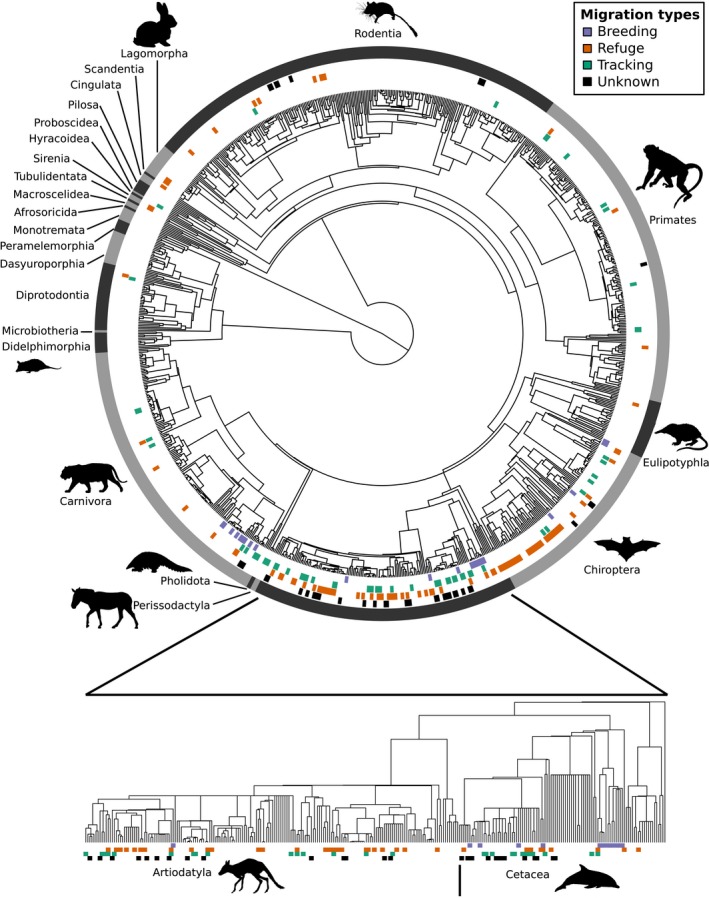
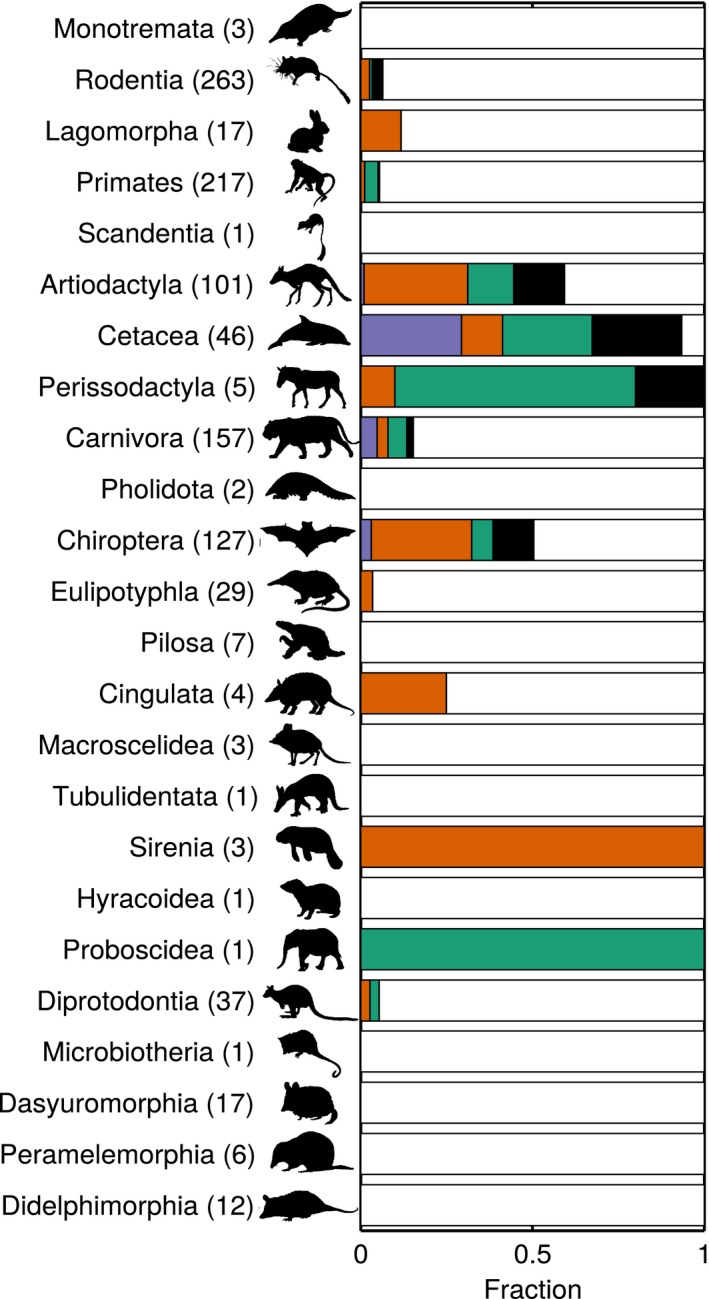
Many organisms migrate between distinct habitats, exploiting variable resources while profoundly affecting ecosystem services, disease spread, and human welfare. However, the very characteristics that make migration captivating and significant also make it difficult to study, and we lack a comprehensive understanding of which species migrate and why. Here we show that, among mammals, migration is concentrated within Cetacea and Artiodactyla but also diffusely spread throughout the class (found in 12 of 27 orders). We synthesize the many ecological drivers of round-trip migration into three types of movement-between breeding and foraging sites, between breeding and refuge sites, and continuous tracking of forage/prey-each associated with different traits (body mass, diet, locomotion, and conservation status). Our results provide only partial support for the hypothesis that migration occurs without phylogenetic constraint. Furthermore, our findings suggest that categorizing migration into these three types may aid predictions of migrants' responses to environmental changes.
许多生物在不同的栖息地之间迁徙,利用各种资源,同时深刻影响生态系统服务、疾病传播和人类福祉。然而,正是这些使迁徙引人入胜且意义重大的特征,也使得研究它变得困难,而且我们对哪些物种会迁徙以及迁徙原因缺乏全面的了解。在这里,我们表明,在哺乳动物中,迁徙集中在鲸目和偶蹄目,但也广泛分布于整个纲(在27个目中的12个目中有发现)。我们将往返迁徙的众多生态驱动因素综合为三种类型的移动——在繁殖地和觅食地之间、在繁殖地和避难地之间,以及持续追踪食物/猎物——每种都与不同的特征(体重、饮食、运动方式和保护状况)相关。我们的结果仅为迁徙不受系统发育限制这一假设提供了部分支持。此外,我们的研究结果表明,将迁徙分为这三种类型可能有助于预测迁徙者对环境变化的反应。