Gan Ning, Du Xiaowen, Cao Yuting, Hu Futao, Li Tianhua, Jiang Qianli
The State Key Laboratory Base of Novel Functional Materials and Preparation Science, Faculty of Material Science and Chemical Engineering, Ningbo University, Ningbo 315211, China.
Department of Laboratory Medicine, Nanfang Hospital, Southern Medical University, Guangzhou 510515, China.
Materials (Basel). 2013 Mar 25;6(4):1255-1269. doi: 10.3390/ma6041255.
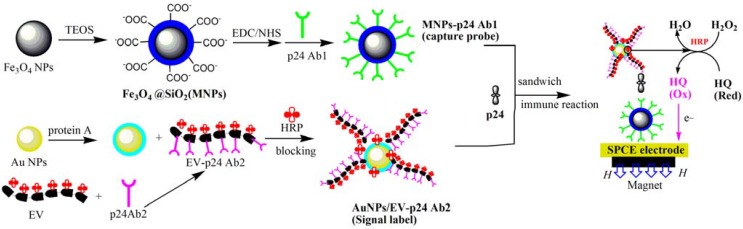
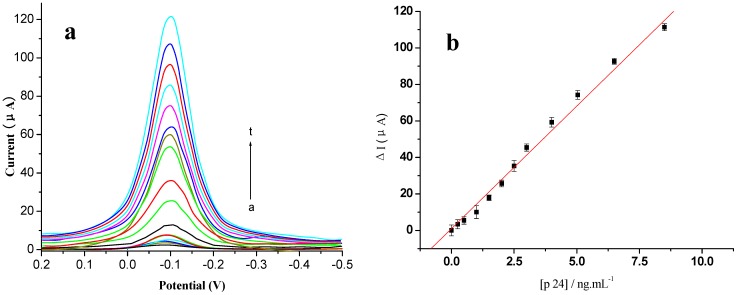
An ultrasensitive portable electrochemical immunosensor for human immunodeficiency virus p24 (HIV p24) antigen detection has been developed, whereby the detection sensitivity was 1000 times higher than that of the ELISA method. Firstly, a novel HRP enzyme-antibody copolymer (EV-p24 Ab2) was synthesized through an EnVision regent (EV, a dextrin amine skeleton anchoring more than 100 molecules of HRP and 15 molecules of anti IgG), then incubated in the secondary antibody of p24. Secondly, the copolymer was immobilized on the gold nanocolloids (AuNPs) to fabricate a novel signal tag (AuNPs/EV-p24 Ab2). Subsequently, a sandwich-type immunoreaction would take place between the capture probe (silicon dioxide-coated magnetic Fe₃O₄ nanoparticles (MNPs) labeled with the primary p24 antibody (MNPs-p24 Ab1)), p24 (different concentrations) and the signal tag [AuNPs/EV-p24 Ab2)] to form the immunocomplex. Finally, the immunocomplex was absorbed on the surface of screen printed carbon electrode (SPCE) by a magnet and immersed in the o-hydroxyl phenol (HQ) and H₂O₂. The large amounts of HRP on the signal tag can catalyze the oxidation of HQ by H₂O₂, which can induce an amplified reductive current. Moreover, the capture probe could improve the accumulation ability of p24 and facilitate its separation from the substrate through the magnet. Under optimal conditions, the proposed immunoassay exhibited good sensitivity to p24 within a certain concentration range from 0.001 to 10.00 ng/mL, with a detection limit of 0.5 pg/mL (S/N = 3). The proposed method can be used for real-time and early detection of HIV-infected people.
一种用于检测人类免疫缺陷病毒p24(HIV p24)抗原的超灵敏便携式电化学免疫传感器已被开发出来,其检测灵敏度比酶联免疫吸附测定(ELISA)方法高1000倍。首先,通过EnVision试剂(EV,一种锚定100多个辣根过氧化物酶(HRP)分子和15个抗IgG分子的糊精胺骨架)合成了一种新型的HRP酶 - 抗体共聚物(EV - p24 Ab2),然后将其与p24的二抗一起孵育。其次,将该共聚物固定在金纳米胶体(AuNPs)上,制备出一种新型信号标签(AuNPs/EV - p24 Ab2)。随后,在捕获探针(用p24一抗(MNPs - p24 Ab1)标记的二氧化硅包覆磁性Fe₃O₄纳米颗粒(MNPs))、p24(不同浓度)和信号标签[AuNPs/EV - p24 Ab2)]之间会发生夹心型免疫反应,形成免疫复合物。最后,通过磁铁将免疫复合物吸附在丝网印刷碳电极(SPCE)表面,并将其浸入邻羟基苯酚(HQ)和H₂O₂中。信号标签上的大量HRP可催化H₂O₂氧化HQ,从而诱导放大的还原电流。此外,捕获探针可提高p24的富集能力,并便于通过磁铁将其与底物分离。在最佳条件下,所提出的免疫测定法在0.001至10.00 ng/mL的一定浓度范围内对p24表现出良好的灵敏度,检测限为0.5 pg/mL(S/N = 3)。该方法可用于对HIV感染者进行实时早期检测。