Key Laboratory of Three Gorges Reservoir Region's Eco-Environment, Ministry of Education, Chongqing University, Chongqing 400045, China.
Int J Environ Res Public Health. 2011 Apr;8(4):1258-70. doi: 10.3390/ijerph8041258. Epub 2011 Apr 21.
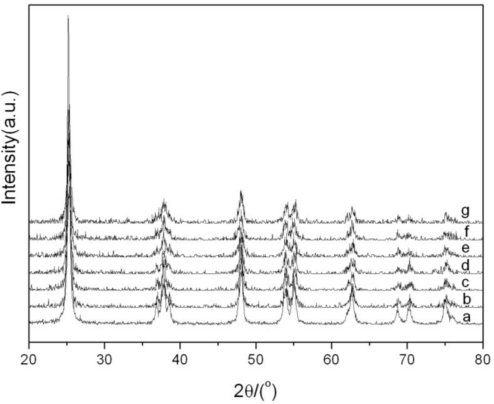
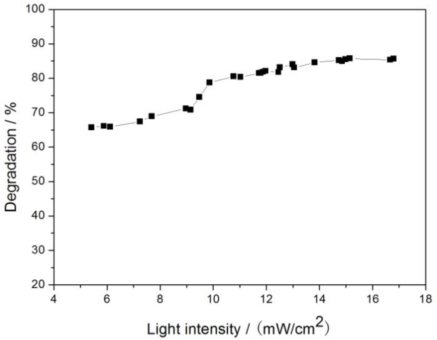
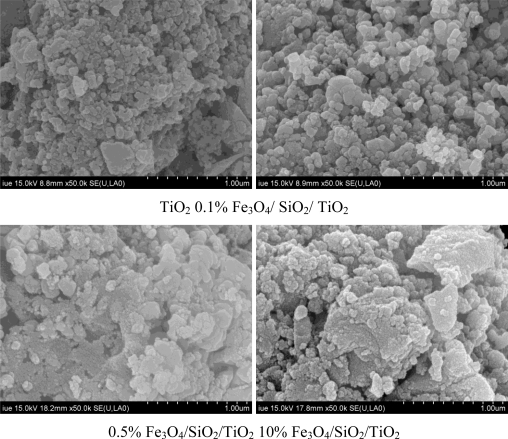
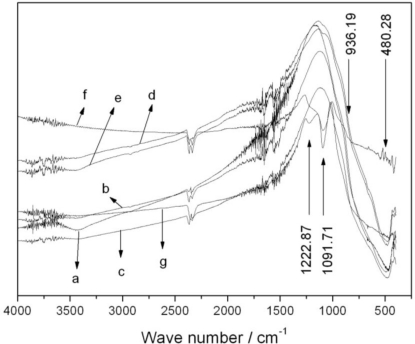
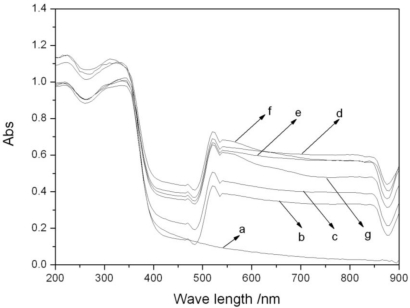
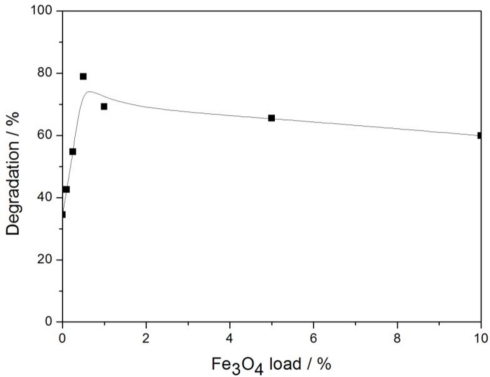
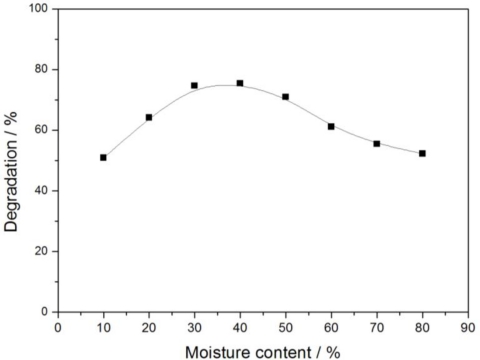
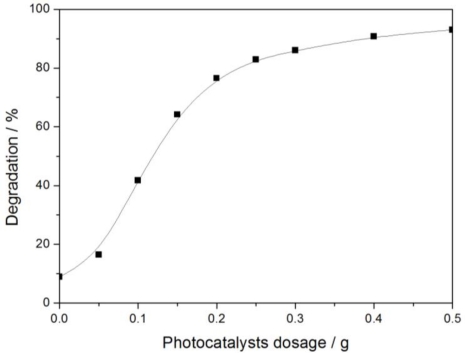
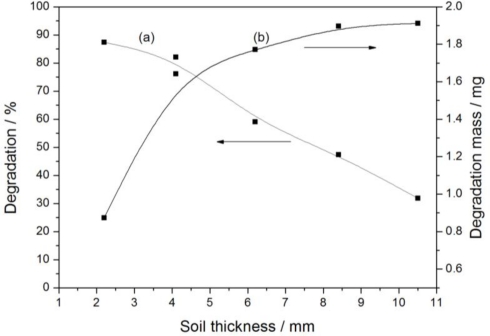
In this study, Fe(3)O(4)/SiO(2)/TiO(2) photocatalyst was prepared via a sol-gel method, and Fe(3)O(4) particles were used as the core of the colloid. Diffraction peaks of Fe(3)O(4) crystals are not found by XRD characterization, indicating that Fe(3)O(4) particles are well encapsulated by SiO(2). FTIR characterization shows that diffraction peaks of Ti-O-Si chemical bonds become obvious when the Fe(3)O(4) loading is more than 0.5%. SEM characterization indicates that agglomeration occurs in the Fe(3)O(4)/SiO(2)/TiO(2) photocatalyst, whereas photocatalysts modified by Fe(3)O(4)/SiO(2) present excellent visible light absorption performance and photocatalytic activity, especially when the Fe(3)O(4) loading is 0.5%. Photocatalytic degradation of glyphosate in soil by these photocatalysts under solar irradiation was investigated. Results show that 0.5% Fe(3)O(4)/SiO(2)/TiO(2) has the best photocatalytic activity. The best moisture content of soil is 30%~50%. Degradation efficiency of glyphosate reaches 89% in 2 h when the dosage of photocatalyst is 0.4 g/100 g (soil), and it increased slowly when more photocatalyst was used. Soil thickness is a very important factor for the photocatalytic rate. The thinner the soil is, the better the glyphosate degradation is. Degradation of glyphosate is not obviously affected by sunlight intensity when the intensity is below 6 mW/cm(2) or above 10 mW/cm(2), but it is accelerated significantly when the sunlight intensity increases from 6 mW/cm(2) to 10 mW/cm(2).
在这项研究中,通过溶胶-凝胶法制备了 Fe(3)O(4)/SiO(2)/TiO(2)光催化剂,Fe(3)O(4)颗粒用作胶体的核。XRD 特征表明,Fe(3)O(4)晶体的衍射峰不明显,表明 Fe(3)O(4)颗粒被 SiO(2)很好地包裹。FTIR 特征表明,当 Fe(3)O(4)负载量大于 0.5%时,Ti-O-Si 化学键的衍射峰变得明显。SEM 特征表明,Fe(3)O(4)/SiO(2)/TiO(2)光催化剂发生团聚,而经 Fe(3)O(4)/SiO(2)改性的光催化剂具有优异的可见光吸收性能和光催化活性,尤其是当 Fe(3)O(4)负载量为 0.5%时。研究了这些光催化剂在太阳照射下对土壤中草甘膦的光催化降解。结果表明,0.5% Fe(3)O(4)/SiO(2)/TiO(2)具有最佳的光催化活性。土壤的最佳含水量为 30%~50%。当光催化剂用量为 0.4 g/100 g(土壤)时,2 h 内草甘膦的降解效率达到 89%,当使用更多光催化剂时,降解效率增加缓慢。土壤厚度是光催化速率的一个非常重要的因素。土壤越薄,草甘膦的降解越好。当光照强度低于 6 mW/cm(2)或高于 10 mW/cm(2)时,草甘膦的降解受光照强度的影响不明显,但当光照强度从 6 mW/cm(2)增加到 10 mW/cm(2)时,降解明显加快。