Reidy Bogumiła, Haase Andrea, Luch Andreas, Dawson Kenneth A, Lynch Iseult
Centre for BioNano Interactions, School of Chemistry and Chemical Biology, University College Dublin, Belfield, Dublin 4, Ireland.
Department of Product Safety, German Federal Institute for Risk Assessment (BfR), Berlin 10589, Germany.
Materials (Basel). 2013 Jun 5;6(6):2295-2350. doi: 10.3390/ma6062295.
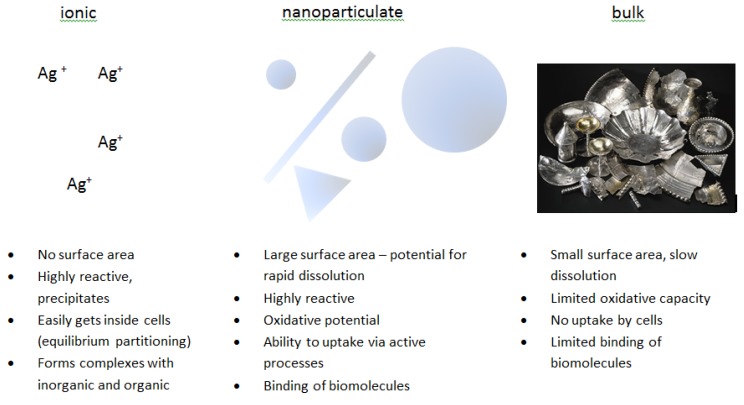
Nanosilver, due to its small particle size and enormous specific surface area, facilitates more rapid dissolution of ions than the equivalent bulk material; potentially leading to increased toxicity of nanosilver. This, coupled with their capacity to adsorb biomolecules and interact with biological receptors can mean that nanoparticles can reach sub-cellular locations leading to potentially higher localized concentrations of ions once those particles start to dissolve or degrade . Further complicating the story is the capacity for nanoparticles to generate reactive oxygen species, and to interact with, and potentially disturb the functioning of biomolecules such as proteins, enzymes and DNA. The fact that the nanoparticle size, shape, surface coating and a host of other factors contribute to these interactions, and that the particles themselves are evolving or ageing leads to further complications in terms of elucidating mechanisms of interaction and modes of action for silver nanoparticles, in contrast to dissolved silver species. This review aims to provide a critical assessment of the current understanding of silver nanoparticle toxicity, as well as to provide a set of pointers and guidelines for experimental design of future studies to assess the environmental and biological impacts of silver nanoparticles. In particular; in future we require a detailed description of the nanoparticles; their synthesis route and stabilisation mechanisms; their coating; and evolution and ageing under the exposure conditions of the assay. This would allow for comparison of data from different particles; different environmental or biological systems; and structure-activity or structure-property relationships to emerge as the basis for predictive toxicology. On the basis of currently available data; such comparisons or predictions are difficult; as the characterisation and time-resolved data is not available; and a full understanding of silver nanoparticle dissolution and ageing under different conditions is observed. Clear concerns are emerging regarding the overuse of nanosilver and the potential for bacterial resistance to develop. A significant conclusion includes the need for a risk-benefit analysis for all applications and eventually restrictions of the uses where a clear benefit cannot be demonstrated.
纳米银因其粒径小、比表面积大,比同等块状材料更易促进离子的快速溶解;这可能导致纳米银的毒性增加。再加上它们吸附生物分子并与生物受体相互作用的能力,这可能意味着纳米颗粒能够到达亚细胞位置,一旦这些颗粒开始溶解或降解,就可能导致离子在局部的浓度升高。使情况更加复杂的是,纳米颗粒能够产生活性氧,并与蛋白质、酶和DNA等生物分子相互作用,进而可能干扰其功能。纳米颗粒的尺寸、形状、表面涂层以及许多其他因素都会影响这些相互作用,而且颗粒本身也在不断演变或老化,这使得与溶解态银物种相比,阐明银纳米颗粒的相互作用机制和作用方式变得更加复杂。本综述旨在对当前对银纳米颗粒毒性的理解进行批判性评估,并为未来评估银纳米颗粒对环境和生物影响的研究的实验设计提供一系列指导方针。特别是,未来我们需要对纳米颗粒进行详细描述,包括它们的合成路线和稳定机制、涂层以及在检测暴露条件下的演变和老化情况。这将有助于比较来自不同颗粒、不同环境或生物系统的数据,并形成结构-活性或结构-性质关系,作为预测毒理学的基础。根据目前可得的数据,由于缺乏表征和时间分辨数据,并且尚未全面了解银纳米颗粒在不同条件下的溶解和老化情况,因此很难进行这样的比较或预测。人们对纳米银的过度使用以及细菌产生耐药性的可能性越来越担忧。一个重要结论是,需要对所有应用进行风险效益分析,并最终限制那些无法证明有明显益处的用途。