Department of Disease Control, London School of Hygiene and Tropical Medicine, London, UK.
Kilimanjaro Christian Medical University College, Moshi, Tanzania.
Malar J. 2017 Aug 15;16(1):336. doi: 10.1186/s12936-017-1972-z.
Mosquito nets containing synergists designed to overcome metabolic resistance mechanisms in vectors have been developed. These may enhance excitability in the mosquitoes and affect how they respond to CDC light-traps. Investigating the behaviour of vectors of disease in relation to novel mosquito nets is, therefore, essential for the design of sampling and surveillance systems.
In an initial experiment in Muleba, Tanzania, nine bedrooms from three housing clusters were sampled. CDC light-traps were operated indoors next to occupied untreated nets (UTN), Olyset long lasting insecticidal net (LLIN) and Olyset Plus LLIN containing piperonyl butoxide (PBO) synergist. Nets were rotated daily between the nine rooms over nine nights. A further series of experiments using the nets on alternate nights in a single room was undertaken during the short rains. Anopheles gambiae s.l. were collected in CDC light-traps, a window-trap and Furvela tent-trap. Anopheles gambiae s.l. were identified to species by polymerase chain reaction (PCR).
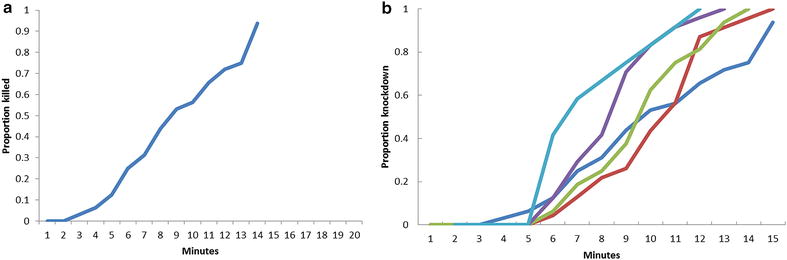
In the initial experiment 97.7% of the 310 An. gambiae s.l. were An. gambiae s.s., the remainder being Anopheles arabiensis. The number of mosquitoes collected from 81 light-trap collections was greater in the presence of an Olyset [density rate ratio 1.81, 95% CI (1.22-2.67), p = 0.003] relative to an UTN. In a second experiment, in the wet season 84% of the 180 An. gambiae s.l. identified were An. arabiensis. The number of An. gambiae s.l. collected from a light-trap compared to a tent-trap was significantly higher when an Olyset Plus net was used compared to an UTN. Survival of the mosquitoes in the window trap was not reduced by the use of an Olyset Plus net in the bedroom relative to an Olyset net.
Mosquitoes entering bedrooms, even those susceptible to pyrethroids, were not killed by contact with an Olyset Plus LLIN. The enhanced numbers of An. gambiae or An. arabiensis collected in light-traps when a treated net is used requires further experimentation and may be because of a heightened escape reaction on the part of the mosquito.
已开发出含有增效剂的蚊帐,旨在克服病媒新陈代谢抗性机制。这些增效剂可能会增强蚊子的兴奋性并影响它们对 CDC 诱蚊灯的反应。因此,研究疾病病媒的行为与新型蚊帐之间的关系对于采样和监测系统的设计至关重要。
在坦桑尼亚姆莱巴的初步实验中,从三个住房集群中抽取了 9 间卧室进行采样。在室内,紧邻未处理的蚊帐(UTN)、Olyset 长效驱虫蚊帐(LLIN)和含有增效剂派卡瑞丁的 Olyset Plus LLIN,操作 CDC 诱蚊灯。在 9 个晚上,每天将蚊帐在 9 个房间之间轮换。在雨季的短时间内,在一个房间内每隔一晚使用这些蚊帐进行了一系列进一步的实验。用 CDC 诱蚊灯、窗诱捕器和 Furvela 帐篷诱捕器收集冈比亚按蚊。冈比亚按蚊通过聚合酶链反应(PCR)鉴定到种。
在初步实验中,310 只冈比亚按蚊中有 97.7%为冈比亚按蚊 s.s.,其余为斑须按蚊。在有 Olyset 的情况下,从 81 次诱蚊灯收集的蚊子数量更多[密度比 1.81,95%置信区间(1.22-2.67),p=0.003],而与 UTN 相比。在第二个实验中,在雨季,鉴定出的 180 只冈比亚按蚊中有 84%为斑须按蚊。与 UTN 相比,使用 Olyset Plus 蚊帐时,从诱蚊灯收集到的冈比亚按蚊数量明显高于帐篷诱捕器。与使用 Olyset 蚊帐相比,在卧室中使用 Olyset Plus 蚊帐不会降低蚊子在窗诱捕器中的存活率。
即使接触到拟除虫菊酯,进入卧室的蚊子也不会被 Olyset Plus LLIN 杀死。当使用处理过的蚊帐时,在诱蚊灯中收集到的冈比亚按蚊或斑须按蚊数量增加,需要进一步的实验,这可能是因为蚊子的逃避反应加剧。