Division of Gastroenterology and Hepatology, Chang Gung Memorial Hospital, Chang Gung University, Taoyuan, Taiwan.
Division of Gastroenterology and Hepatology, Department of Internal Medicine, Taipei Veteran General Hospital, No. 201, Section 2, Shih-Pai Road, Taipei, 11217, Taiwan.
Crit Care. 2017 Aug 15;21(1):214. doi: 10.1186/s13054-017-1768-0.
Cirrhotic patients are susceptible to sepsis and critical illness-related corticosteroid insufficiency (CIRCI). Dehydroepiandrosterone sulfate (DHEAS) is a corticotropin-dependent adrenal androgen, which has immunostimulating and antiglucocorticoid effects. Considering the synchronized synthesis of cortisol and DHEAS and their opposing effects to each other, investigators have proposed measuring these two hormones as a ratio. Severe sepsis has been associated with low DHEAS, especially relative to high cortisol. Despite growing interest in the role of adrenal androgen replacement in critical illness, there have been no data about DHEAS and the DHEAS/cortisol ratio in patients with liver cirrhosis. We studied whether low concentrations of DHEAS and decreased DHEAS/cortisol ratio are associated with poor outcome in patients with liver cirrhosis and septic shock.
We recruited 46 cirrhotic patients with septic shock, and 46 noncirrhotic counterparts matched by age and sex. We evaluated adrenal function using the short corticotropin stimulation test and analyzed the relation between DHEAS and cortisol.
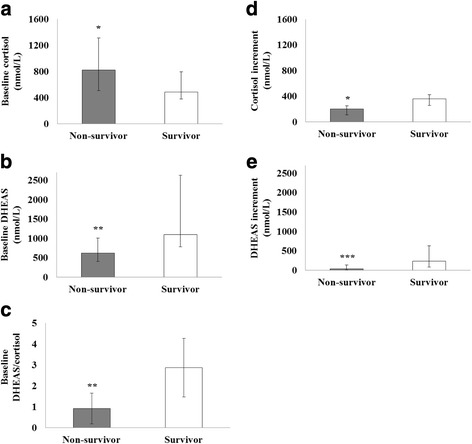
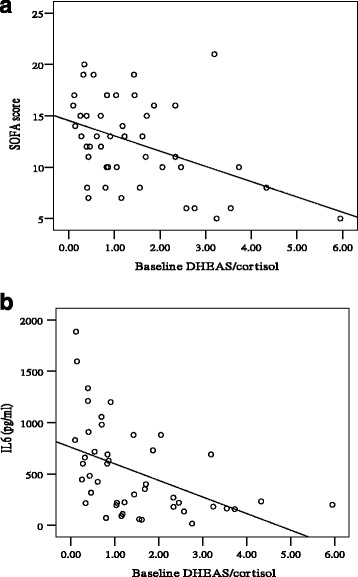
While the nonsurvivors in the cirrhotic group had significantly lower baseline DHEAS, lower baseline DHEAS/cortisol ratio, and reduced increments of both DHEAS and cortisol upon corticotropin stimulation, the survivors had lower baseline cortisol. Cirrhotic patients with lower DHEAS/cortisol ratio (<1.50) had higher levels of interleukin-6 and tumor necrosis factor alpha, higher Sequential Organ Failure Assessment scores, and higher rates of CIRCI and hospital mortality. Using the area under the receiver operating characteristic (AUROC) curve, both DHEAS and the DHEAS/cortisol ratio demonstrated a good discriminative power for predicting hospital survival (AUROC 0.807 and 0.925 respectively). The cirrhotic group had lower DHEAS and DHEAS/cortisol ratio but higher rates of CIRCI and hospital mortality, compared to the noncirrhotic group.
There is dissociation between cortisol (increased) and DHEAS (decreased) in those cirrhotic patients who succumb to septic shock. Low DHEAS/cortisol ratios are associated with more severe diseases, inflammation, and CIRCI and can serve as a prognostic marker. More investigations are needed to evaluate the role of adrenal androgen in this clinical setting.
肝硬化患者易发生脓毒症和与危重病相关的皮质类固醇不足(CIRCI)。硫酸脱氢表雄酮(DHEAS)是一种促肾上腺皮质激素依赖性肾上腺雄激素,具有免疫刺激和抗糖皮质激素作用。考虑到皮质醇和 DHEAS 的同步合成及其相互拮抗作用,研究人员提出将这两种激素作为一个比值进行测量。严重脓毒症与 DHEAS 降低有关,尤其是与皮质醇升高相比。尽管人们对肾上腺雄激素替代在危重病中的作用越来越感兴趣,但关于肝硬化患者的 DHEAS 和 DHEAS/皮质醇比值的数据尚未见报道。我们研究了 DHEAS 浓度降低和 DHEAS/皮质醇比值降低是否与肝硬化合并感染性休克患者的不良预后相关。
我们招募了 46 例肝硬化合并感染性休克患者和 46 例年龄和性别相匹配的非肝硬化患者。我们使用短促皮质素刺激试验评估肾上腺功能,并分析 DHEAS 与皮质醇之间的关系。
在肝硬化组中,死亡患者的基础 DHEAS 明显较低,基础 DHEAS/皮质醇比值较低,促皮质素刺激后 DHEAS 和皮质醇的增加值均降低,而幸存者的基础皮质醇较低。DHEAS/皮质醇比值较低(<1.50)的肝硬化患者白细胞介素-6 和肿瘤坏死因子-α水平较高,序贯器官衰竭评估评分较高,CIRCI 和医院死亡率较高。使用受试者工作特征(ROC)曲线下面积(AUROC),DHEAS 和 DHEAS/皮质醇比值均具有良好的预测医院生存率的区分能力(AUROC 分别为 0.807 和 0.925)。与非肝硬化组相比,肝硬化组的 DHEAS 和 DHEAS/皮质醇比值较低,但 CIRCI 和医院死亡率较高。
在因感染性休克而死亡的肝硬化患者中,皮质醇(增加)和 DHEAS(减少)之间存在分离。低 DHEAS/皮质醇比值与更严重的疾病、炎症和 CIRCI 相关,并可作为预后标志物。需要进一步研究来评估肾上腺雄激素在这种临床情况下的作用。