Beishuizen Albertus, Thijs Lambertus G, Vermes István
Department of Intensive Care, VU University Medical Center, Amsterdam, The Netherlands.
Crit Care. 2002 Oct;6(5):434-8. doi: 10.1186/cc1530. Epub 2002 Jul 9.
Dehydroepiandrosterone (DHEA) and its sulphate (DHEAS) are pleiotropic adrenal hormones with immunostimulating and antiglucocorticoid effects. The present study was conducted to evaluate the time course of DHEAS levels in critically ill patients and to study their association with the hypothalamic-pituitary-adrenal axis.
This was a prospective observational clinical and laboratory study, including 30 patients with septic shock, eight patients with multiple trauma, and 40 age- and sex-matched control patients. We took serial measurements of blood concentrations of DHEAS, cortisol, tumour necrosis factor-alpha and IL-6, and of adrenocorticotrophic hormone immunoreactivity over 14 days or until discharge/death.
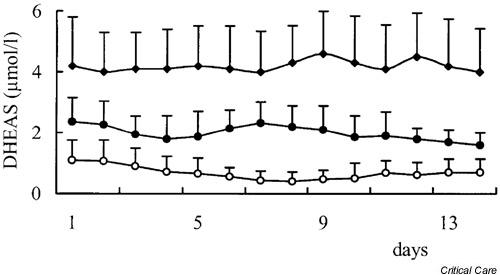
On admission, DHEAS was extremely low in septic shock (1.2 +/- 0.8 mol/l) in comparison with multiple trauma patients (2.4 +/- 0.5 micromol/l; P < 0.05) and control patients (4.2 +/- 1.8; P < 0.01). DHEAS had a significant (P < 0.01) negative correlation with age, IL-6 and Acute Physiology and Chronic Health Evaluation II scores in both patient groups. Only during the acute phase did DHEAS negatively correlate with dopamine. Nonsurvivors of septic shock (n = 11) had lower DHEAS levels (0.4 +/- 0.3 micromol/l) than did survivors (1.7 +/- 1.1 micromol/l; P < 0.01). The time course of DHEAS exhibited a persistent depletion during follow up, whereas cortisol levels were increased at all time points.
We identified extremely low DHEAS levels in septic shock and, to a lesser degree, in multiple trauma patients as compared with those of age- and sex-matched control patients. There appeared to be a dissociation between DHEAS (decreased) and cortisol (increased) levels, which changed only slightly over time. Nonsurvivors of sepsis and patients with relative adrenal insufficiency had the lowest DHEAS values, suggesting that DHEAS might be a prognostic marker and a sign of exhausted adrenal reserve in critical illness.
脱氢表雄酮(DHEA)及其硫酸盐(DHEAS)是具有免疫刺激和抗糖皮质激素作用的多效性肾上腺激素。本研究旨在评估重症患者DHEAS水平的时间进程,并研究其与下丘脑 - 垂体 - 肾上腺轴的关系。
这是一项前瞻性观察性临床和实验室研究,包括30例感染性休克患者、8例多发伤患者以及40例年龄和性别匹配的对照患者。我们在14天内或直至出院/死亡期间,连续测量DHEAS、皮质醇、肿瘤坏死因子 - α和IL - 6的血药浓度以及促肾上腺皮质激素免疫反应性。
入院时,感染性休克患者的DHEAS水平极低(1.2±0.8μmol/l),与多发伤患者(2.4±0.5μmol/l;P<0.05)和对照患者(4.2±1.8;P<0.01)相比。在两组患者中,DHEAS与年龄、IL - 6以及急性生理与慢性健康状况评分II均呈显著负相关(P<0.01)。仅在急性期,DHEAS与多巴胺呈负相关。感染性休克的非幸存者(n = 11)的DHEAS水平(0.4±0.3μmol/l)低于幸存者(1.7±1.1μmol/l;P<0.01)。在随访期间,DHEAS的时间进程显示持续降低,而皮质醇水平在所有时间点均升高。
我们发现,与年龄和性别匹配的对照患者相比,感染性休克患者以及程度较轻的多发伤患者的DHEAS水平极低。DHEAS(降低)和皮质醇(升高)水平之间似乎存在分离,且随时间变化不大。脓毒症非幸存者和相对肾上腺功能不全患者的DHEAS值最低,这表明DHEAS可能是一种预后标志物,也是危重病中肾上腺储备耗竭的标志。