Department of Medical Sciences, 2i3T Scarl, University of Turin, Turin, Italy.
Department of Surgical Sciences, University of Turin, Turin, Italy.
Sci Rep. 2017 Aug 15;7(1):8180. doi: 10.1038/s41598-017-08250-0.
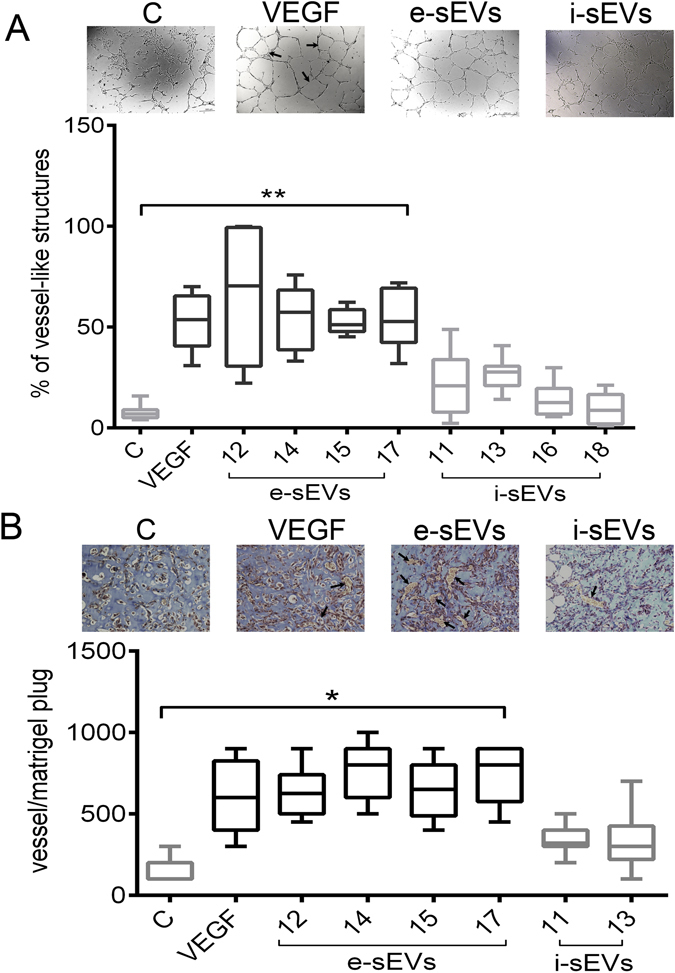
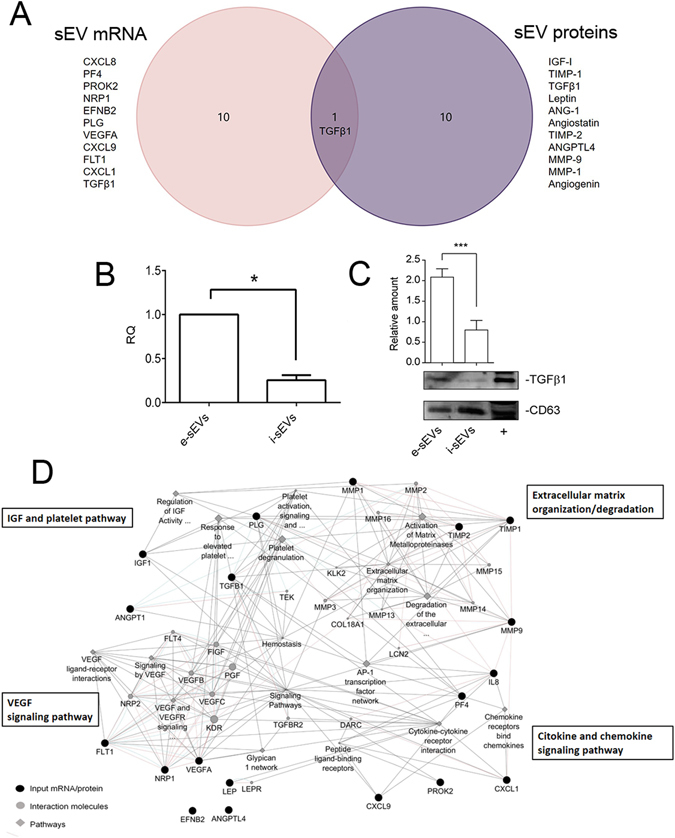
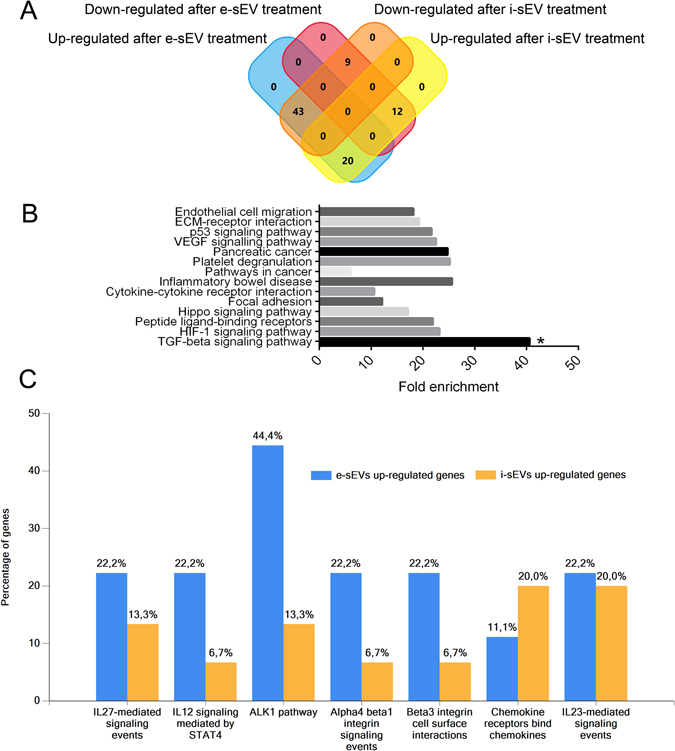
Serum is an abundant and accessible source of circulating extracellular vesicles (EVs). Serum-EV (sEV) pro-angiogenic capability and mechanisms are herein analyzed using an in vitro assay which predicts sEV angiogenic potential in vivo. Effective sEVs (e-sEVs) also improved vascular remodeling and prevented muscle damage in a mouse model of acute hind limb ischemia. e-sEV angiogenic proteomic and transcriptomic analyses show a positive correlation with matrix-metalloproteinase activation and extracellular matrix organization, cytokine and chemokine signaling pathways, Insulin-like Growth Factor and platelet pathways, and Vascular Endothelial Growth Factor signaling. A discrete gene signature, which highlights differences in e-sEV and ineffective-EV biological activity, was identified using gene ontology (GO) functional analysis. An enrichment of genes associated with the Transforming Growth Factor beta 1 (TGFβ1) signaling cascade is associated with e-sEV administration but not with ineffective-EVs. Chromatin immunoprecipitation analysis on the inhibitor of DNA binding I (ID1) promoter region, and the knock-down of small mother against decapentaplegic (SMAD)1-5 proteins confirmed GO functional analyses. This study demonstrates sEV pro-angiogenic activity, validates a simple, sEV pro-angiogenic assay which predicts their biological activity in vivo, and identifies the TGFβ1 cascade as a relevant mediator. We propose serum as a readily available source of EVs for therapeutic purposes.
血清是一种丰富且易于获得的循环细胞外囊泡 (EV) 来源。本研究通过体外分析,评估了血清 EV(sEV)的促血管生成能力及其机制,该分析可预测 sEV 在体内的促血管生成潜能。有效的 sEV(e-sEV)还改善了急性下肢缺血小鼠模型中的血管重塑并预防了肌肉损伤。e-sEV 的血管生成蛋白质组学和转录组学分析显示,与基质金属蛋白酶激活和细胞外基质组织、细胞因子和趋化因子信号通路、胰岛素样生长因子和血小板途径以及血管内皮生长因子信号转导呈正相关。通过基因本体 (GO) 功能分析,确定了一个离散的基因特征,该特征突出了 e-sEV 和无效-EV 生物学活性的差异。GO 功能分析显示,与 TGFβ1 信号级联相关的基因富集与 e-sEV 的给药有关,但与无效-EVs 无关。对 DNA 结合抑制剂 I(ID1)启动子区域进行染色质免疫沉淀分析,以及对小母亲对抗 decapentaplegic (SMAD)1-5 蛋白进行敲低,证实了 GO 功能分析的结果。本研究证明了 sEV 的促血管生成活性,验证了一种简单的 sEV 促血管生成分析方法,该方法可预测其在体内的生物学活性,并确定 TGFβ1 级联作为一种相关的调节剂。我们提出将血清作为治疗用途 EV 的易得来源。