Center for Neuroscience, Department of Human Physiology, Flinders University, Adelaide, SA, Australia.
Department of Psychiatry, New York University School of Medicine, New York, NY, USA.
Psychopharmacology (Berl). 2017 Nov;234(21):3259-3269. doi: 10.1007/s00213-017-4710-x. Epub 2017 Aug 15.
We recently introduced a new rat model of emotional hyperthermia in which a salient stimulus activates brown adipose tissue (BAT) thermogenesis and tail artery constriction. Antipsychotic drugs, both classical and second generation, act to reduce excessive assignment of salience to objects and events in the external environment. The close association between salient occurrences and increases in body temperature suggests that antipsychotic drugs may also reduce emotional hyperthermia.
We determined whether chlorpromazine, clozapine, and risperidone dose dependently reduce emotionally elicited increases in BAT thermogenesis, cutaneous vasoconstriction, and body temperature in rats.
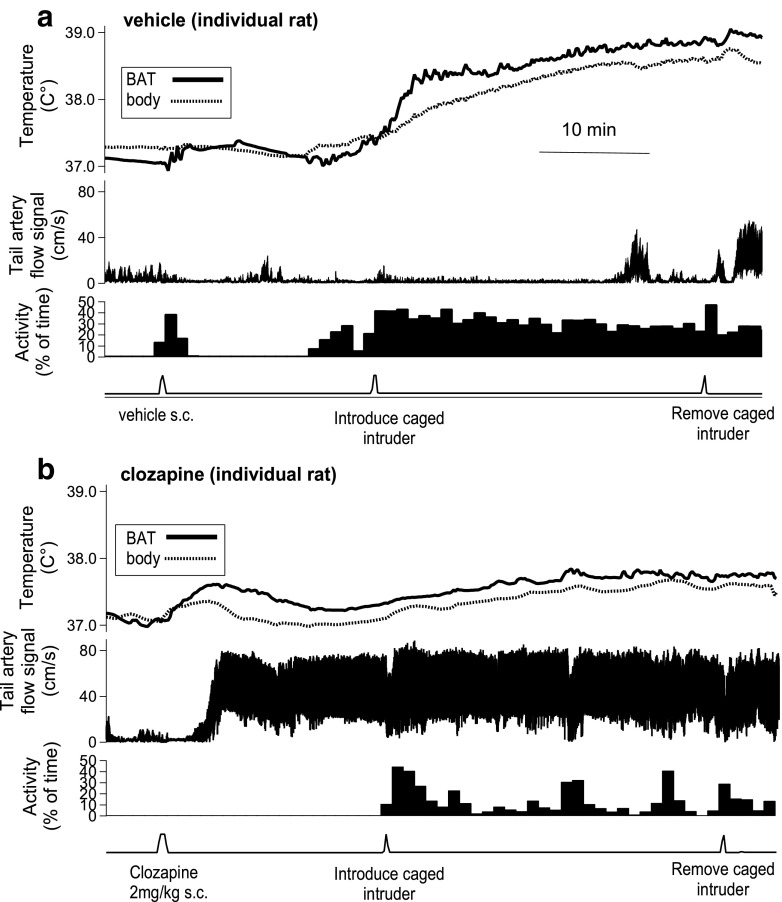
Rats, chronically instrumented for measurement of BAT and body temperature and tail artery blood flow, singly housed, were confronted with an intruder rat (confined within a small wire-mesh cage) after systemic pre-treatment of the resident rat with vehicle or antipsychotic agent. BAT and body temperatures, tail blood flow, and behavioral activity were continuously measured.
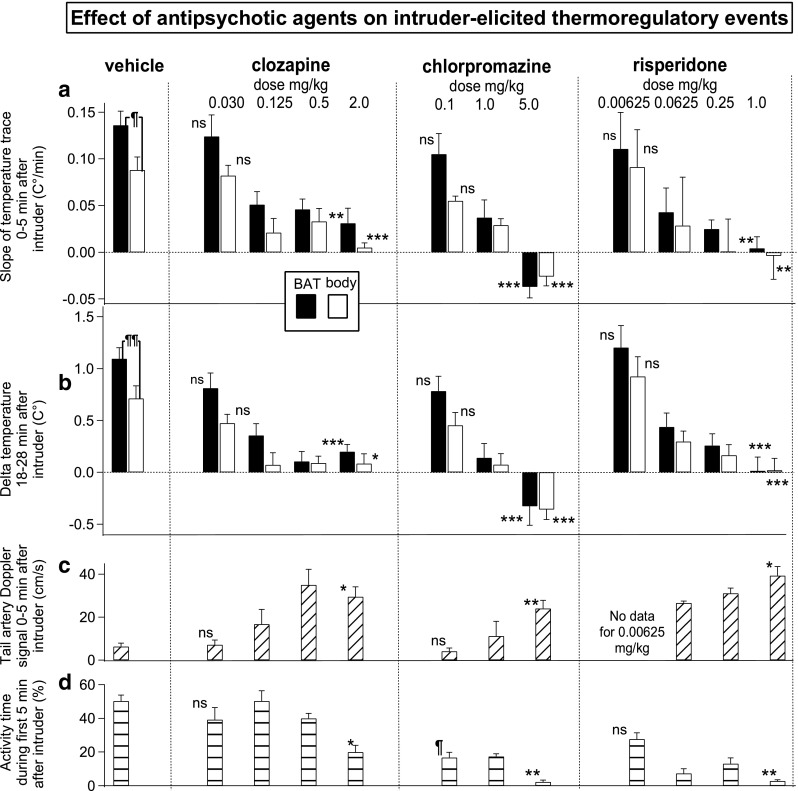
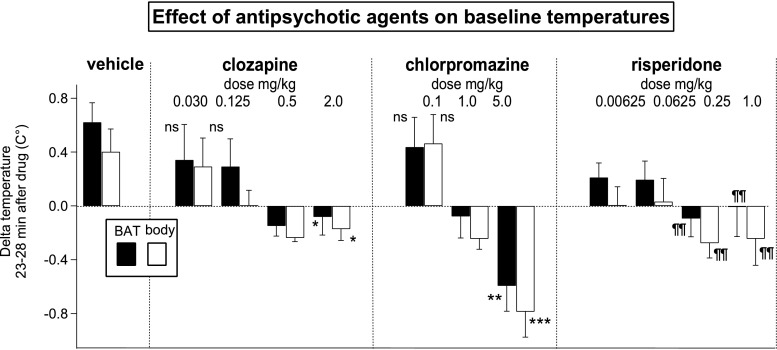
Clozapine (30 μg-2 mg/kg), chlorpromazine (0.1-5 mg/kg), and risperidone (6.25 μg-1 mg/kg) robustly and dose-relatedly reduced intruder-elicited BAT thermogenesis and tail artery vasoconstriction, with consequent dose-related reduction in emotional hyperthermia.
Chlorpromazine, a first-generation antipsychotic, as well as clozapine and risperidone, second-generation agents, dose-dependently reduce emotional hyperthermia. Dopamine D receptor antagonist properties of chlorpromazine do not contribute to thermoregulatory effects. Interactions with monoamine receptors are important, and these monoamine receptor interactions may also contribute to the therapeutic effects of all three antipsychotics. Thermoregulatory actions of putative antipsychotic agents may constitute a biological marker of their therapeutic properties.
我们最近引入了一种新的大鼠情感性体温过高模型,其中显著刺激激活棕色脂肪组织(BAT)产热和尾动脉收缩。抗精神病药物,无论是经典还是第二代,都能减少对外界环境中物体和事件的过度关注。显著事件和体温升高之间的密切关联表明,抗精神病药物也可能减少情感性体温过高。
我们确定氯丙嗪、氯氮平和利培酮是否剂量依赖性地降低大鼠因情绪引起的 BAT 产热、皮肤血管收缩和体温升高。
慢性植入 BAT 和体温以及尾动脉血流测量装置的大鼠,独居,在接受驻留大鼠全身预处理后,与一只入侵者大鼠(被限制在一个小的金属丝网格笼中)对峙。连续测量 BAT 和体温、尾血流和行为活动。
氯氮平(30μg-2mg/kg)、氯丙嗪(0.1-5mg/kg)和利培酮(6.25μg-1mg/kg)均能显著且剂量依赖性地降低因入侵者引起的 BAT 产热和尾动脉收缩,从而导致情绪性体温过高的剂量依赖性降低。
第一代抗精神病药物氯丙嗪,以及第二代药物氯氮平和利培酮,均能剂量依赖性地降低情感性体温过高。氯丙嗪的多巴胺 D 受体拮抗剂特性对体温调节作用没有贡献。与单胺受体的相互作用很重要,这些单胺受体相互作用也可能有助于这三种抗精神病药物的治疗效果。假定抗精神病药物的体温调节作用可能构成其治疗特性的生物学标志物。