Emergency Medical Center, Ministry of Health and Medical Education, Tehran, Iran.
HIV/STI Surveillance Research Center, and WHO Collaborating Center for HIV Surveillance, Institute for Futures Studies in Health, Kerman University of Medical Sciences, Kerman, Iran.
Int J Health Policy Manag. 2017 Feb 1;6(2):97-102. doi: 10.15171/ijhpm.2016.103.
In Islamic countries alcohol consumption is considered as against religious values. Therefore, estimation of frequency of alcohol consumptions using direct methods is prone to different biases. In this study, we indirectly estimated the frequency of alcohol use in Iran, in network of a representative sample using network scale up (NSU) method.
In a national survey, about 400 participants aged above 18 at each province, around 12 000 in total, were recruited. In a gender-match face to face interview, respondents were asked about the number of those who used alcohol (even one episode) in previous year in their active social network, classified by age and gender. The results were corrected for the level of visibility of alcohol consumption.
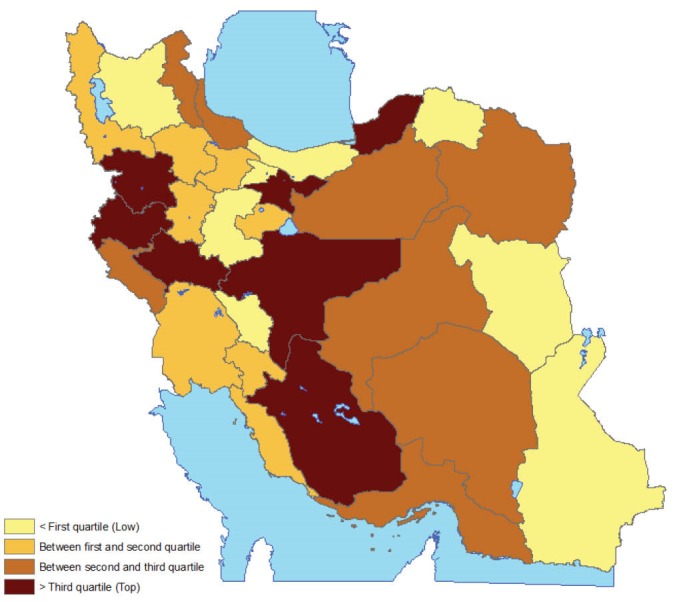
The relative frequency of alcohol use at least once in previous year, among general population aged above 15, was estimated at 2.31% (95% CI: 2.12%, 2.53%). The relative frequency among males was about 8 times higher than females (4.13% versus 0.56%). The relative frequency among those aged 18 to 30 was 3 times higher than those aged above 30 (3.97% versus 1.36%). The relative frequency among male aged 18 to 30 was about 7%.
It seems that the NSU is a feasible method to monitor the relative frequency of alcohol use in Iran, and possibly in countries with similar culture. Alcohol use was lower than non-Muslim countries, however, its relative frequency, in particular in young males, was noticeable.
在伊斯兰国家,饮酒被视为违背宗教价值观的行为。因此,使用直接方法估计饮酒频率容易受到各种偏差的影响。在这项研究中,我们使用网络规模扩大(NSU)方法,在一个有代表性的样本网络中,间接估计伊朗的饮酒频率。
在一项全国性调查中,每个省份约有 400 名年龄在 18 岁以上的参与者,总共约有 12000 人。在面对面的性别匹配访谈中,受访者被问及在过去一年中,他们活跃的社交网络中按年龄和性别分类的饮酒者(即使只有一次)的人数。结果经过了饮酒可见度的校正。
在 15 岁以上的普通人群中,过去一年至少饮酒一次的相对频率估计为 2.31%(95%CI:2.12%,2.53%)。男性的相对频率大约是女性的 8 倍(4.13%比 0.56%)。18 至 30 岁人群的相对频率比 30 岁以上人群高 3 倍(3.97%比 1.36%)。18 至 30 岁男性的相对频率约为 7%。
NSU 似乎是一种可行的方法,可以监测伊朗,以及可能在具有相似文化的国家中,饮酒的相对频率。饮酒率低于非穆斯林国家,但特别是在年轻男性中,相对频率相当显著。