Tahmasebi Farnoush, Longstaffe Fred J, Zazula Grant, Bennett Bruce
Department of Earth Sciences, The University of Western Ontario, London, Ontario, Canada.
Yukon Palaeontology Program, Department of Tourism and Culture, Government of Yukon, Whitehorse, Yukon Territory, Canada.
PLoS One. 2017 Aug 16;12(8):e0183016. doi: 10.1371/journal.pone.0183016. eCollection 2017.
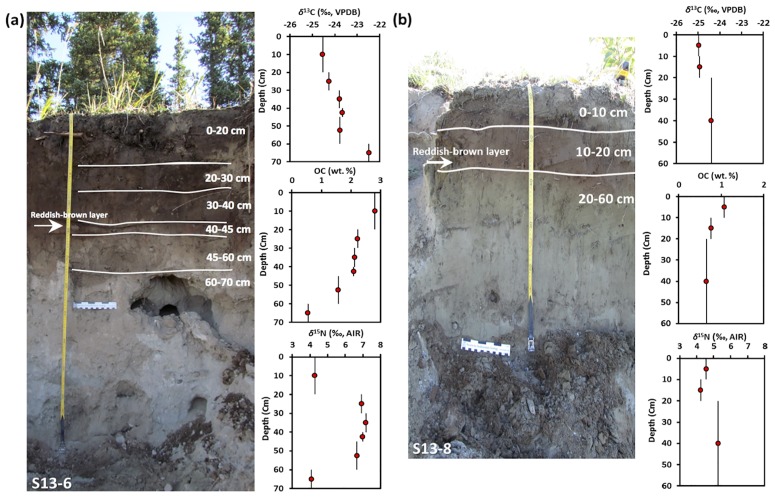
We examine here the carbon and nitrogen isotopic compositions of bulk soils (8 topsoil and 7 subsoils, including two soil profiles) and five different plant parts of 79 C3 plants from two main functional groups: herbs and shrubs/subshrubs, from 18 different locations in grasslands of southern Yukon Territory, Canada (eastern shoreline of Kluane Lake and Whitehorse area). The Kluane Lake region in particular has been identified previously as an analogue for Late Pleistocene eastern Beringia. All topsoils have higher average total nitrogen δ15N and organic carbon δ13C than plants from the same sites with a positive shift occurring with depth in two soil profiles analyzed. All plants analyzed have an average whole plant δ13C of -27.5 ± 1.2 ‰ and foliar δ13C of -28.0 ± 1.3 ‰, and average whole plant δ15N of -0.3 ± 2.2 ‰ and foliar δ15N of -0.6 ± 2.7 ‰. Plants analyzed here showed relatively smaller variability in δ13C than δ15N. Their average δ13C after suitable corrections for the Suess effect should be suitable as baseline for interpreting diets of Late Pleistocene herbivores that lived in eastern Beringia. Water availability, nitrogen availability, spacial differences and intra-plant variability are important controls on δ15N of herbaceous plants in the study area. The wider range of δ15N, the more numerous factors that affect nitrogen isotopic composition and their likely differences in the past, however, limit use of the modern N isotopic baseline for vegetation in paleodietary models for such ecosystems. That said, the positive correlation between foliar δ15N and N content shown for the modern plants could support use of plant δ15N as an index for plant N content and therefore forage quality. The modern N isotopic baseline cannot be applied directly to the past, but it is prerequisite to future efforts to detect shifts in N cycling and forage quality since the Late Pleistocene through comparison with fossil plants from the same region.
我们在此研究了加拿大育空地区南部草原(克卢恩湖东岸和白马地区)18个不同地点的79种C3植物(来自草本植物和灌木/亚灌木两个主要功能组)的五种不同植物部位以及大量土壤(8个表土和7个底土,包括两个土壤剖面)的碳和氮同位素组成。特别是克卢恩湖地区此前已被确定为晚更新世东白令陆桥的类似区域。所有表土的平均总氮δ15N和有机碳δ13C均高于同一地点的植物,在所分析的两个土壤剖面中,随着深度增加出现正向变化。所有分析的植物全株平均δ13C为-27.5±1.2‰,叶片δ13C为-28.0±1.3‰,全株平均δ15N为-0.3±2.2‰,叶片δ15N为-0.6±2.7‰。此处分析的植物δ13C的变异性相对小于δ15N。经过对苏斯效应的适当校正后,它们的平均δ13C应适合作为解释生活在东白令陆桥的晚更新世食草动物饮食的基线。水分可利用性、氮可利用性、空间差异和植物内变异性是研究区域内草本植物δ15N的重要控制因素。然而,δ15N的范围越广,影响氮同位素组成的因素就越多,且它们过去可能存在差异,这限制了在这类生态系统的古饮食模型中使用现代植被的氮同位素基线。话虽如此,现代植物叶片δ15N与氮含量之间的正相关关系可能支持将植物δ15N用作植物氮含量及因此用作饲料质量的指标。现代氮同位素基线不能直接应用于过去,但它是未来通过与同一地区的化石植物比较来检测自晚更新世以来氮循环和饲料质量变化的前提条件。