Lin Huei-Ru, Otsubo Tetsuya, Imanaka Yuichi
The Japan Foundation for Aging and Health, 4F, 1-1 Aza Gengoyama, Oaza Morioka, Higashiura-cho, Chita-gun, Aichi, 470-2101, Japan.
Department of Healthcare Economics and Quality Management, Graduate School of Medicine, Kyoto University, Yoshida Konoe-cho, Sakyo-ku, Kyoto, 606-8501, Japan.
BMC Geriatr. 2017 Aug 15;17(1):182. doi: 10.1186/s12877-017-0555-8.
Japan is known for its long life expectancy and rapidly aging society that there are various demands of older adults need to be fulfilled with, and one of them is long-term care needs. Therefore, Japan implemented the Long-Term Care Insurance in year 2000 for citizens who are above 65-year old and citizens who are above 40-year old in needs of long-term care services. This study was undertaken to longitudinally examine the influence of dementia and living alone on care needs increases among older long-term care insurance service users in Japan.
Long-term care insurance claims data were used to identify enrollees who applied for long-term care services between October 2010 and September 2011, and subjects were tracked until March 2015. A Kaplan-Meier survival analysis was conducted to examine increases in care needs over time in months. Cox regression models were used to examine the effects of dementia and living alone on care needs increases.
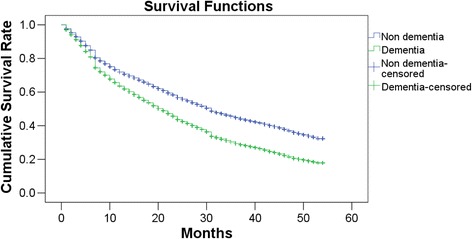
The cumulative survival rates before care needs increased over the 4.5-year observation period were 17.6% in the dementia group and 31.9% in the non-dementia group. After adjusting for age, sex, care needs level, and status of living alone, the risk of care needs increases was found to be 1.5 times higher in the dementia group. Living alone was not a significant risk factor of care needs increases, but people with dementia who lived alone had a higher risk of care needs increases than those without dementia.
Dementia, older age, the female sex, and lower care needs levels were associated with a higher risk of care needs increases over the study period. Among these variables, dementia had the strongest impact on care needs increases, especially in persons who lived alone.
日本以其较长的预期寿命和快速老龄化的社会而闻名,老年人有各种需求需要得到满足,其中之一就是长期护理需求。因此,日本于2000年为65岁以上的公民以及有长期护理服务需求的40岁以上公民实施了长期护理保险。本研究旨在纵向考察痴呆症和独居对日本老年长期护理保险服务使用者护理需求增加的影响。
使用长期护理保险理赔数据来确定2010年10月至2011年9月期间申请长期护理服务的参保人,并对受试者进行跟踪直至2015年3月。进行Kaplan-Meier生存分析以检查护理需求随时间(以月为单位)的增加情况。使用Cox回归模型来检查痴呆症和独居对护理需求增加的影响。
在4.5年的观察期内,护理需求增加前的累积生存率在痴呆症组中为17.6%,在非痴呆症组中为31.9%。在调整年龄、性别、护理需求水平和独居状况后,发现痴呆症组护理需求增加的风险高出1.5倍。独居不是护理需求增加的显著风险因素,但独居的痴呆症患者护理需求增加的风险高于非痴呆症患者。
在研究期间,痴呆症、高龄、女性以及较低的护理需求水平与护理需求增加的较高风险相关。在这些变量中,痴呆症对护理需求增加的影响最大,尤其是在独居者中。