Pennington Zachary T, Anderson Austin S, Fanselow Michael S
Department of Psychology, UCLA, Los Angeles, California 90095, USA.
Brain Research Institute, UCLA, Los Angeles, California 90095, USA.
Learn Mem. 2017 Aug 16;24(9):400-406. doi: 10.1101/lm.046110.117. Print 2017 Sep.
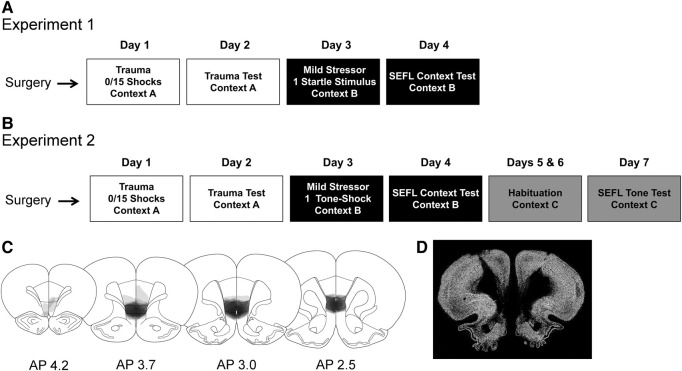
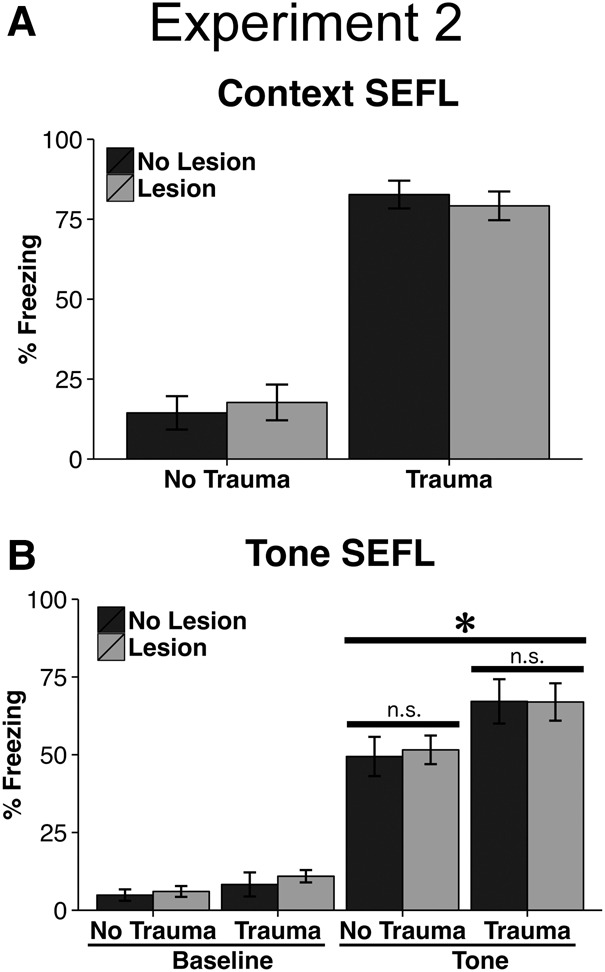
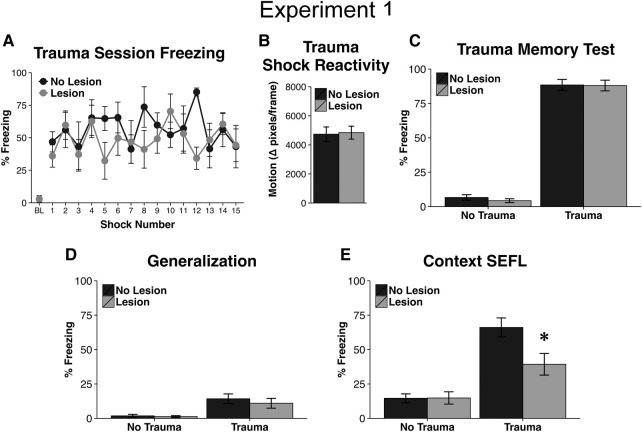
The ventromedial prefrontal cortex (vmPFC) has consistently appeared altered in post-traumatic stress disorder (PTSD). Although the vmPFC is thought to support the extinction of learned fear responses, several findings support a broader role for this structure in the regulation of fear. To further characterize the relationship between vmPFC dysfunction and responses to traumatic stress, we examined the effects of pretraining vmPFC lesions on trauma reactivity and enhanced fear learning in a rodent model of PTSD. In Experiment 1, lesions did not produce differences in shock reactivity during an acute traumatic episode, nor did they alter the strength of the traumatic memory. However, when lesioned animals were subsequently given a single mild aversive stimulus in a novel context, they showed a blunting of the enhanced fear response to this context seen in traumatized animals. In order to address this counterintuitive finding, Experiment 2 assessed whether lesions also attenuated fear responses to discrete tone cues. Enhanced fear for discrete cues following trauma was preserved in lesioned animals, indicating that the deficit observed in Experiment 1 is limited to contextual stimuli. These findings further support the notion that the vmPFC contributes to the regulation of fear through its influence on context learning and contrasts the prevailing view that the vmPFC directly inhibits fear.
腹内侧前额叶皮层(vmPFC)在创伤后应激障碍(PTSD)中一直表现出改变。尽管vmPFC被认为有助于消退习得的恐惧反应,但多项研究结果支持该结构在恐惧调节中发挥更广泛的作用。为了进一步阐明vmPFC功能障碍与创伤应激反应之间的关系,我们在PTSD啮齿动物模型中研究了训练前vmPFC损伤对创伤反应性和增强的恐惧学习的影响。在实验1中,损伤在急性创伤事件期间并未导致休克反应性出现差异,也未改变创伤记忆的强度。然而,当给损伤动物随后在新环境中给予单次轻度厌恶刺激时,它们对该环境的增强恐惧反应出现了钝化,而这种反应在受创伤动物中可以看到。为了解决这一与直觉相悖的发现,实验2评估了损伤是否也减弱了对离散音调线索的恐惧反应。创伤后对离散线索的增强恐惧在损伤动物中得以保留,这表明实验1中观察到的缺陷仅限于情境刺激。这些发现进一步支持了这样一种观点,即vmPFC通过对情境学习的影响来促进恐惧调节,这与vmPFC直接抑制恐惧的主流观点形成了对比。