Division of Preventive Medicine, Department of Family Medicine and Public Health, University of California, San Diego, California, USA.
Division of Cardiovascular Medicine, Department of Medicine, University of California, San Diego, California, USA.
Heart. 2018 Jan;104(2):135-143. doi: 10.1136/heartjnl-2017-311536. Epub 2017 Aug 16.
Recently, the density score of coronary artery calcium (CAC) has been shown to be associated with a lower risk of cardiovascular disease (CVD) events at any level of CAC volume. Whether risk factors for CAC volume and CAC density are similar or distinct is unknown. We sought to evaluate the associations of CVD risk factors with CAC volume and CAC density scores.
Baseline measurements from 6814 participants free of clinical CVD were collected for the Multi-Ethnic Study of Atherosclerosis. Participants with detectable CAC (n=3398) were evaluated for this study. Multivariable linear regression models were used to evaluate independent associations of CVD risk factors with CAC volume and CAC density scores.
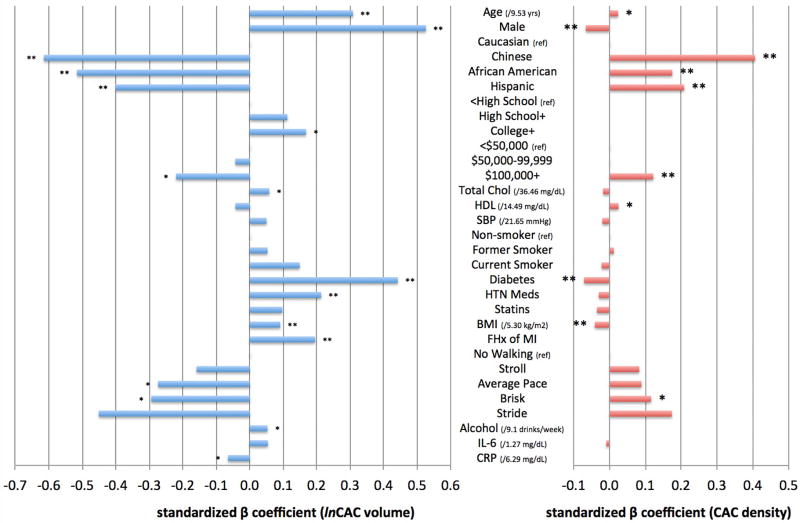
Whereas most CVD risk factors were associated with higher CAC volume scores, many risk factors were associated with CAC density scores. For example, diabetes was associated with a higher natural logarithm () transformed CAC volume score (standardised β=0.44 (95% CI 0.31 to 0.58) ln-units) but a lower CAC density score (β=-0.07 (-0.12 to -0.02) density units). Chinese, African-American and Hispanic race/ethnicity were each associated with lower CAC volume scores (β=-0.62 (-0.83to -0.41), -0.52 (-0.64 to -0.39) and -0.40 (-0.55 to -0.26) ln-units, respectively) and higher CAC density scores (β= 0.41 (0.34 to 0.47), 0.18 (0.12 to 0.23) and 0.21 (0.15 to 0.26) density units, respectively) relative to non-Hispanic White.
In a cohort free of clinical CVD, CVD risk factors are differentially associated with CAC volume and density scores, with many CVD risk factors associated with the CAC density score after controlling for the CAC volume score. These findings suggest complex associations between CVD risk factors and these components of CAC.
最近,冠状动脉钙(CAC)密度评分已被证明与任何 CAC 体积水平的心血管疾病(CVD)事件风险降低相关。CAC 体积和 CAC 密度的危险因素是否相似或不同尚不清楚。我们试图评估 CVD 危险因素与 CAC 体积和 CAC 密度评分的相关性。
从无临床 CVD 的 6814 名参与者中收集了基线测量值,用于进行多民族动脉粥样硬化研究。对可检测 CAC(n=3398)的参与者进行了此项研究。使用多变量线性回归模型评估 CVD 危险因素与 CAC 体积和 CAC 密度评分的独立相关性。
虽然大多数 CVD 危险因素与 CAC 体积评分升高相关,但许多危险因素与 CAC 密度评分相关。例如,糖尿病与较高的自然对数()转换 CAC 体积评分(标准化β=0.44(95%CI 0.31 至 0.58)ln-单位)相关,但与较低的 CAC 密度评分(β=-0.07(-0.12 至 -0.02)密度单位)相关。中国、非裔美国人和西班牙裔种族/民族分别与较低的 CAC 体积评分(β=-0.62(-0.83 至 -0.41)、-0.52(-0.64 至 -0.39)和-0.40(-0.55 至 -0.26)ln 单位)和较高的 CAC 密度评分(β=0.41(0.34 至 0.47)、0.18(0.12 至 0.23)和 0.21(0.15 至 0.26)密度单位)相关,与非西班牙裔白人相比。
在无临床 CVD 的队列中,CVD 危险因素与 CAC 体积和密度评分存在差异相关性,在控制 CAC 体积评分后,许多 CVD 危险因素与 CAC 密度评分相关。这些发现表明 CVD 危险因素与 CAC 这些成分之间存在复杂的关联。