Huang Da-Wei, Huang Mei, Lin Xian-Sheng, Huang Qiang
Department of General Surgery, Affiliated Provincial Hospital, Anhui Medical University, Hefei.
Anhui Province Key Laboratory of Hepatopancreatobiliary Surgery, Anhui Provincial Hospital, Hefei, People's Republic of China.
Onco Targets Ther. 2017 Jul 31;10:3817-3825. doi: 10.2147/OTT.S141476. eCollection 2017.
CD155, an immunoglobulin-like adhesion molecule, plays an important role in carcinoma such as cells migration, proliferation, metastasis, and tumor immune. The upregulation of CD155 has been found in several human malignancies, but its expression in cholangiocarcinoma (CCA) still remains unclear. The aim of this study is to investigate CD155 expression and its correlations with clinicopathologic data, angiogenesis, and prognosis in the patients with CCA.
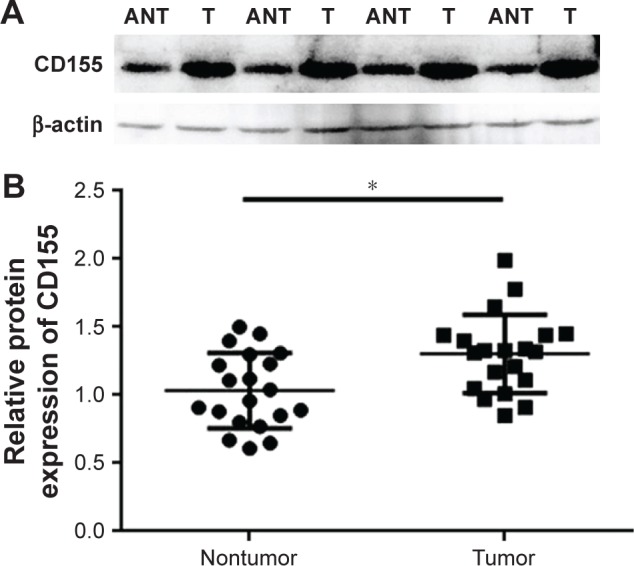
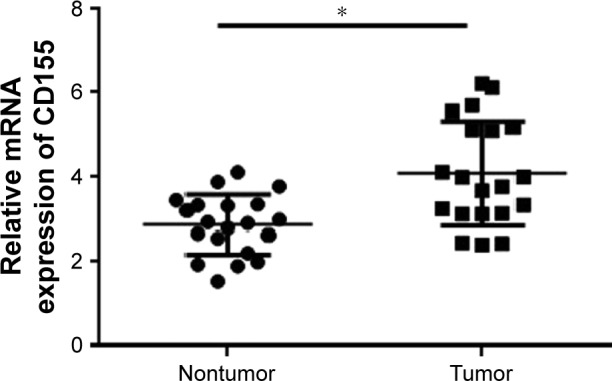
CD155 expression was investigated in 20 paired CCA tissues and corresponding paracancerous tissues by Western blotting and quantitative real-time polymerase chain reaction assays at protein and mRNA levels. Besides, this study evaluated the correlation between the tumor CD155 expression and the level of both vascular endothelial growth factor and intratumoral microvessel density by immunohistochemistry in 90 cases of CCA. Moreover, the clinical and prognostic significance of CD155 in CCA was assessed by immunohistochemistry.
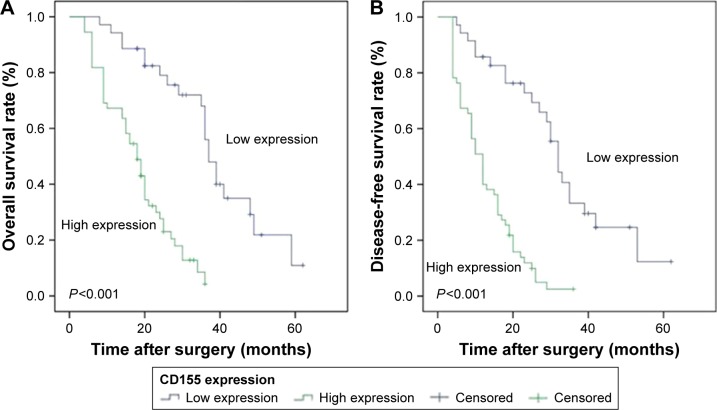
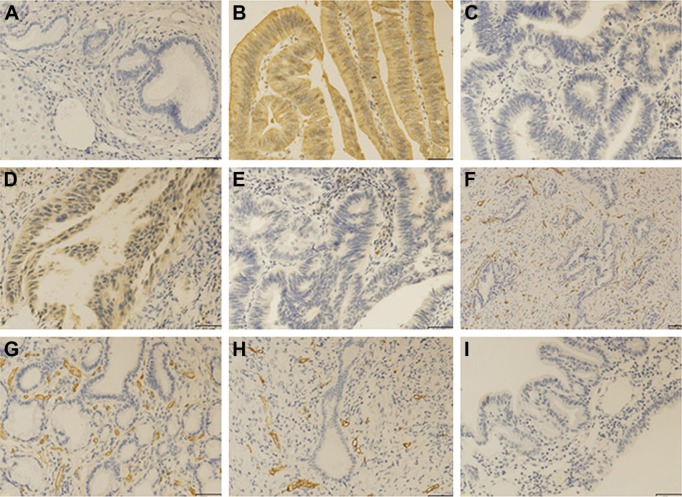
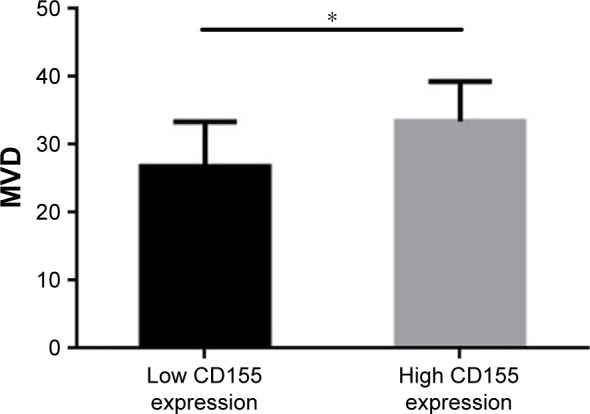
The protein and mRNA levels of CD155 were higher in CCA tumor tissues compared with corresponding paracancerous tissues (<0.05). Immunohistochemical staining showed that CD155 was located in the cytoplasm of carcinoma cells and overexpressed in 61.2% (55/90) CCA tissues. Obviously, CD155 expression level was significantly correlated with tumor histological grade (=0.002), lymph node metastasis (<0.001), and tumor-node-metastasis (=0.03). Additionally, Spearman rank correlation test demonstrated that CD155 expression was positively associated with vascular endothelial growth factor (=0.481, <0.001) and microvessel density (=0.442, <0.001) in CCA tissues. More importantly, CCA patients with high CD155 expression had a markedly shorter overall survival (<0.001) and disease-free survival (<0.001) after surgical resection, and multivariate analysis showed that high CD155 expression was an independent poor prognostic predictor of overall survival and disease-free survival (<0.001).
Our results revealed that upregulated CD155 correlated with aggressive clinicopathologic characteristics, angiogenesis, and poor prognosis in CCA and may be a promising prognostic biomarker for the CCA patients.
CD155是一种免疫球蛋白样粘附分子,在癌细胞迁移、增殖、转移及肿瘤免疫等癌症相关过程中发挥重要作用。在多种人类恶性肿瘤中均发现CD155表达上调,但其在胆管癌(CCA)中的表达仍不明确。本研究旨在探讨CD155在CCA患者中的表达情况及其与临床病理数据、血管生成和预后的相关性。
采用蛋白质印迹法和定量实时聚合酶链反应检测20对CCA组织及其相应癌旁组织中CD155在蛋白质和mRNA水平的表达。此外,本研究通过免疫组织化学法评估90例CCA患者肿瘤组织中CD155表达与血管内皮生长因子水平及肿瘤内微血管密度之间的相关性。此外,通过免疫组织化学法评估CD155在CCA中的临床及预后意义。
与相应癌旁组织相比,CCA肿瘤组织中CD155的蛋白质和mRNA水平更高(<0.05)。免疫组织化学染色显示,CD155定位于癌细胞胞质中,在61.2%(55/90)的CCA组织中过表达。显然,CD155表达水平与肿瘤组织学分级(=0.002)、淋巴结转移(<0.001)及肿瘤-淋巴结-转移分期(=0.03)显著相关。此外,Spearman等级相关检验表明,CD155表达与CCA组织中的血管内皮生长因子(=0.481,<0.001)和微血管密度(=0.442,<0.001)呈正相关。更重要的是,CD155高表达的CCA患者手术切除后的总生存期(<0.001)和无病生存期(<0.001)明显缩短,多因素分析显示,CD155高表达是总生存期和无病生存期的独立不良预后预测指标(<0.001)。
我们的研究结果表明,CD155上调与CCA侵袭性临床病理特征、血管生成及不良预后相关,可能是CCA患者有前景的预后生物标志物。