Yang Shuang, Chen Lijun, Chan Daniel W, Li Qing Kay, Zhang Hui
Department of Pathology, Johns Hopkins Medicine, Smith Bldg 4013, 400 N. Broadway, Baltimore, MD 21287 USA.
Clin Proteomics. 2017 Aug 15;14:31. doi: 10.1186/s12014-017-9166-9. eCollection 2017.
Non-small cell lung carcinoma (NSCLC) remains the leading cause of cancer deaths in the United States. More than half of NSCLC patients have clinical presentations with locally advanced or metastatic disease at the time of diagnosis. The large-scale genomic analysis of NSCLC has demonstrated that molecular alterations are substantially different between adenocarcinoma (ADC) and squamous cell carcinoma (SqCC). However, a comprehensive analysis of proteins and glycoproteins in different subtypes of NSCLC using advanced proteomic approaches has not yet been conducted.
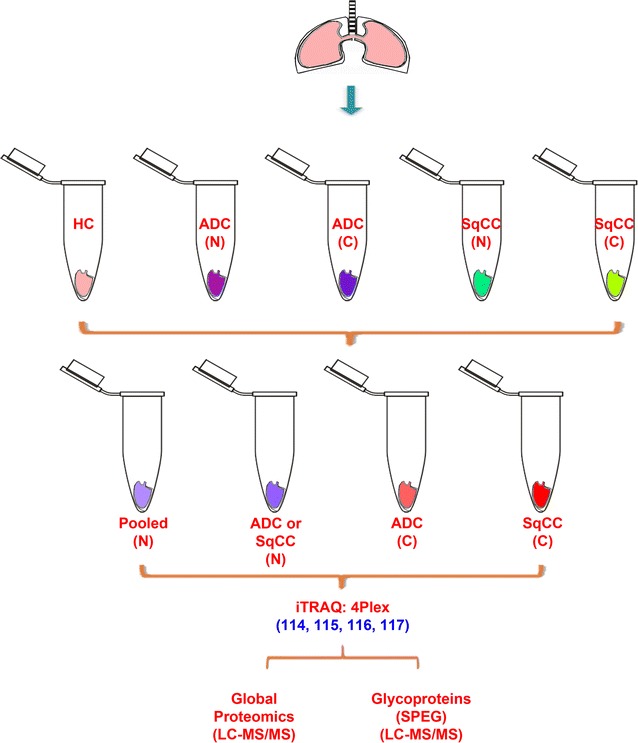
We applied mass spectrometry (MS) technology featuring proteomics and glycoproteomics to analyze six primary lung SqCCs and eleven ADCs, and we compared the expression level of proteins and glycoproteins in tumors using quantitative proteomics. Glycoproteins were analyzed by enrichment using a chemoenzymatic method, solid-phase extraction of glycopeptides, and quantified by iTRAQ-LC-MS/MS. Protein quantitation was further annotated via Ingenuity Pathway Analysis.
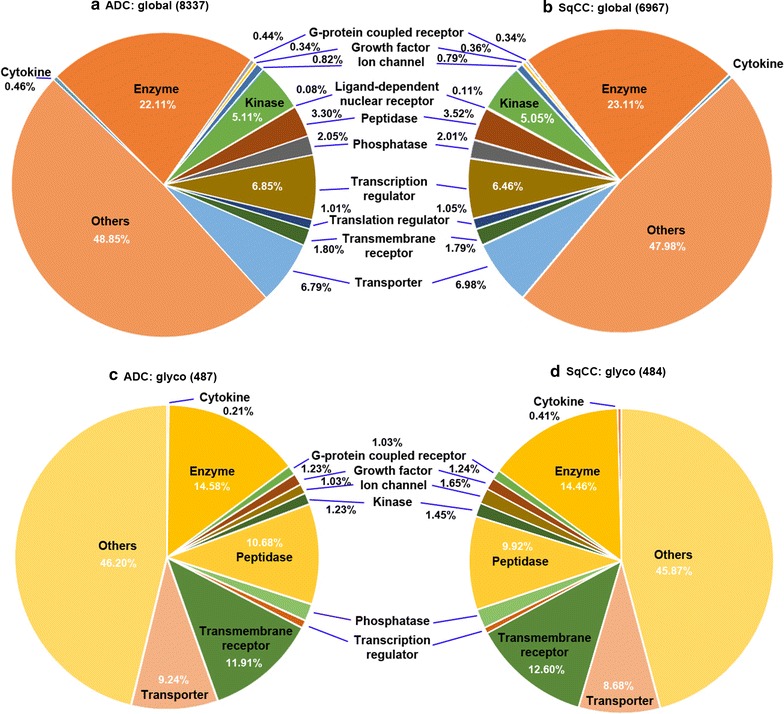
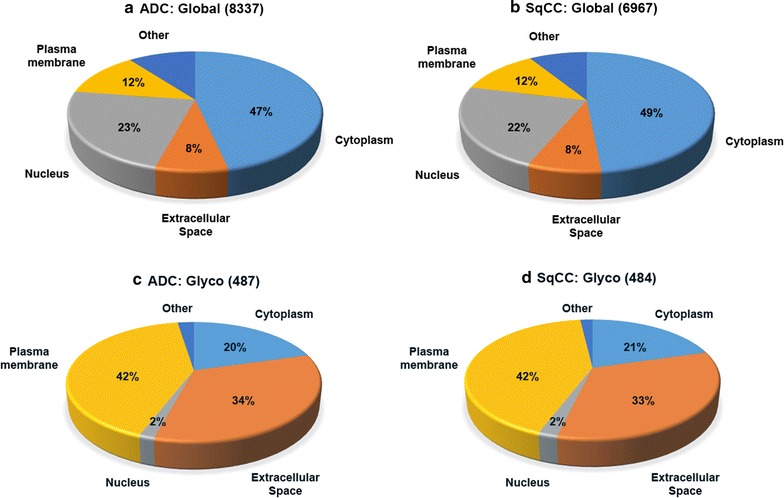
Over 6000 global proteins and 480 glycoproteins were quantitatively identified in both SqCC and ADC. ADC proteins (8337) consisted of enzymes (22.11%), kinases (5.11%), transcription factors (6.85%), transporters (6.79%), and peptidases (3.30%). SqCC proteins (6967) had a very similar distribution. The identified glycoproteins, in order of relative abundance, included membrane (42%) and extracellular matrix (>33%) glycoproteins. Oncogene-coded proteins (82) increased 1.5-fold among 1047 oncogenes identified in ADC, while 124 proteins from SqCC were up-regulated in tumor tissues among a total of 827 proteins. We identified 680 and 563 tumor suppressor genes from ADC and SqCC, respectively.
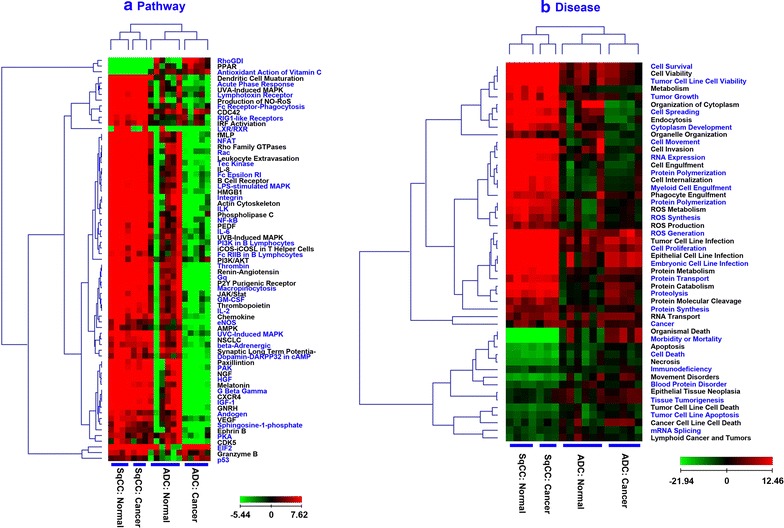
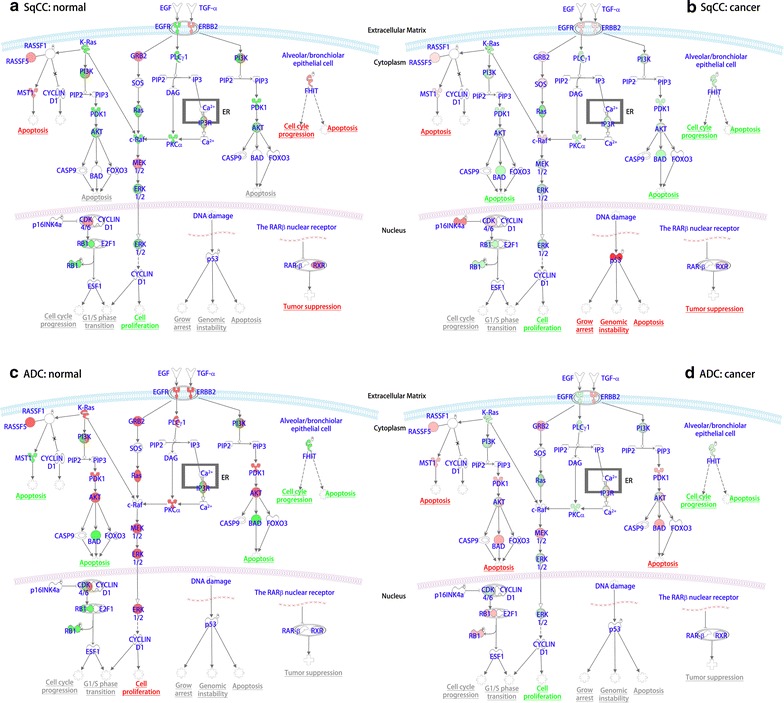
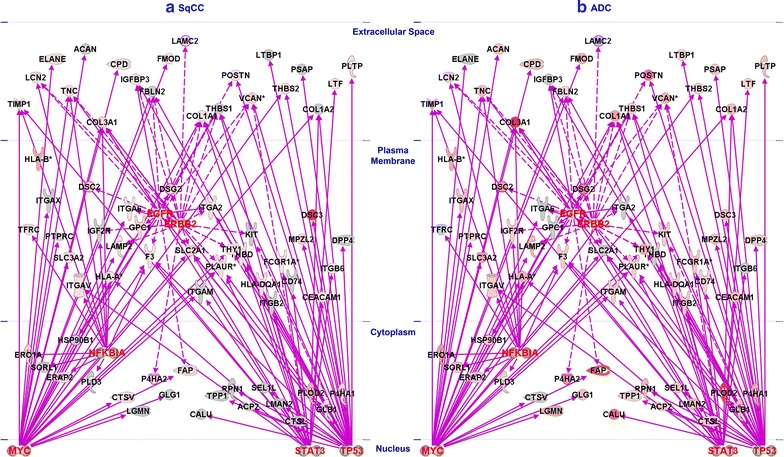
Our systematic analysis of proteins and glycoproteins demonstrates changes of protein and glycoprotein relative abundance in SqCC (TP53, U2AF1, and RXR) and in ADC (SMARCA4, NOTCH1, PTEN, and MST1). Among them, eleven glycoproteins were upregulated in both ADC and SqCC. Two glycoproteins (ELANE and IGFBP3) were only increased in SqCC, and six glycoproteins (ACAN, LAMC2, THBS1, LTBP1, PSAP and COL1A2) were increased in ADC. Ingenuity Pathway Analysis (IPA) showed that several crucial pathways were activated in SqCC and ADC tumor tissues.
非小细胞肺癌(NSCLC)仍是美国癌症死亡的主要原因。超过半数的NSCLC患者在确诊时就已出现局部晚期或转移性疾病的临床表现。NSCLC的大规模基因组分析表明,腺癌(ADC)和鳞状细胞癌(SqCC)之间的分子改变存在显著差异。然而,尚未使用先进的蛋白质组学方法对NSCLC不同亚型中的蛋白质和糖蛋白进行全面分析。
我们应用了具有蛋白质组学和糖蛋白质组学特点的质谱(MS)技术,分析了6例原发性肺SqCC和11例ADC,并使用定量蛋白质组学比较了肿瘤中蛋白质和糖蛋白的表达水平。通过化学酶法富集、糖肽的固相萃取对糖蛋白进行分析,并通过iTRAQ-LC-MS/MS进行定量。通过Ingenuity通路分析进一步注释蛋白质定量结果。
在SqCC和ADC中均定量鉴定出超过6000种全局蛋白质和480种糖蛋白。ADC蛋白质(8337种)包括酶(22.11%)、激酶(5.11%)、转录因子(6.85%)、转运蛋白(6.79%)和肽酶(3.30%)。SqCC蛋白质(6967种)具有非常相似的分布。鉴定出的糖蛋白按相对丰度排序,包括膜糖蛋白(42%)和细胞外基质糖蛋白(>33%)。在ADC中鉴定出的1047个癌基因中,癌基因编码的蛋白质(82种)增加了1.5倍,而在总共827种蛋白质中,SqCC的124种蛋白质在肿瘤组织中上调。我们分别从ADC和SqCC中鉴定出680个和563个肿瘤抑制基因。
我们对蛋白质和糖蛋白的系统分析表明,SqCC(TP53、U2AF1和RXR)和ADC(SMARCA4、NOTCH1、PTEN和MST1)中蛋白质和糖蛋白的相对丰度发生了变化。其中,11种糖蛋白在ADC和SqCC中均上调。两种糖蛋白(ELANE和IGFBP3)仅在SqCC中增加,6种糖蛋白(ACAN、LAMC2、THBS1、LTBP1、PSAP和COL1A2)在ADC中增加。Ingenuity通路分析(IPA)表明,SqCC和ADC肿瘤组织中的几个关键通路被激活。