Lei Lu, Li Kejia, Li Ling, Fang Xia, Zhou Tingting, Zhang Cheng, Luo Yong, Liu Hua, Li Xiaoqiang, Zheng Hongting, Zhang Lin, Yang Gangyi, Gao Lin
Department of Endocrinology, the Affiliated Hospital, Zunyi Medical College, Guizhou, China.
Department of Endocrinology, the Second Affiliated Hospital, Chongqing Medical University, Chongqing, China.
Nutr Metab (Lond). 2017 Aug 14;14:53. doi: 10.1186/s12986-017-0210-6. eCollection 2017.
Zinc-α2-glycoprotein (ZAG) is a novel adipokine that reduces insulin resistance, protecting against type 2 diabetes. However, past studies have been contradictory. This cross-sectional study aims to investigate the association of circulating ZAG with metabolic syndrome (MetS) in middle-aged and older Chinese adults.
Four hundred eighty nine individuals (234 healthy controls and 255 MetS patients) were examined. All individuals were screened for MetS according to the diagnostic guidelines of the United States National Cholesterol Education Program (NCEP) Expert Panel Adult Treatment Panel (ATP) III criteria. Circulating ZAG and ADI levels were measured by ELISA. Blood fat, glucose and insulin were measured with a commercial kit. Circulating ZAG levels were compared with various parameters in study subjects.
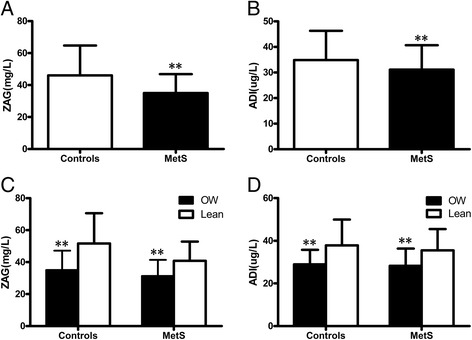
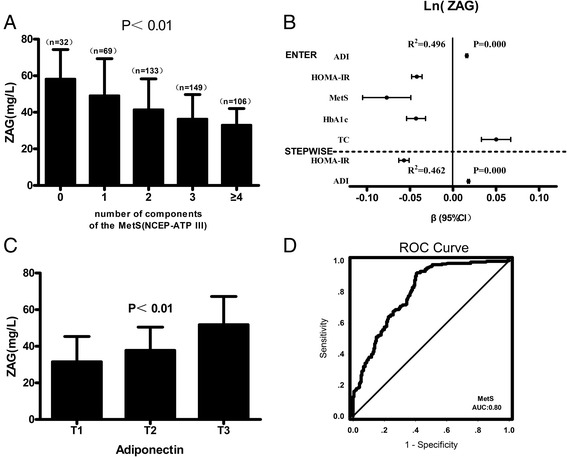
Plasma ZAG levels were lower in MetS patients compared to those of the healthy controls (35.0 ± 11.7 vs. 46.1 ± 18.6 mg/L, < 0.01). ZAG showed a positive correlation with age, HDL-C, HOMA-β and ADI, but a negative correlation with Fat%, BMI, WHR, blood pressure, triglycerides, FFA, FBG, 2 h-BG, fasting insulin, 2 h-Ins, HbA1c and HOMA-IR ( < 0.01). When the population was divided according to tertiles of ADI, subjects in the highest tertile had the highest ZAG levels. The analysis of ROC curves revealed that the best cutoff value for plasma ZAG to predict MetS was 45.2 mg/L (sensitivity 92%, specificity 59%, and AUC 0.80).
We found that circulating ZAG levels were decreased in patients with MetS. In fact, circulating ZAG decreased progressively with an increasing number of MetS components and associated with ADI levels, suggesting that ZAG is related to IR and MetS and may be a sensitizer.
ChiCTR-OCC-11001422. Registered 23 June 2011.
锌-α2-糖蛋白(ZAG)是一种新型脂肪因子,可降低胰岛素抵抗,预防2型糖尿病。然而,过去的研究结果相互矛盾。这项横断面研究旨在调查中国中老年人群中循环ZAG与代谢综合征(MetS)之间的关联。
对489名个体(234名健康对照者和255名MetS患者)进行了检查。所有个体均根据美国国家胆固醇教育计划(NCEP)专家小组成人治疗小组(ATP)III标准的诊断指南进行MetS筛查。采用酶联免疫吸附测定法(ELISA)检测循环ZAG和ADI水平。使用商用试剂盒测量血脂、血糖和胰岛素水平。将循环ZAG水平与研究对象的各项参数进行比较。
与健康对照组相比,MetS患者的血浆ZAG水平较低(35.0±11.7 vs. 46.1±18.6 mg/L,P<0.01)。ZAG与年龄、高密度脂蛋白胆固醇(HDL-C)、胰岛素抵抗稳态模型评估-β细胞功能指数(HOMA-β)和ADI呈正相关,但与脂肪百分比(Fat%)、体重指数(BMI)、腰臀比(WHR)、血压、甘油三酯、游离脂肪酸(FFA)、空腹血糖(FBG)、餐后2小时血糖(2 h-BG)、空腹胰岛素、餐后2小时胰岛素(2 h-Ins)、糖化血红蛋白(HbA1c)和胰岛素抵抗稳态模型评估-胰岛素抵抗指数(HOMA-IR)呈负相关(P<0.01)。当根据ADI三分位数对人群进行划分时,处于最高三分位数的受试者ZAG水平最高。ROC曲线分析显示,血浆ZAG预测MetS的最佳截断值为45.2 mg/L(敏感性92%,特异性59%,曲线下面积[AUC] 0.80)。
我们发现MetS患者的循环ZAG水平降低。事实上,循环ZAG水平随着MetS组分数量的增加而逐渐降低,并与ADI水平相关,这表明ZAG与胰岛素抵抗和MetS有关,可能是一种增敏剂。
中国临床试验注册中心注册号:ChiCTR-OCC-11001422。于2011年6月23日注册。