Schuster Susan, Tholen Lotte E, Overheul Gijs J, van Kuppeveld Frank J M, van Rij Ronald P
Department of Medical Microbiology, Radboud University Medical Center, Radboud Institute for Molecular Life Sciences, Nijmegen, The Netherlands.
Virology Division, Department of Infectious Diseases and Immunology, Faculty of Veterinary Medicine, Utrecht University, Utrecht, The Netherlands.
mSphere. 2017 Aug 16;2(4). doi: 10.1128/mSphere.00333-17. eCollection 2017 Jul-Aug.
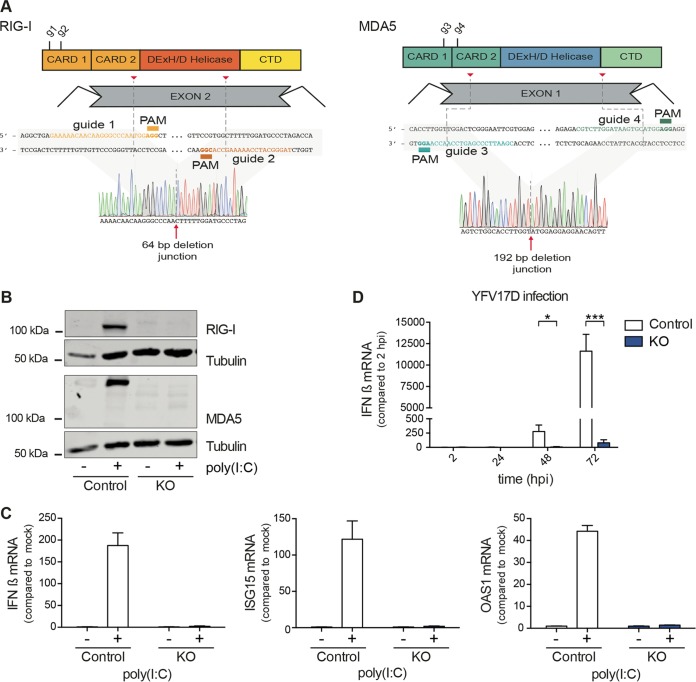
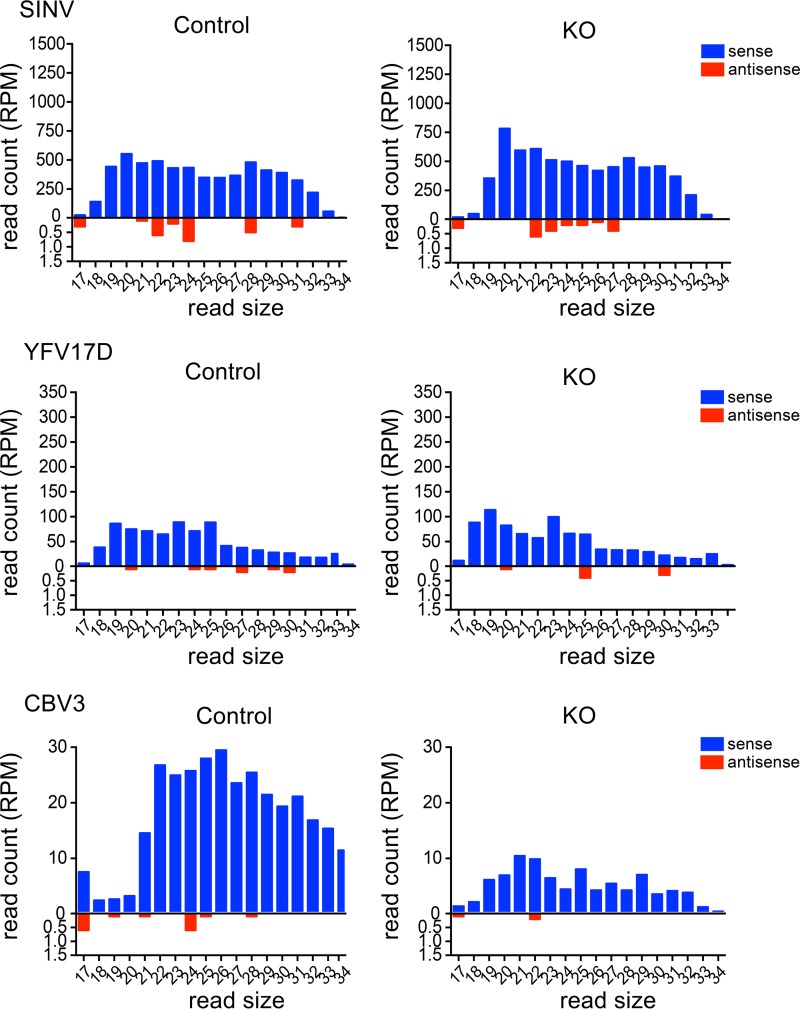
Antiviral immunity in insects and plants is mediated by the RNA interference (RNAi) pathway in which viral long double-stranded RNA (dsRNA) is processed into small interfering RNAs (siRNAs) by Dicer enzymes. Although this pathway is evolutionarily conserved, its involvement in antiviral defense in mammals is the subject of debate. In vertebrates, recognition of viral RNA induces a sophisticated type I interferon (IFN)-based immune response, and it has been proposed that this response masks or inhibits antiviral RNAi. To test this hypothesis, we analyzed viral small RNA production in differentiated cells deficient in the cytoplasmic RNA sensors RIG-I and MDA5. We did not detect 22-nucleotide (nt) viral siRNAs upon infection with three different positive-sense RNA viruses. Our data suggest that the depletion of cytoplasmic RIG-I-like sensors is not sufficient to uncover viral siRNAs in differentiated cells. The contribution of the RNA interference (RNAi) pathway in antiviral immunity in vertebrates has been widely debated. It has been proposed that RNAi possesses antiviral activity in mammalian systems but that its antiviral effect is masked by the potent antiviral interferon response in differentiated mammalian cells. In this study, we show that inactivation of the interferon response is not sufficient to uncover antiviral activity of RNAi in human epithelial cells infected with three wild-type positive-sense RNA viruses.
昆虫和植物中的抗病毒免疫由RNA干扰(RNAi)途径介导,在该途径中,病毒长双链RNA(dsRNA)被Dicer酶加工成小干扰RNA(siRNA)。尽管该途径在进化上是保守的,但其在哺乳动物抗病毒防御中的作用仍存在争议。在脊椎动物中,对病毒RNA的识别会引发复杂的基于I型干扰素(IFN)的免疫反应,有人提出这种反应会掩盖或抑制抗病毒RNAi。为了验证这一假设,我们分析了缺乏细胞质RNA传感器RIG-I和MDA5的分化细胞中病毒小RNA的产生情况。在用三种不同的正链RNA病毒感染后,我们未检测到22个核苷酸(nt)的病毒siRNA。我们的数据表明,细胞质中RIG-I样传感器的缺失不足以在分化细胞中发现病毒siRNA。RNA干扰(RNAi)途径在脊椎动物抗病毒免疫中的作用一直存在广泛争议。有人提出RNAi在哺乳动物系统中具有抗病毒活性,但其抗病毒作用在分化的哺乳动物细胞中被强大的抗病毒干扰素反应所掩盖。在这项研究中,我们表明,在感染三种野生型正链RNA病毒的人上皮细胞中,干扰素反应的失活不足以揭示RNAi的抗病毒活性。