Collaborative Innovation Center for Cancer Medicine, State Key Laboratory of Oncology in South China, Sun Yat-sen University Cancer Center, Guangzhou, China.
Department of Pathology, Sun Yat-Sen University Cancer Center, Guangzhou, China.
J Cell Mol Med. 2017 Dec;21(12):3718-3729. doi: 10.1111/jcmm.13281. Epub 2017 Aug 16.
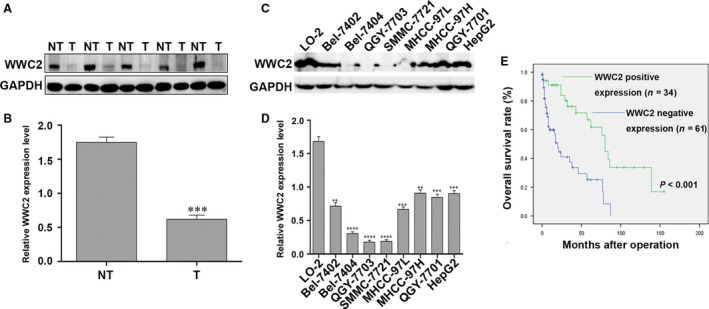
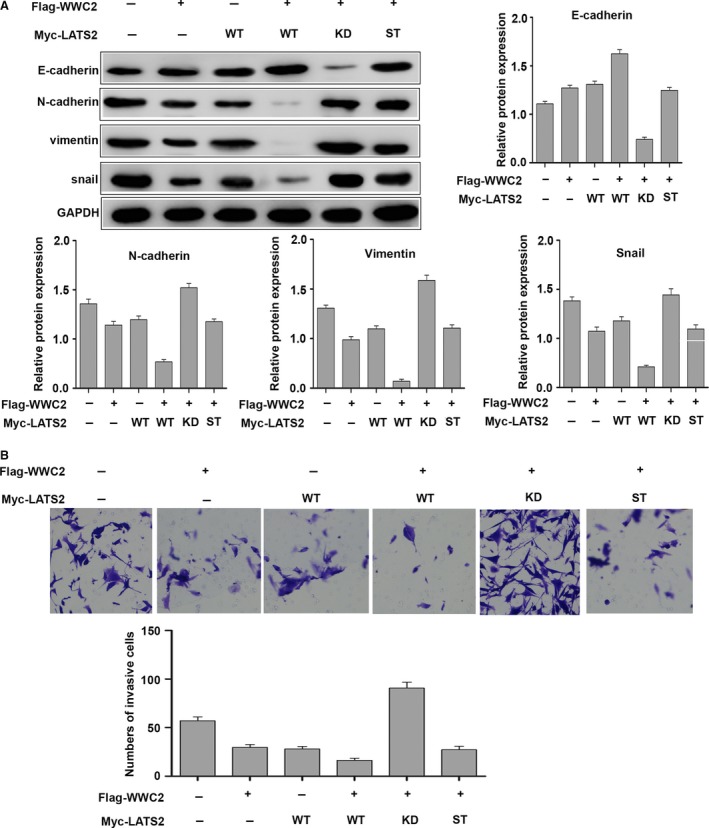
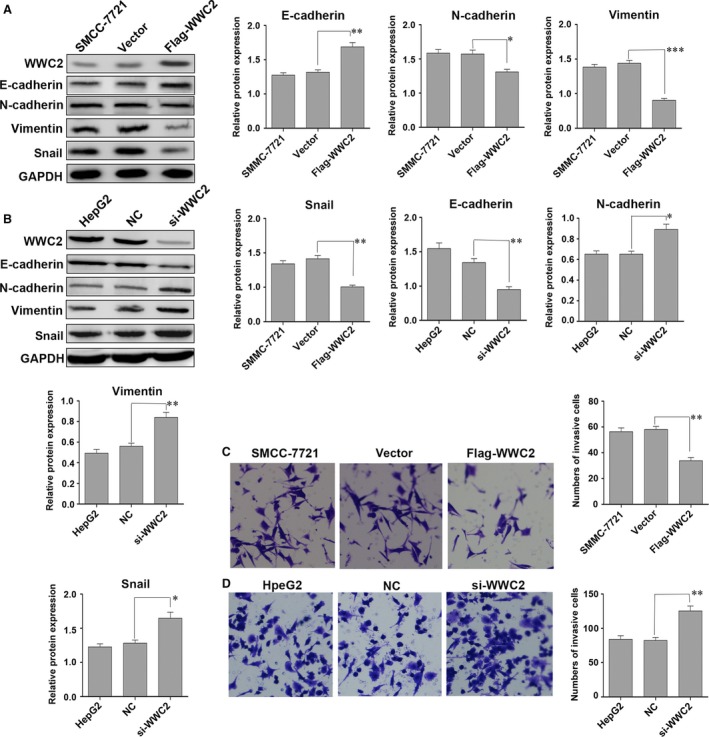
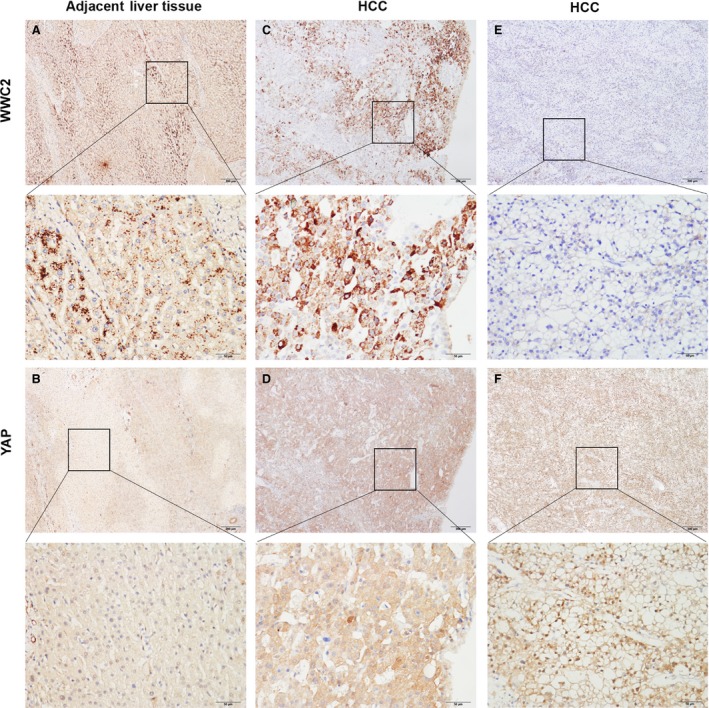
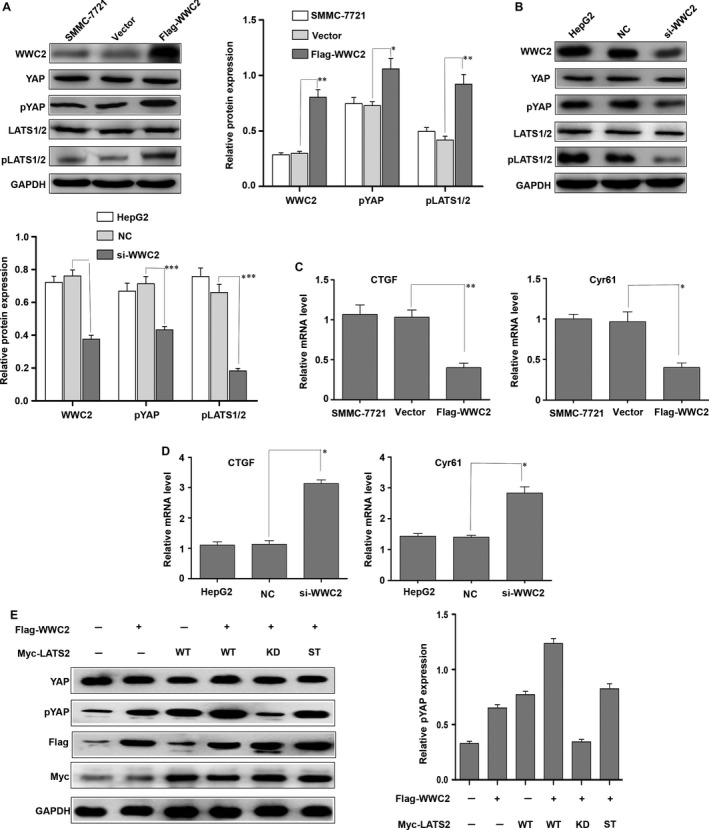
WWC family proteins negatively regulate HEK293 cell proliferation and organ growth by suppressing the transcriptional activity of Yes-associated protein (YAP), a major effector of the Hippo pathway. The function of the scaffolding protein WWC1 (also called KIBRA) has been intensively studied in cells and animal models. However, the expression and clinicopathologic significance of WWC2 in cancer are poorly characterized. This study aimed to clarify the biological function and mechanism of action of WWC2 in hepatocellular carcinoma (HCC). Retrospective analysis revealed WWC2 was significantly down-regulated in 95 clinical HCC tissues compared to the paired adjacent non-cancerous tissues. Moreover, loss of WWC2 expression was significantly associated with advanced clinicopathological features, including venous infiltration, larger tumour size and advanced TNM stage. Positive WWC2 expression was associated with significantly better 5-year overall survival, and WWC2 was an independent prognostic factor for overall survival in HCC. Moreover, we confirmed WWC2 inhibits HCC cell invasive ability in vitro. Elevated YAP expression was also observed in the same cohort of HCC tissues. Pearson's correlation coefficient analysis indicated WWC2 expression correlated inversely with nuclear YAP protein expression in HCC. Mechanistically, we confirmed overexpression of WWC2 suppresses the invasive and metastatic potential of HCC cells by activating large tumour suppressor 1 and 2 kinases (LATS1/2), which in turn phosphorylates the transcriptional co-activator YAP. Overall, this study indicates WWC2 functions as a tumour suppressor by negatively regulating the Hippo signalling pathway and may serve as a prognostic marker in HCC.
WWC 家族蛋白通过抑制 Hippo 通路的主要效应因子 Yes 相关蛋白 (YAP) 的转录活性,负调控 HEK293 细胞增殖和器官生长。支架蛋白 WWC1(也称为 KIBRA)的功能已在细胞和动物模型中得到深入研究。然而,WWC2 在癌症中的表达和临床病理意义尚未得到充分描述。本研究旨在阐明 WWC2 在肝细胞癌 (HCC) 中的生物学功能和作用机制。回顾性分析显示,与配对的相邻非癌组织相比,95 例临床 HCC 组织中 WWC2 的表达显著下调。此外,WWC2 表达缺失与晚期临床病理特征显著相关,包括静脉浸润、肿瘤体积较大和较晚的 TNM 分期。阳性 WWC2 表达与显著改善的 5 年总生存率相关,并且 WWC2 是 HCC 患者总生存率的独立预后因素。此外,我们还在体外证实了 WWC2 抑制 HCC 细胞的侵袭能力。在同一批 HCC 组织中还观察到 YAP 表达升高。Pearson 相关系数分析表明,在 HCC 中,WWC2 表达与核 YAP 蛋白表达呈负相关。在机制上,我们证实 WWC2 的过表达通过激活大肿瘤抑制 1 和 2 激酶 (LATS1/2) 抑制 HCC 细胞的侵袭和转移潜力,从而磷酸化转录共激活因子 YAP。总体而言,这项研究表明 WWC2 通过负调控 Hippo 信号通路发挥肿瘤抑制作用,可能作为 HCC 的预后标志物。