Rishi Pukhraj, Rishi Ekta, Sharma Minal, Maitray Aditya, Bhende Muna, Gopal Lingam, Sharma Tarun, Ratra Dhanashree, Sen Parveen, Bhende Pramod, Rao Chetan, Susvar Pradeep
Shri Bhagwan Mahavir Vitreoretinal Services, Sankara Nethralaya, Chennai, Tamil Nadu, India.
Indian J Ophthalmol. 2017 Aug;65(8):712-718. doi: 10.4103/ijo.IJO_174_17.
To evaluate the incidence, outcomes, and risk factors for hemorrhagic complications in eyes with polypoidal choroidal vasculopathy (PCV) following photodynamic therapy (PDT).
Medical records of 94 eyes of 86 consecutive patients with PCV who underwent PDT between January 2007 and December 2014 were retrospectively reviewed. The diagnosis of PCV was based on clinical features and indocyanine green angiography. Eyes were treated with PDT monotherapy or a combination of PDT plus anti-vascular endothelial growth factor. PDT was performed at (standard [SFPDT] or reduced fluence RFPDT).
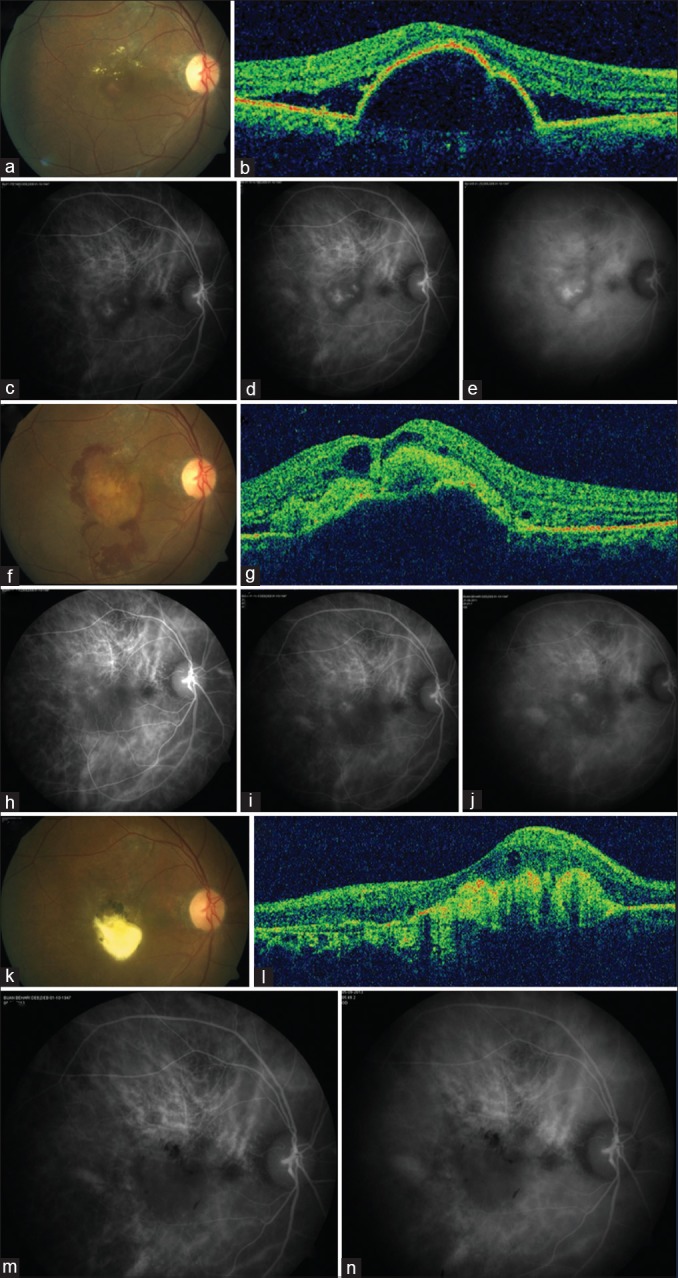
Ninety-four eyes had 119 PDT treatment sessions (mean: 1.3 sessions). Mean presenting vision was 0.46 ± 0.44 logarithm of the minimum angle of resolution (logMAR). Following PDT, ten eyes (11%) of nine patients had hemorrhagic complications such as subretinal hemorrhage (SRH; n = 5), subretinal pigment epithelium (RPE) hemorrhage (n = 1), breakthrough vitreous hemorrhage (BVH; n = 3), and SRH with sub-RPE hemorrhage and BVH (n = 1). Median interval to hemorrhage following PDT was 2 months. Age (P = 0.842), duration of symptoms (P = 0.352), number of laser spots (P = 0.219), and laser spot size (LSS) (P = 0.096) were not significantly associated with increased risk of hemorrhagic complications. Female gender was associated with reduced risk of hemorrhage (P = 0.045). SFPDT was significantly associated with increased risk of hemorrhage (P = 0.026). The probability of developing hemorrhagic complications in SFPDT group was 0.24 compared to 0.07 in RFPDT group (P = 0.039). Multivariate logistic regression analysis showed SFPDT as the only significant risk factor for hemorrhage following PDT (odds ratio 5.3, 95% confidence interval 1.1-24.8, P = 0.03). Mean final vision was 0.61 ± 0.53 logMAR at mean follow-up of 33 months (median = 22 months; range = 2-157 months).
Age, LSS, number of laser spots, preexisting hemorrhages, or use of anticoagulants were not associated with increased risk of hemorrhagic complications. SFPDT was significantly associated with increased risk of hemorrhagic complications in such eyes.
评估息肉样脉络膜血管病变(PCV)患者在光动力疗法(PDT)后发生出血性并发症的发生率、结局及危险因素。
回顾性分析2007年1月至2014年12月期间连续86例接受PDT治疗的PCV患者的94只眼的病历。PCV的诊断基于临床特征和吲哚菁绿血管造影。采用PDT单一疗法或PDT联合抗血管内皮生长因子治疗。PDT采用标准剂量(SFPDT)或降低剂量(RFPDT)进行。
94只眼共接受了119次PDT治疗(平均:1.3次)。初始平均视力为最小分辨角对数(logMAR)0.46±0.44。PDT后,9例患者的10只眼(11%)出现了出血性并发症,如视网膜下出血(SRH;n = 5)、视网膜色素上皮(RPE)下出血(n = 1)、玻璃体积血突破(BVH;n = 3)以及SRH合并RPE下出血和BVH(n = 1)。PDT后出血的中位间隔时间为2个月。年龄(P = 0.842)、症状持续时间(P = 0.352)、激光光斑数量(P = 0.219)和激光光斑大小(LSS)(P = 0.096)与出血性并发症风险增加无显著相关性。女性性别与出血风险降低相关(P = 0.045)。SFPDT与出血风险增加显著相关(P = 0.026)。SFPDT组发生出血性并发症的概率为0.24,而RFPDT组为0.07(P = 0.039)。多因素逻辑回归分析显示,SFPDT是PDT后出血的唯一显著危险因素(比值比5.3,95%置信区间1.1 - 24.8,P = 0.03)。平均随访33个月(中位数 = 22个月;范围 = 2 - 157个月)时,最终平均视力为0.61±0.53 logMAR。
年龄、LSS、激光光斑数量、既往出血情况或抗凝剂的使用与出血性并发症风险增加无关。SFPDT与此类眼中出血性并发症风险增加显著相关。