• 文献检索
  • 文档翻译
  • 深度研究
  • 学术资讯
  • Suppr Zotero 插件Zotero 插件
  • 邀请有礼
  • 套餐&价格
  • 历史记录
应用&插件
Suppr Zotero 插件Zotero 插件浏览器插件Mac 客户端Windows 客户端微信小程序
定价
高级版会员购买积分包购买API积分包
服务
文献检索文档翻译深度研究API 文档MCP 服务
关于我们
关于 Suppr公司介绍联系我们用户协议隐私条款
关注我们

Suppr 超能文献

核心技术专利:CN118964589B侵权必究
粤ICP备2023148730 号-1Suppr @ 2026

文献检索

告别复杂PubMed语法,用中文像聊天一样搜索,搜遍4000万医学文献。AI智能推荐,让科研检索更轻松。

立即免费搜索

文件翻译

保留排版,准确专业,支持PDF/Word/PPT等文件格式,支持 12+语言互译。

免费翻译文档

深度研究

AI帮你快速写综述,25分钟生成高质量综述,智能提取关键信息,辅助科研写作。

立即免费体验

哪些国家和地区存在未被统计的儿童?94 个国家和地区使用全国代表性家庭调查评估五岁以下儿童的出生证明覆盖情况及其不平等性。

Who and where are the uncounted children? Inequalities in birth certificate coverage among children under five years in 94 countries using nationally representative household surveys.

机构信息

Harvard T.H. Chan School of Public Health, 677 Huntington Ave, Boston, MA, 02115, USA.

International Center for Equity in Health, Federal University of Pelotas, Mal. Deodoro, 1160, 3d Floor, Pelotas, RS, 96020-220, Brazil.

出版信息

Int J Equity Health. 2017 Aug 18;16(1):148. doi: 10.1186/s12939-017-0635-6.

DOI:10.1186/s12939-017-0635-6
PMID:28821291
原文链接:https://pmc.ncbi.nlm.nih.gov/articles/PMC5562988/
Abstract

BACKGROUND

Birth registration, and the possession of a birth certificate as proof of registration, has long been recognized as a fundamental human right. Data from a functioning civil registration and vital statistics (CRVS) system allows governments to benefit from accurate and universal data on birth and death rates. However, access to birth certificates remains challenging and unequal in many low and middle-income countries. This paper examines wealth, urban/rural and gender inequalities in birth certificate coverage.

METHODS

We analyzed nationally representative household surveys from 94 countries between 2000 and 2014 using Demographic Health Surveys and Multiple Indicator Cluster Surveys. Birth certificate coverage among children under five was examined at the national and regional level. Absolute measures of inequality were used to measure inequalities in birth certificate coverage by wealth quintile, urban/rural residence and sex of the child.

RESULTS

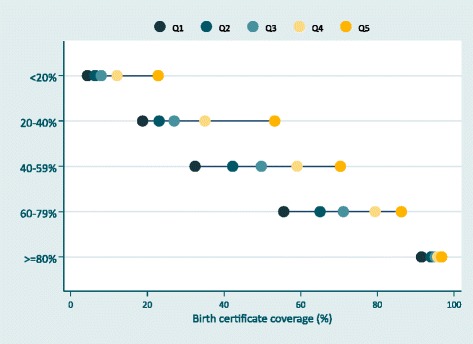
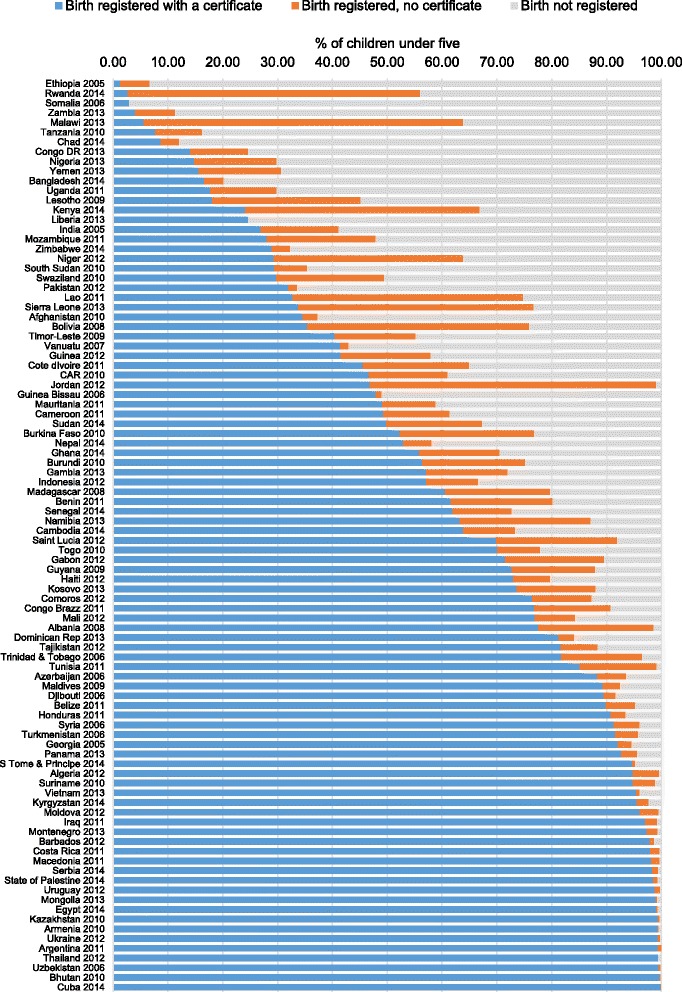
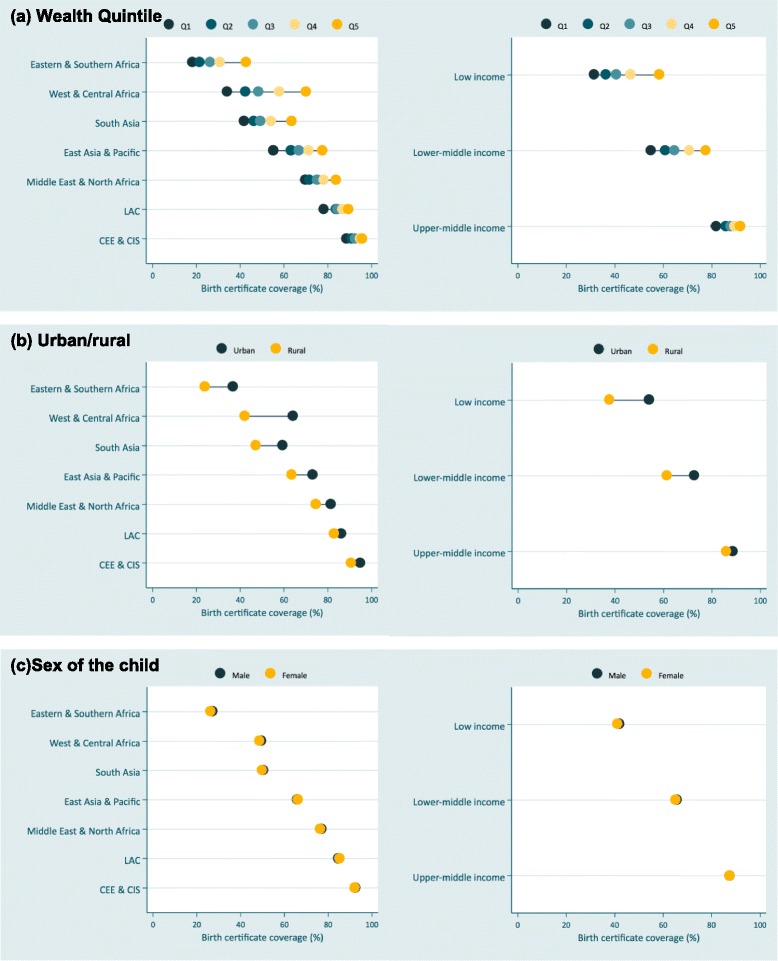
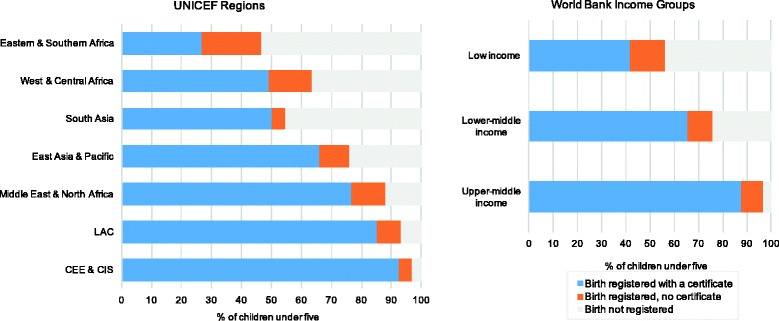
Over four million children were included in the analysis. Birth certificate coverage was over 90% in 29 countries and below 50% in 36 countries, indicating that more than half the children under five surveyed in these countries did not have a birth certificate. Eastern & Southern Africa had the lowest average birth certificate coverage (26.9%) with important variability among countries. Significant wealth inequalities in birth certificate coverage were observed in 74 countries and in most UNICEF regions, and urban/rural inequalities were present in 60 countries. Differences in birth certificate coverage between girls and boys tended to be small.

CONCLUSIONS

We show that wealth and urban/rural inequalities in birth certificate coverage persist in most low and middle income countries, including countries where national birth certificate coverage is between 60 and 80%. Weak CRVS systems, particularly in South Asia and Africa lead rural and poor children to be systematically excluded from the benefits tied to a birth certificate, and prevent these children from being counted in national health data. Greater funding and attention is needed to strengthen CRVS systems and equity analyses should inform such efforts, especially as data needs for the Sustainable Development Goals expand. Monitoring disaggregated data on birth certificate coverage is essential to reducing inequalities in who is counted and registered. Strengthening CRVS systems can enable a child's right to identity, improve health data and promote equity.

摘要

背景

长期以来,人们一直认为出生登记以及拥有出生证明作为登记证明是一项基本人权。功能完备的民事登记和人口动态统计系统(CRVS)的数据使政府能够受益于关于出生率和死亡率的准确和普遍数据。然而,在许多低收入和中等收入国家,获得出生证明仍然具有挑战性且不平等。本文研究了出生证明覆盖范围方面的财富、城乡和性别不平等问题。

方法

我们使用人口与健康调查和多指标类集调查,分析了 2000 年至 2014 年期间来自 94 个国家的具有代表性的家庭调查数据。在国家和区域层面检查了五岁以下儿童的出生证明覆盖率。使用绝对不平等衡量标准衡量了按财富五分位数、城乡居住和儿童性别划分的出生证明覆盖率的不平等程度。

结果

共有超过 400 万儿童被纳入分析。在 29 个国家,出生证明覆盖率超过 90%,而在 36 个国家,这一比例低于 50%,这表明在这些国家接受调查的五岁以下儿童中,超过一半没有出生证明。东非和南非的出生证明覆盖率最低(26.9%),各国之间差异很大。在 74 个国家和大多数儿童基金会区域都观察到出生证明覆盖率方面存在显著的财富不平等现象,而在 60 个国家都存在城乡不平等现象。出生证明覆盖率在女孩和男孩之间的差异往往很小。

结论

我们表明,在大多数低收入和中等收入国家,包括出生证明覆盖率在 60%至 80%之间的国家,财富和城乡出生证明覆盖率不平等仍然存在。在南亚和非洲,民事登记和人口动态统计系统薄弱,导致农村和贫困儿童被系统地排除在出生证明所带来的利益之外,并且使这些儿童无法被纳入国家卫生数据。需要更多的资金和关注来加强民事登记和人口动态统计系统,而且随着可持续发展目标数据需求的扩大,公平分析应该为这些努力提供信息。监测出生证明覆盖率的分类数据对于减少谁被计入和登记的不平等至关重要。加强民事登记和人口动态统计系统可以使儿童的身份权得到保障,改善卫生数据并促进公平。
https://cdn.ncbi.nlm.nih.gov/pmc/blobs/7487/5562988/d746c50d7c1b/12939_2017_635_Fig4_HTML.jpg
https://cdn.ncbi.nlm.nih.gov/pmc/blobs/7487/5562988/ac2e2301edc3/12939_2017_635_Fig1_HTML.jpg
https://cdn.ncbi.nlm.nih.gov/pmc/blobs/7487/5562988/494bbbdefe6e/12939_2017_635_Fig2_HTML.jpg
https://cdn.ncbi.nlm.nih.gov/pmc/blobs/7487/5562988/637aa9ce8c11/12939_2017_635_Fig3_HTML.jpg
https://cdn.ncbi.nlm.nih.gov/pmc/blobs/7487/5562988/d746c50d7c1b/12939_2017_635_Fig4_HTML.jpg
https://cdn.ncbi.nlm.nih.gov/pmc/blobs/7487/5562988/ac2e2301edc3/12939_2017_635_Fig1_HTML.jpg
https://cdn.ncbi.nlm.nih.gov/pmc/blobs/7487/5562988/494bbbdefe6e/12939_2017_635_Fig2_HTML.jpg
https://cdn.ncbi.nlm.nih.gov/pmc/blobs/7487/5562988/637aa9ce8c11/12939_2017_635_Fig3_HTML.jpg
https://cdn.ncbi.nlm.nih.gov/pmc/blobs/7487/5562988/d746c50d7c1b/12939_2017_635_Fig4_HTML.jpg

相似文献

1
Who and where are the uncounted children? Inequalities in birth certificate coverage among children under five years in 94 countries using nationally representative household surveys.哪些国家和地区存在未被统计的儿童?94 个国家和地区使用全国代表性家庭调查评估五岁以下儿童的出生证明覆盖情况及其不平等性。
Int J Equity Health. 2017 Aug 18;16(1):148. doi: 10.1186/s12939-017-0635-6.
2
A missed opportunity: birth registration coverage is lagging behind Bacillus Calmette-Guérin (BCG) immunization coverage and maternal health services utilization in low- and lower middle-income countries.一个错失的机会:在低收入和中低收入国家,出生登记覆盖率落后于卡介苗(BCG)免疫接种覆盖率和孕产妇保健服务利用率。
J Health Popul Nutr. 2019 Oct 18;38(Suppl 1):25. doi: 10.1186/s41043-019-0183-3.
3
Changes and inequalities in early birth registration and childhood care and education in Vietnam: findings from the Multiple Indicator Cluster Surveys, 2006 and 2011.越南早期出生登记以及儿童保育与教育方面的变化和不平等:2006年和2011年多指标类集调查结果
Glob Health Action. 2016 Feb 29;9:29470. doi: 10.3402/gha.v9.29470. eCollection 2016.
4
Going deeper with health equity measurement: how much more can surveys reveal about inequalities in health intervention coverage and mortality in Zambia?深入探讨健康公平衡量标准:调查在多大程度上能揭示赞比亚在卫生干预措施覆盖范围和死亡率方面的不平等?
Int J Equity Health. 2023 Jun 2;22(1):109. doi: 10.1186/s12939-023-01901-x.
5
Birth registration coverage according to the sex of the head of household: an analysis of national surveys from 93 low- and middle-income countries.根据户主性别划分的出生登记覆盖情况:对 93 个中低收入国家的国家调查分析。
BMC Public Health. 2022 Oct 19;22(1):1942. doi: 10.1186/s12889-022-14325-z.
6
Socioeconomic inequalities in access to skilled birth attendance among urban and rural women in low-income and middle-income countries.低收入和中等收入国家城乡女性在获得熟练助产服务方面的社会经济不平等。
BMJ Glob Health. 2018 Dec 1;3(6):e000898. doi: 10.1136/bmjgh-2018-000898. eCollection 2018.
7
Is the scale up of malaria intervention coverage also achieving equity?疟疾干预措施覆盖范围的扩大是否也实现了公平?
PLoS One. 2009 Dec 22;4(12):e8409. doi: 10.1371/journal.pone.0008409.
8
Delivery channels and socioeconomic inequalities in coverage of reproductive, maternal, newborn, and child health interventions: analysis of 36 cross-sectional surveys in low-income and middle-income countries.生殖、孕产妇、新生儿和儿童健康干预措施的提供渠道和社会经济不平等:对低收入和中等收入国家的 36 项横断面调查的分析。
Lancet Glob Health. 2021 Aug;9(8):e1101-e1109. doi: 10.1016/S2214-109X(21)00204-7. Epub 2021 May 26.
9
Are inequities decreasing? Birth registration for children under five in low-income and middle-income countries, 1999-2016.不平等现象正在减少吗?1999 - 2016年低收入和中等收入国家五岁以下儿童的出生登记情况。
BMJ Glob Health. 2019 Dec 16;4(6):e001926. doi: 10.1136/bmjgh-2019-001926. eCollection 2019.
10
State of inequality in diphtheria-tetanus-pertussis immunisation coverage in low-income and middle-income countries: a multicountry study of household health surveys.低收入和中等收入国家白喉-破伤风-百日咳免疫覆盖率的不平等状况:一项多国家庭健康调查研究。
Lancet Glob Health. 2016 Sep;4(9):e617-26. doi: 10.1016/S2214-109X(16)30141-3. Epub 2016 Aug 3.

引用本文的文献

1
Prevalence and factors associated with undocumented children under-five in Haiti.海地五岁以下无证儿童的流行情况及相关因素。
Int J Equity Health. 2024 Aug 26;23(1):169. doi: 10.1186/s12939-024-02255-8.
2
Death registration coverage 2019-2021, India.2019-2021 年印度死亡登记覆盖情况。
Bull World Health Organ. 2023 Feb 1;101(2):102-110. doi: 10.2471/BLT.22.288889. Epub 2022 Nov 25.
3
The Need to Address Fragmentation and Silos in Mortality Information Systems: The Case of Ghana and Peru.需要解决死亡率信息系统中的碎片化和孤岛问题:以加纳和秘鲁为例。

本文引用的文献

1
Ages of legal importance: Implications in relation to birth registration and age assessment practices.具有法律意义的年龄:与出生登记和年龄评估做法相关的影响。
Med Sci Law. 2016 Jan;56(1):77-82. doi: 10.1177/0025802415590172. Epub 2015 Jun 21.
2
Socioeconomic determinants of birth registration in Ghana.加纳出生登记的社会经济决定因素。
BMC Int Health Hum Rights. 2015 Jun 15;15:14. doi: 10.1186/s12914-015-0053-z.
3
Civil registration and vital statistics: progress in the data revolution for counting and accountability.民事登记和人口动态统计:数据革命在计数与问责方面的进展。
Int J Public Health. 2022 Dec 14;67:1604721. doi: 10.3389/ijph.2022.1604721. eCollection 2022.
4
Birth registration coverage according to the sex of the head of household: an analysis of national surveys from 93 low- and middle-income countries.根据户主性别划分的出生登记覆盖情况:对 93 个中低收入国家的国家调查分析。
BMC Public Health. 2022 Oct 19;22(1):1942. doi: 10.1186/s12889-022-14325-z.
5
Household and context-level determinants of birth registration in Sub-Saharan Africa.撒哈拉以南非洲地区家庭和环境层面的出生登记决定因素。
PLoS One. 2022 Apr 8;17(4):e0265882. doi: 10.1371/journal.pone.0265882. eCollection 2022.
6
Prevalence and determinants of death registration and certification uptake in Uganda.乌干达死亡登记和认证率的流行情况及决定因素。
PLoS One. 2022 Mar 4;17(3):e0264742. doi: 10.1371/journal.pone.0264742. eCollection 2022.
7
Population perspectives and demographic methods to strengthen CRVS systems: introduction.加强民事登记和人口动态统计系统的人口视角与人口统计方法:引言
Genus. 2022;78(1):8. doi: 10.1186/s41118-022-00156-8. Epub 2022 Feb 23.
8
Fertility intentions and child health in India: Women's use of health services, breastfeeding, and official birth documentation following an unwanted birth.印度的生育意愿和儿童健康:意外生育后妇女对卫生服务的使用、母乳喂养和正式出生证明。
PLoS One. 2021 Nov 4;16(11):e0259311. doi: 10.1371/journal.pone.0259311. eCollection 2021.
9
Transgender data collection in the electronic health record: Current concepts and issues.电子健康记录中的跨性别数据采集:当前概念和问题。
J Am Med Inform Assoc. 2022 Jan 12;29(2):271-284. doi: 10.1093/jamia/ocab136.
10
Have inequalities in completeness of death registration between states in India narrowed during two decades of civil registration system strengthening?印度各州间的死亡登记完整性不平等在过去二十年的民事登记系统强化中是否有所缩小?
Int J Equity Health. 2021 Aug 30;20(1):195. doi: 10.1186/s12939-021-01534-y.
Lancet. 2015 Oct 3;386(10001):1373-1385. doi: 10.1016/S0140-6736(15)60173-8. Epub 2015 May 10.
4
Are well functioning civil registration and vital statistics systems associated with better health outcomes?健全的民事登记和人口动态统计系统是否与更好的健康结果相关?
Lancet. 2015 Oct 3;386(10001):1386-1394. doi: 10.1016/S0140-6736(15)60172-6. Epub 2015 May 10.
5
A global assessment of civil registration and vital statistics systems: monitoring data quality and progress.全球民事登记与生命统计系统评估:监测数据质量和进展。
Lancet. 2015 Oct 3;386(10001):1395-1406. doi: 10.1016/S0140-6736(15)60171-4. Epub 2015 May 10.
6
Towards universal civil registration and vital statistics systems: the time is now.迈向全民民事登记和生命统计系统:现在正是时候。
Lancet. 2015 Oct 3;386(10001):1407-1418. doi: 10.1016/S0140-6736(15)60170-2. Epub 2015 May 10.
7
Understanding whose births get registered: a cross sectional study in Bauchi and Cross River states, Nigeria.了解哪些人的出生得到登记:尼日利亚包奇州和克罗斯河州的一项横断面研究。
BMC Res Notes. 2015 Mar 13;8:79. doi: 10.1186/s13104-015-1026-y.
8
Birth registration: a child's passport to protection.出生登记:儿童获得保护的通行证。
Lancet Glob Health. 2014 Feb;2(2):e67-8. doi: 10.1016/S2214-109X(13)70180-3. Epub 2013 Dec 12.
9
Birth registration and access to health care: an assessment of Ghana's campaign success.出生登记和获得医疗保健:对加纳运动成功的评估。
Bull World Health Organ. 2013 Jun 1;91(6):459-64. doi: 10.2471/BLT.12.111351. Epub 2013 Apr 25.
10
Measuring coverage in MNCH: determining and interpreting inequalities in coverage of maternal, newborn, and child health interventions.测量母婴、新生儿和儿童健康干预措施的覆盖情况:确定和解释覆盖不平等。
PLoS Med. 2013;10(5):e1001390. doi: 10.1371/journal.pmed.1001390. Epub 2013 May 7.