Naseem Rabia, Adam Arsalan Majeed, Khan Fiza, Dossal Adiya, Khan Ibrahim, Khan Ammara, Paul Hannah, Jawed Hafsa, Aslam Aisha, Syed Faez Muhammad, Niazi Muhammad Ahsen, Nadeem Shehzeen, Khan Aruba, Zia Amber, Arshad Mohammad Hussham
Dow Medical College, Dow University of Health Sciences, Karachi, Pakistan.
Dow Medical College, Dow University of Health Sciences, Karachi, Pakistan.
Indian Heart J. 2017 Jul-Aug;69(4):442-446. doi: 10.1016/j.ihj.2017.01.012. Epub 2017 Jan 26.
Resistant hypertension is a well-recognized clinical challenge yet there are no reported data on its prevalence in Pakistan. These patients are subjected to a higher risk of developing hypertensive complications. The objective of our study was to evaluate the prevalence and determinants of resistant hypertension in an Asian cohort of hypertensive patients.
This cross-sectional study was carried out among hypertensive patients visiting a tertiary care hospital in Karachi from September-December 2015. Patient data and characteristics were recorded using a pre-coded questionnaire. Morisky and Berlin questionnaires were used to assess compliance to medications and determine the risk of developing obstructive sleep apnea, respectively. Pearson's chi-square test was used to analyze statistical differences between hypertensive patients and related factors.
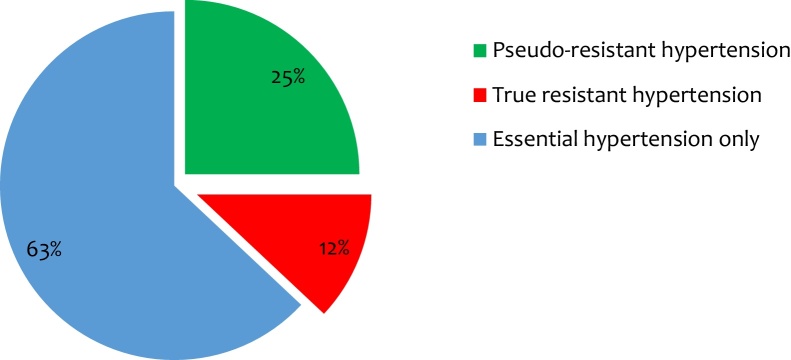
A total of 515 patients were included in the study. Overall, 12% of the total patients (n=62) were resistant hypertensives and 25% (n=129) had pseudo-resistant hypertension. Resistant patients were more often females, older and had a higher body mass index (all P<0.001). Use of painkillers and noncompliance to dietary recommendations were found to be significant determinants of resistant hypertension. Prevalence of comorbid conditions, including diabetes (p=0.33), hyperlipidemia (p=0.46), and chronic kidney disease (p=0.23), was not significantly higher in patients with resistant hypertension.
Nearly one in ten hypertensive patients had true resistant hypertension, and twenty-five percent of patients had pseudo-resistance. Resistance hypertensions is significantly associated with female gender, older age, obesity, dietary noncompliance and increased use of NSAIDs.
难治性高血压是一个公认的临床挑战,但在巴基斯坦尚无关于其患病率的报道数据。这些患者发生高血压并发症的风险更高。我们研究的目的是评估亚洲高血压患者队列中难治性高血压的患病率及其决定因素。
这项横断面研究于2015年9月至12月在卡拉奇一家三级护理医院就诊的高血压患者中进行。使用预先编码的问卷记录患者数据和特征。分别使用Morisky问卷和柏林问卷评估药物依从性和确定发生阻塞性睡眠呼吸暂停的风险。采用Pearson卡方检验分析高血压患者与相关因素之间的统计学差异。
共有515名患者纳入研究。总体而言,全部患者中有12%(n = 62)为难治性高血压患者,25%(n = 129)为假性难治性高血压患者。难治性高血压患者女性更多、年龄更大且体重指数更高(所有P < 0.001)。发现使用止痛药和不遵守饮食建议是难治性高血压的重要决定因素。难治性高血压患者中合并症的患病率,包括糖尿病(p = 0.33)、高脂血症(p = 0.46)和慢性肾脏病(p = 0.23),并无显著更高。
近十分之一的高血压患者患有真正的难治性高血压,25%的患者存在假性难治性高血压。难治性高血压与女性、高龄、肥胖、饮食不依从和非甾体抗炎药使用增加显著相关。