Qian Minjie, Ni Junbei, Niu Qingfeng, Bai Songling, Bao Lu, Li Jianzhao, Sun Yongwang, Zhang Dong, Teng Yuanwen
Department of Horticulture, Zhejiang UniversityHangzhou, China.
The Key Laboratory of Horticultural Plant Growth, Development and Quality Improvement, Ministry of Agriculture of ChinaHangzhou, China.
Front Physiol. 2017 Aug 7;8:550. doi: 10.3389/fphys.2017.00550. eCollection 2017.
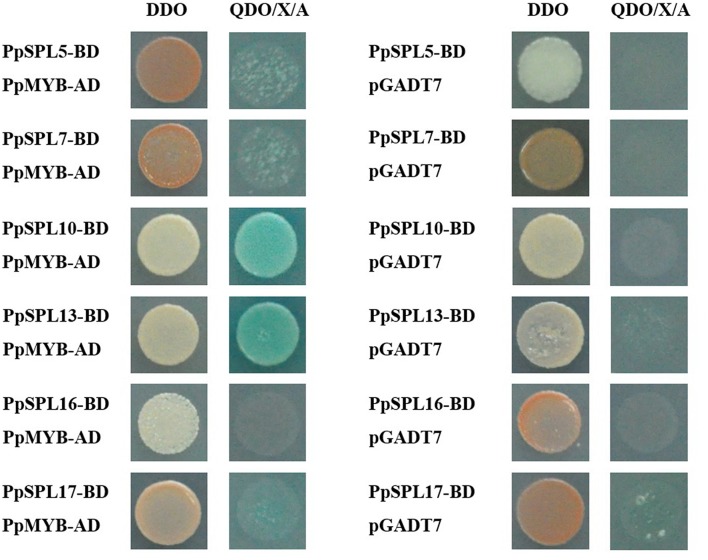
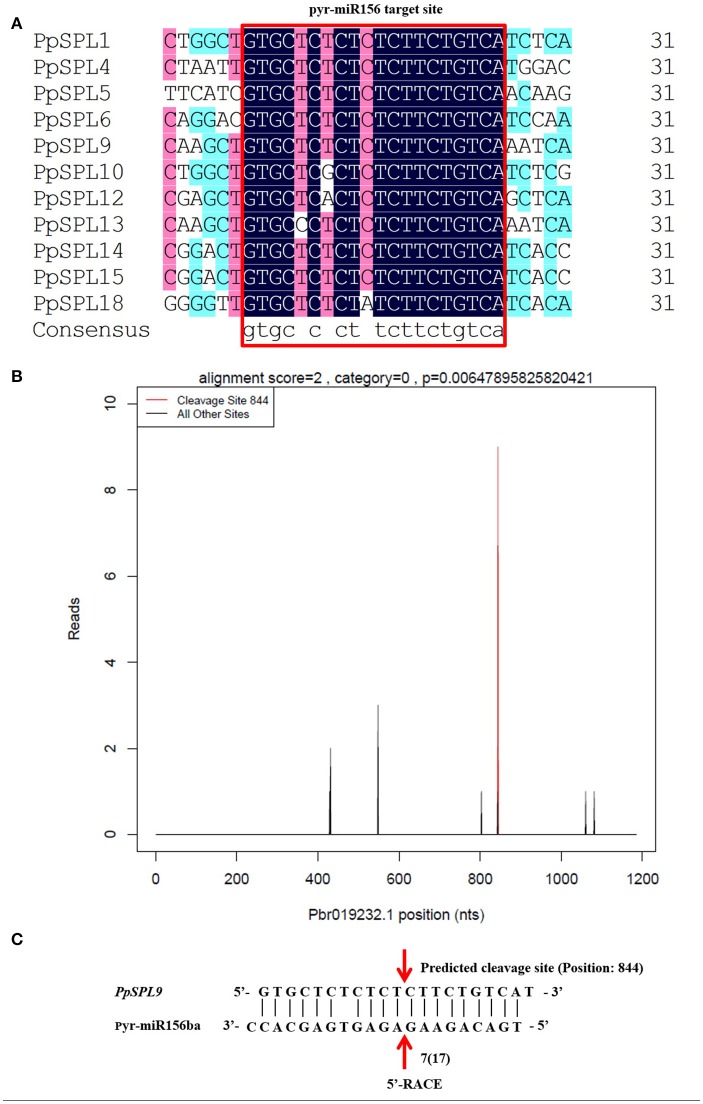
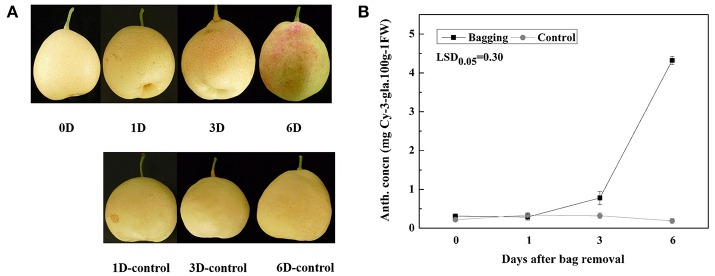
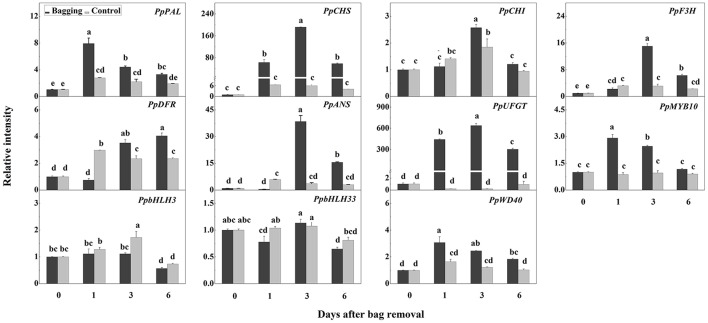
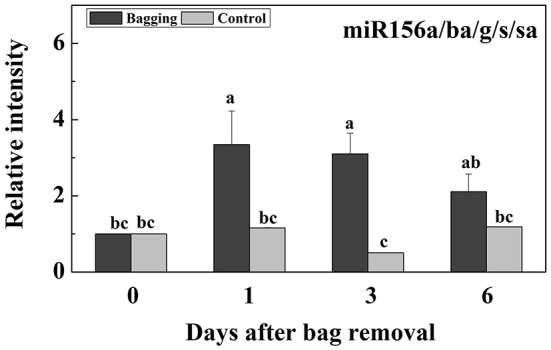
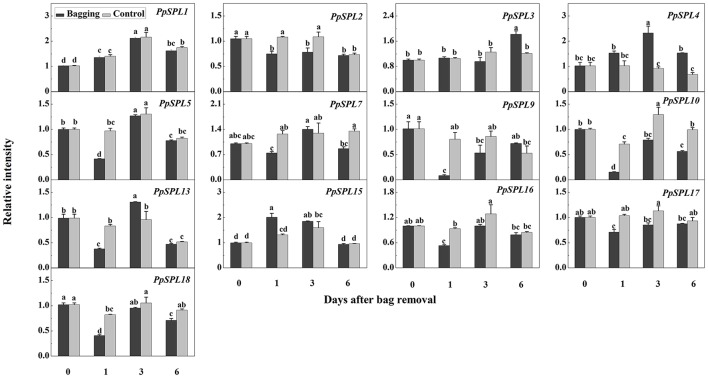
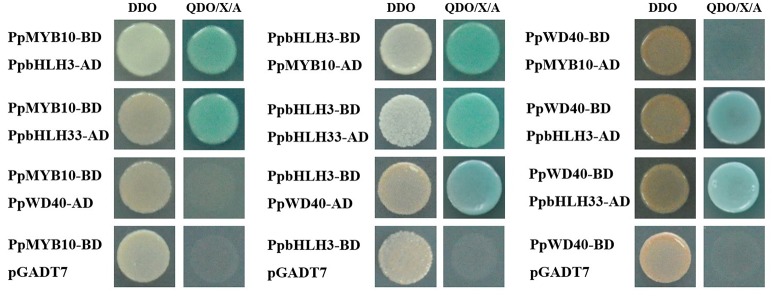
MicroRNA156 is an evolutionarily highly conserved plant micro-RNA (miRNA) that controls an age-dependent flowering pathway. miR156 and its target () genes regulate anthocyanin accumulation in plants, but it is unknown whether this process is affected by light. Red Chinese sand pear () fruits exhibit a unique coloration pattern in response to bagging treatments, which makes them appropriate for studying the molecular mechanism underlying light-induced anthocyanin accumulation in fruit. Based on high-throughput miRNA and degradome sequencing data, we determined that miR156 was expressed in pear fruit peels, and targeted four genes. Light-responsive elements were detected in the promoter regions of the miR156a and miR156ba precursors. We identified 19 genes using the "Suli" pear ( Chinese White Pear Group) genome database, of which seven members were putative miR156 targets. The upregulated expression of anthocyanin biosynthetic and regulatory genes and downregulated expression of , and were observed in pear fruits after bags were removed from plants during the anthocyanin accumulation period. Additionally, miR156a/ba/g/s/sa abundance increased after bags were removed. Yeast two-hybrid results suggested that PpMYB10, PpbHLH, and PpWD40 could form a protein complex, probably involved in anthocyanin biosynthesis. Additionally, PpSPL10 and PpSPL13 interacted with PpMYB10. The results obtained in this study are helpful in understanding the possible role of miR156 and its target genes in regulating light-induced red peel coloration and anthocyanin accumulation in pear.
MicroRNA156是一种在进化上高度保守的植物微小RNA(miRNA),它控制着一条依赖年龄的开花途径。miR156及其靶标()基因调节植物中花青素的积累,但尚不清楚该过程是否受光照影响。红皮酥梨()果实对套袋处理表现出独特的着色模式,这使其适合用于研究果实中光诱导花青素积累的分子机制。基于高通量miRNA和降解组测序数据,我们确定miR156在梨果皮中表达,并靶向四个基因。在miR156a和miR156ba前体的启动子区域检测到光响应元件。我们利用“酥梨”(白梨组)基因组数据库鉴定出19个基因,其中七个成员是推定的miR156靶标。在花青素积累期从植株上摘除袋子后,观察到梨果实中花青素生物合成和调控基因的表达上调,以及、和的表达下调。此外,摘除袋子后miR156a/ba/g/s/sa丰度增加。酵母双杂交结果表明,PpMYB10、PpbHLH和PpWD40可以形成一个蛋白质复合体,可能参与花青素生物合成。此外,PpSPL10和PpSPL13与PpMYB10相互作用。本研究获得的结果有助于理解miR156及其靶标基因在调节梨果实光诱导红皮着色和花青素积累中的可能作用。