Phillips Alexandra M, Coe Jason B, Rock Melanie J, Adams Cindy L
University of Calgary, Calgary, AB, Canada.
Department of Population Medicine, Ontario Veterinary College, University of Guelph, Guelph, ON, Canada.
Front Vet Sci. 2017 Jul 31;4:117. doi: 10.3389/fvets.2017.00117. eCollection 2017.
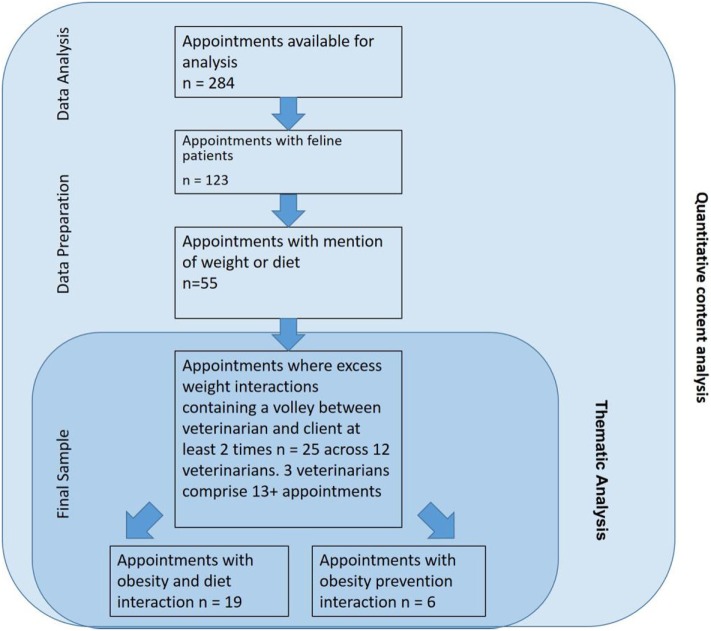
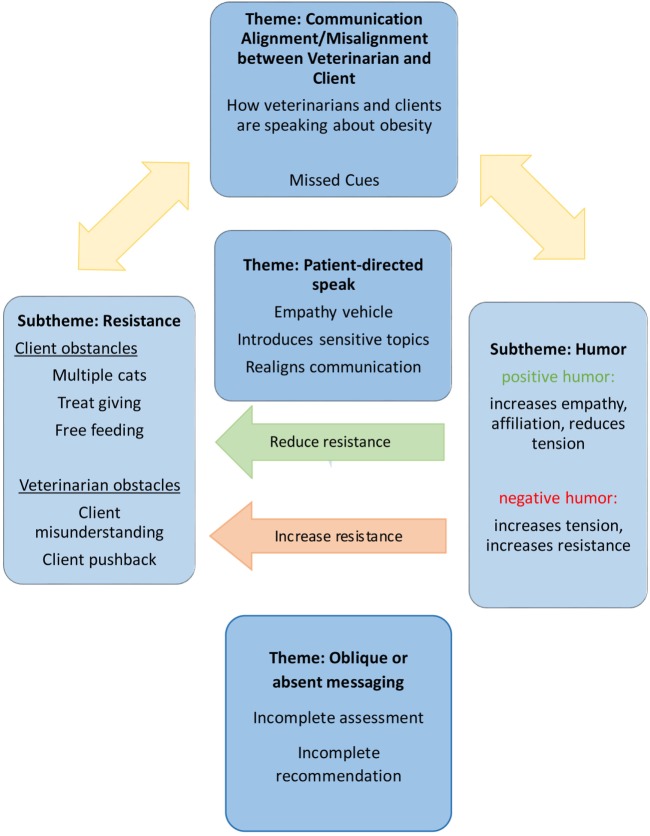
Feline obesity has become a common disease and important animal welfare issue. Little is known about how, or how often, veterinarians and feline-owning clients are addressing obesity during clinical appointments. The purpose of this qualitative study was to characterize verbal and non-verbal communication between veterinarians and clients regarding feline obesity. The sample consisted of video-recordings of 17 veterinarians during 284 actual appointments in companion animal patients in Eastern Ontario. This audio-visual dataset served to identify 123 feline appointments. Of these, only 25 appointments were identified in which 12 veterinarians and their clients spoke about feline obesity. Thematic analysis of the videos and transcripts revealed inconsistencies in the depth of address of feline obesity and its prevention by participating veterinarians. In particular, in-depth nutritional history taking and clear recommendations of management rarely took place. Veterinarians appeared to attempt to strengthen the veterinary-client relationship and cope with ambiguity in their role managing obesity with humor and by speaking directly to their animal patients. Clients also appeared to use humor to deal with discomfort surrounding the topic. Our findings have implications for communication skills training within veterinary curricula and professional development among practicing veterinarians. As obesity is complex and potentially sensitive subject matter, we suggest a need for veterinarians to have further intentionality and training toward in-depth nutritional history gathering and information sharing while navigating obesity management discussions to more completely address client perspective and patient needs.
猫肥胖症已成为一种常见疾病和重要的动物福利问题。关于兽医和养猫客户在临床诊疗过程中如何以及多久处理一次肥胖问题,我们知之甚少。这项定性研究的目的是描述兽医与客户之间关于猫肥胖症的言语和非言语交流。样本包括安大略省东部17名兽医在284次实际陪伴动物诊疗过程中的视频记录。这个视听数据集用于识别123次猫科动物诊疗。其中,只有25次诊疗被识别出12名兽医及其客户谈到了猫肥胖症。对视频和文字记录的主题分析显示,参与研究的兽医在处理猫肥胖症及其预防的深度方面存在不一致。特别是,很少进行深入的营养史询问和明确的管理建议。兽医似乎试图通过幽默以及直接与动物患者交流来加强兽医与客户的关系,并应对他们在管理肥胖症角色中的模糊性。客户似乎也用幽默来处理围绕这个话题的不适。我们的研究结果对兽医课程中的沟通技能培训以及执业兽医的专业发展具有启示意义。由于肥胖是一个复杂且可能敏感的主题,我们建议兽医在进行肥胖症管理讨论时,需要更有针对性并接受进一步培训,以深入收集营养史并分享信息,从而更全面地考虑客户观点和患者需求。